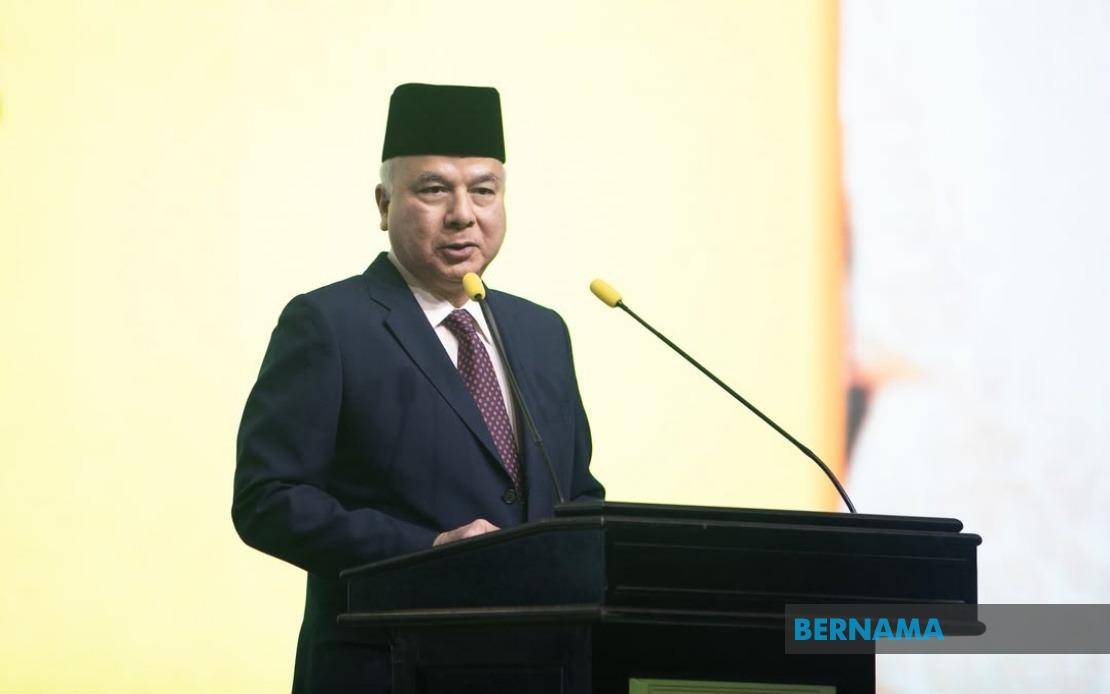
The distinction between national success and failure often hinges not on material abundance but on the quality of institutions and character of leadership, according to Sultan Nazrin Shah, Sultan of Perak, who delivered these insights at the 8th World Conference on Islamic Thought and Civilisation in Ipoh on July 21. Even societies blessed with natural resources, skilled workforces and vibrant cultural heritage can disappoint their citizens if institutional frameworks prove fragile, political leaders resist scrutiny, or governance becomes a vehicle for private ambition rather than public welfare.
His Royal Highness articulated a comprehensive vision of effective governance as the seamless integration of interconnected institutional elements capable of transcending individual administrations or political cycles. The essence of sound governance manifests through concrete practices: the transparent management of state finances such that taxpayers understand how their contributions advance collective interests, the consistent and impartial enforcement of legal standards ensuring no person—regardless of rank or influence—escapes accountability, and simultaneously no citizen—regardless of station—remains unprotected by the law's shield. The Sultan's remarks, attended by Deputy Prime Minister Datuk Seri Fadillah Yusof, Perak Menteri Besar Datuk Seri Saarani Mohamad and Higher Education Minister Datuk Seri Dr Zambry Abd Kadir, extended to the cultivation of political culture wherein legitimate disagreement flourishes through institutional channels rather than erupting into destructive conflict.
The Sultan's perspective on stability challenges conventional assumptions that orderly governance requires suppressed dissent. Many globally recognised stable democracies simultaneously rank among the world's most debated societies, yet maintain cohesion precisely because contestation operates within established institutional frameworks rather than spilling into streets or violence. Conversely, instability emerges not necessarily from disagreement's existence but from the deterioration of mutual trust in the mechanisms designed to resolve disputes. When citizens cease believing elections reflect genuine choice, courts dispense impartial justice, or public office remains inaccessible to bribery, the state's foundation erodes progressively, with disadvantaged populations absorbing disproportionate damage.
This institutional degradation carries profound implications for Malaysia's development trajectory and regional standing. The Sultan emphasised that governance frameworks must embed the principle that every citizen merits consideration, arguing that budgetary allocations function simultaneously as moral and financial documents, unveiling which constituencies governments genuinely prioritise. A civil service that serves all citizens equitably irrespective of ethnicity, faith or political loyalty represents state cohesion in its most tangible expression. Leadership characterised by humility, genuine consultation before policy-making, and recognition that power constitutes a temporary stewardship rather than personal possession generates deeper citizen commitment than any political messaging can achieve.
Regarding economic development, the Sultan rejected insular approaches as fundamentally incompatible with modern prosperity. No nation, regardless of intrinsic advantages, achieves sustainable advancement through isolation, since commerce, capital flows, technological transfer and intellectual exchange constitute the mechanisms through which contemporary economic success travels. Meaningful cooperation spanning government-to-government relationships, public-private partnerships, and government-civil society engagement represents the foundational requirement for durable economic expansion. Evidence consistently demonstrates that nations embracing open trade architecture whilst simultaneously cultivating resilient, multi-sectoral domestic industries substantially outperform those retreating into protectionist positions or maintaining excessive dependency on single sectors.
Yet the Sultan cautioned against cooperation becoming a guise for subordination or openness compromising national sovereignty. Equilibrium exists between welcoming foreign investment and technical expertise whilst simultaneously strengthening indigenous capabilities and strategic autonomy. For Southeast Asian nations including Malaysia navigating great power competition and economic uncertainty, this balance assumes heightened urgency. The region's development challenges require not capital flows alone but genuinely collaborative frameworks protecting long-term regional interests.
The Sultan identified Islamic finance as a substantially underexploited mechanism for advancing development cooperation across Muslim-majority economies. Malaysia has invested decades constructing international architecture for Islamic financial instruments—from sukuk bond issuance to Syariah-compliant fund management to takaful insurance—positioning itself as a global Islamic finance hub. However, this achievement primarily reflects technical compliance with Islamic law's prohibitions on riba rather than realising Islamic finance's distinctive philosophical foundations. Authentic Islamic finance emphasises risk-sharing mechanisms, asset-backing requirements, and equitable distribution of economic returns fundamentally diverging from conventional finance's risk-transfer models.
Deploying Islamic finance according to these principles could transform cross-border infrastructure investment patterns, catalyse small-and-medium enterprise financing throughout the Organisation of Islamic Cooperation membership, and mobilise patient capital toward development imperatives typically ignored by conventional markets—clean water provision, renewable energy transitions, sustainable agriculture. Malaysia, possessing requisite technical expertise and institutional credibility, occupies a unique position advancing this agenda, potentially multiplying Islamic finance's development impact whilst strengthening intra-regional economic interdependence.
The Sultan's remarks reflect Malaysia's constitutional monarchy's consistent emphasis on institutional integrity and good governance as prerequisites for national prosperity. His articulation resonates particularly given Malaysia's ongoing governance challenges, political volatility, and need for institutional strengthening. By framing strong institutions and accountable leadership as foundational rather than supplementary to development, the Sultan positions governance quality alongside infrastructure investment, human capital and technological capability as equally essential components of national strategy. This perspective should guide Malaysian policymakers as they navigate competing demands of economic competition, political stability and citizen confidence in state institutions.

