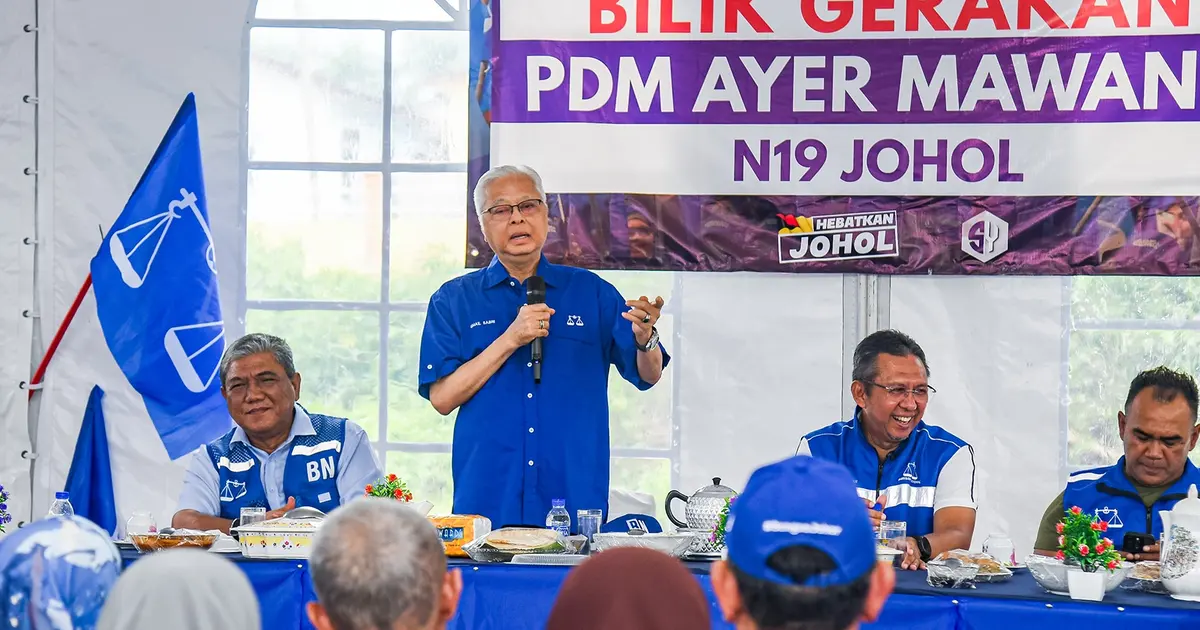
Former Prime Minister Ismail Sabri Yaakob has indicated that a decisive victory in the upcoming Negeri Sembilan state election would demonstrate the effectiveness of the Barisan Nasional-Perikatan Nasional cooperative framework and establish it as a credible model for the 2026 general election campaign. The electoral test in Negeri Sembilan will serve as a critical measure of whether the two major coalitions can translate their political alignment into tangible voter support, with implications extending far beyond the state assembly.
The cooperation between Barisan Nasional and Perikatan Nasional represents a significant realignment in Malaysian politics, bringing together historically distinct electoral blocs in response to the fragmented political landscape that emerged after the 2022 general election. Rather than competing as separate entities, the coalitions have opted for a coordinated approach that aims to consolidate the non-opposition vote and present a unified front to voters. Ismail Sabri's comments underscore the strategic importance his faction places on validating this partnership through concrete electoral success.
Negeri Sembilan holds particular significance as a battleground state where both coalitions maintain substantial political presence and organisational capacity. The state's demographic composition and voting patterns make it representative of broader trends across the peninsula, offering what political strategists view as a reliable indicator of how the BN-PN arrangement might perform nationally. A strong result would provide the coalitions with empirical evidence that their cooperation model resonates with voters rather than simply representing backroom political manoeuvring.
The stakes extend beyond immediate state-level governance. The 2026 general election looms as the next opportunity for Malaysia's electorate to deliver a comprehensive mandate, and the working relationship between Barisan Nasional and Perikatan Nasional could fundamentally shape that contest. If the Negeri Sembilan polls validate their partnership, party leaders would likely move toward formalising deeper integration of campaign machinery, candidate selection, and policy platforms ahead of the national polls. Conversely, a disappointing performance could prompt both coalitions to reconsider the arrangement or negotiate substantially different terms.
The challenge facing the BN-PN partnership lies in converting theoretical cooperation into practical political mobilisation at the grassroots level. Senior leadership alignment, while necessary, proves insufficient without effective organisation at state and parliamentary constituency levels where voters ultimately make decisions. Campaign workers, local party officials, and community influencers must embrace a unified messaging framework rather than reverting to traditional tribal competition between component parties. Ismail Sabri's emphasis on translating cooperation into votes signals awareness that this operational dimension represents the genuine test of the arrangement's viability.
For Barisan Nasional specifically, the Negeri Sembilan election offers an opportunity to demonstrate that it remains capable of winning competitive electoral contests without reverting to the overwhelming dominance of earlier decades. The coalition has experienced significant organisational atrophy in certain constituencies following the 2018 electoral shock, and rebuilding credibility requires tangible victories. Perikatan Nasional, conversely, seeks to prove that it has evolved from the perceived instability of its governance record and possesses the organisational maturity for sustained coalition building.
The composition of voter coalitions that both major groupings need to assemble presents its own complexity. Rural constituencies where Barisan Nasional traditionally maintains strongholds may prove receptive to the partnership message, but urban and semi-urban areas where both coalitions compete for swing voters and younger demographics present substantially greater difficulty. A Negeri Sembilan result that demonstrates strength across diverse constituencies would substantially strengthen confidence that the BN-PN model could work at national scale.
The political opposition faces its own implications from the Negeri Sembilan contest. A decisive BN-PN performance would suggest that splitting the non-government vote across multiple blocs diminishes opposition prospects, potentially forcing reassessment of electoral strategies and coalition structures on that side of the partisan divide. Malaysian voters have demonstrated increasing sophistication in recognising which electoral arrangements offer genuine prospect of government change or continuity, and the Negeri Sembilan result will provide fresh evidence on which to base subsequent political calculations.
Ismail Sabri's framing of the election as validation of the BN-PN working relationship also reflects a deeper political narrative about Malaysia's post-2020 trajectory. The country's recent political history has been characterised by constant flux, coalition instability, and uncertainty about institutional durability. Establishing a durable, functional partnership between major coalitions would represent movement toward greater predictability and stability that many observers regard as essential for economic confidence and policy effectiveness. Negeri Sembilan thus becomes a test case not merely for electoral prospects but for Malaysia's ability to construct sustainable political arrangements.
As Negeri Sembilan voters prepare to cast ballots, the election carries weight extending well beyond state-level legislative business. The outcome will either validate or call into question the fundamental premise underlying the BN-PN partnership, informing calculations by multiple political actors as Malaysia approaches the defining electoral moment of the 2026 general election.

