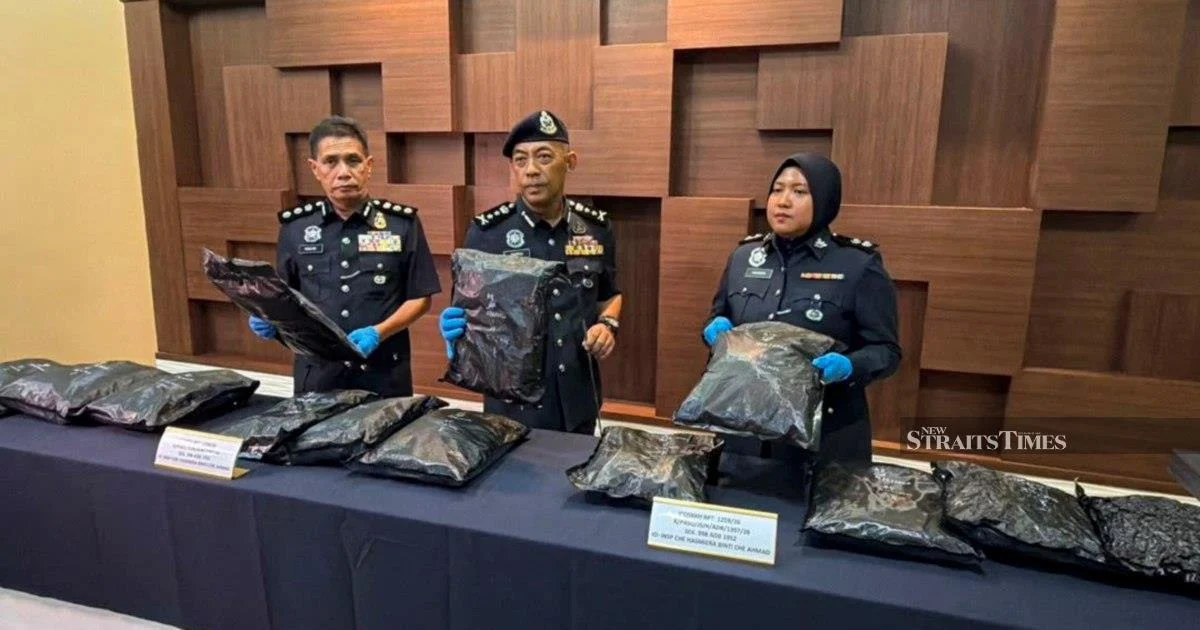
A student enrolled at a private institution of higher learning has been apprehended whilst attempting to bring more than 14 kilograms of cannabis buds across the border at Bukit Kayu Hitam in Kedah, marking another significant drug interdiction at one of Malaysia's busiest land crossing points. The seized narcotics, weighing 14.63kg in total, carry an estimated street value of RM1.17 million according to initial assessments by enforcement authorities. The detention, which took place on Monday, underscores the persistent vulnerability of Malaysia's northern frontier to drug trafficking networks that exploit both amateur and organised courier arrangements.
The suspect, whose identity remains protected pending further investigation, was reportedly selected as a courier to transport the controlled substance from across the border with Thailand. The use of students and individuals with ostensibly legitimate reasons to cross—such as study or commerce—represents a common tactic employed by trafficking syndicates seeking to evade detection at customs checkpoints. Unlike professional smugglers, such individuals often appear low-risk and may be subject to less intensive scrutiny, making them valuable assets within supply chains that funnel illicit drugs into Malaysia's growing recreational and medicinal black markets.
Bukit Kayu Hitam, situated in Kedah's northern region and serving as a primary land gateway between Malaysia and Thailand, has become an increasingly critical focal point for anti-narcotics operations. The checkpoint processes thousands of vehicles and pedestrians daily, creating both opportunity and operational challenge for drug enforcement personnel. Despite advanced screening technologies and trained detection teams, the sheer volume of cross-border traffic complicates efforts to intercept every concealment method. This particular seizure demonstrates that heightened vigilance remains essential, and that intelligence-driven operations can still yield substantial results in disrupting supply networks.
Cannabis remains classified as a Schedule II controlled substance under Malaysia's Dangerous Drugs Act 1952, placing possession and trafficking among serious offences with mandatory custodial sentences. Students convicted of drug-related crimes face not only criminal penalties but also expulsion from educational institutions, effectively derailing academic and career prospects. The decision by educational institutions to participate in enforcement briefings and awareness campaigns has gained momentum, yet recruitment of students by trafficking organisations continues, reflecting both financial desperation among some students and sophisticated social engineering by criminal networks.
The Thai border region has emerged as a significant source zone for cannabis cultivation and distribution, with production increasingly industrialised in response to Thailand's 2018 decriminalisation of medical cannabis. While Thai authorities maintain oversight of legitimate cultivation, porous enforcement in remote areas permits diversion of harvests into black market channels. Malaysian law enforcement has reported escalating interdictions of Thai-origin cannabis at multiple border posts over the past three years, suggesting systematic expansion of trafficking routes capitalising on proximity and established smuggling infrastructure.
The estimated value attached to this seizure—RM1.17 million—reflects current retail pricing within Malaysian urban markets, where cannabis buds typically command premium prices relative to regional averages. Such valuations assume successful distribution through established networks; the actual loss to trafficking operations may involve additional calculations accounting for operational expenses, bribery, and expected confiscation rates. Nonetheless, a single haul of this magnitude represents sufficient revenue disruption to impact mid-tier trafficking organisations, though larger syndicates maintain reserve capacity and diversified supply lines capable of absorbing singular losses.
Investigations into the student's recruitment, funding sources, and intended distribution network are understood to be ongoing, with authorities examining whether the suspect acted independently or as part of a larger operation. Intelligence gathered from this case may facilitate identifying additional participants, including those responsible for organising courier arrangements and maintaining supply relationships. Collaboration between Malaysian and Thai enforcement agencies at border posts has intensified in recent years, with information sharing protocols enabling both nations to develop more comprehensive understanding of cross-border trafficking patterns and methodology.
The detention carries implications extending beyond the individual case, serving as reminder to the broader student population regarding recruitment tactics and the legal consequences of participation in drug smuggling. Educational institutions have increasingly implemented awareness initiatives targeting vulnerability among financially constrained students, presenting counter-narratives to recruitment propositions that emphasise quick earnings. Parent associations and student welfare offices in Kedah have likewise expanded counselling services addressing both substance awareness and economic support mechanisms intended to reduce motivation for illicit income generation.
Bukit Kayu Hitam's strategic location ensures its continued prominence within regional drug enforcement priorities. Authorities have progressively deployed enhanced detection capabilities, including advanced scanning equipment and canine units specifically trained for narcotics identification. The checkpoint operates under stringent protocols requiring mandatory screening of high-risk categories, though application of resources remains constrained by fiscal limitations and personnel availability. This particular seizure validates resource allocation to border security and indicates that procedural effectiveness, when supported by adequate training and equipment, produces measurable disruption to trafficking operations.
The case also highlights evolving smuggling methodologies, as trafficking networks increasingly seek to normalise courier profiles by recruiting ostensibly ordinary individuals engaged in routine border crossings. Future enforcement strategy will likely emphasise intelligence analysis to identify anomalous crossing patterns, financial transaction monitoring to trace funding sources, and expanded information sharing with educational institutions enabling early identification of students approached for recruitment. Sustained investment in preventive approaches, coupled with enforcement intensity, appears necessary to maintain effectiveness against trafficking organisations continuously adapting methods in response to countermeasures.