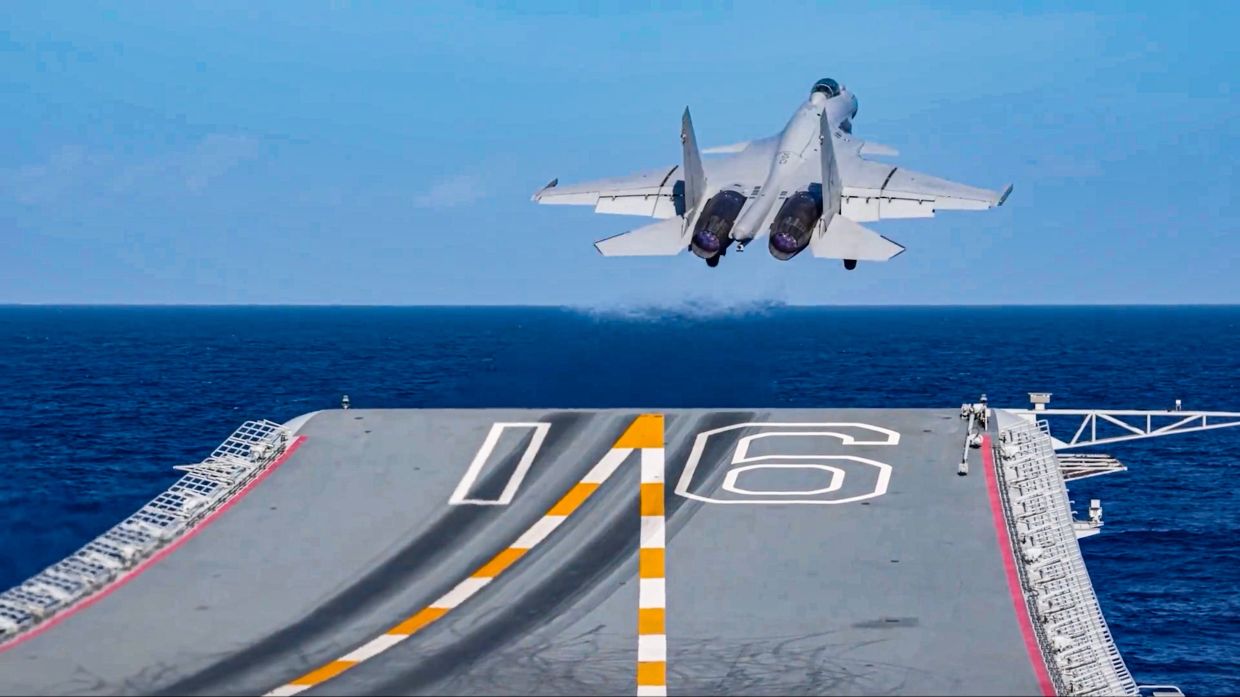
China's ambitious plan to develop a modern blue-water navy capable of projecting power across the Pacific and Indian Oceans confronts a fundamental technological and strategic obstacle: the difficulty of defending expensive aircraft carriers against submarine attacks. As Beijing accelerates the construction and deployment of new carriers, military analysts in Washington and allied nations increasingly view undersea warfare as the critical test that could undermine the effectiveness of this centrepiece of Chinese naval expansion.
A comprehensive analysis from the Centre for Strategic and International Studies in Washington articulates a multifaceted approach for American and allied forces to neutralise the threat posed by Chinese carrier groups. This strategy encompasses coordinated attacks from multiple domains: land-based missile networks, long-range aircraft strikes enabled by satellite intelligence, cyber and electromagnetic warfare, and coordinated drone operations. Yet among these various tactical options, submarine ambushes emerge as the technique most likely to succeed against Chinese naval formations, precisely because the People's Liberation Army Navy has not adequately solved the challenge of detecting and tracking submarines operating in the depths below its carrier formations.
The People's Liberation Army's fundamental weakness lies in its inability to sufficiently monitor the undersea environment, particularly in waters beyond its immediate coastal zones. American attack submarines operating throughout the western Pacific represent an acute threat precisely because they combine advanced stealth technology with formidable striking power. The Centre for Strategic and International Studies report emphasises that China's submarine detection and tracking capabilities contain significant gaps, leaving the country's most valuable and costly naval assets vulnerable to undersea threats. This strategic vulnerability becomes particularly acute when Chinese carriers venture far from home waters where land-based air defences and coastal radar networks cannot provide protective coverage.
Geography fundamentally shapes how this undersea vulnerability translates into concrete military risk. The western Pacific features a limited number of crucial maritime passages—the straits and waterways through which any Chinese carrier force must transit when moving between home ports and operational areas. These chokepoints create natural hunting grounds where submarines and other anti-ship forces could concentrate their efforts. By positioning submarines in advance along the routes that Chinese carriers must traverse, American and allied submarines could threaten these vessels as they transit between strategic zones. The limited number of viable routes compounds China's defensive challenge, as it cannot feasibly protect all possible passages simultaneously.
Christopher Sharman, director of the China Maritime Studies Institute at the United States Naval War College, acknowledges that while China has pursued extensive recent investments in undersea detection and surveillance capabilities, substantial gaps persist in the People's Liberation Army Navy's ability to understand and operate effectively in the submarine warfare domain. The core problem facing China's military strategists involves the comparative disadvantage in oceanographic knowledge and expertise. American naval forces benefit from decades of accumulated scientific understanding about underwater conditions throughout the Pacific Ocean. Chinese meteorological and oceanographic capabilities, despite rapid advancement, still lag considerably behind this accumulated American expertise. This scientific knowledge gap directly translates into operational vulnerability, as incomplete understanding of underwater conditions degrades the effectiveness of both submarine and anti-submarine warfare operations, particularly in waters beyond the first island chain where American submarines might operate against Chinese vessels.
Recognising this strategic liability, Beijing has launched ambitious programmes to close the undersea detection gap. The Transparent Ocean initiative, conceived more than a decade ago, represents a comprehensive effort to construct an integrated network combining satellites, research vessels, buoys, autonomous underwater gliders, and seabed-mounted sensors positioned throughout strategically vital waters including the western Pacific, South China Sea, and Indian Ocean. Chinese government sources have explicitly framed this oceanographic surveillance network as essential to national security rather than merely scientific research. The Ocean University of China, which originally proposed the initiative, reports having deployed hundreds of deep-sea observation systems and progressively expanded monitoring networks from the South China Sea into the broader western Pacific. This systematic programme reflects Beijing's determination to eliminate the information advantage that American submarines currently enjoy in regional waters.
Simultaneously, the People's Liberation Army has substantially upgraded its anti-submarine warfare capabilities through force structure improvements and technological modernisation. The China Maritime Studies Institute has documented the expansion of fixed-wing maritime patrol aircraft, the deployment of Type 927 ocean-surveillance vessels equipped with advanced towed-array sonar systems, and upgrades to sensors installed on helicopters and aircraft employed for submarine hunting. These incremental improvements, while meaningful, address only part of the broader challenge facing Chinese naval strategists who must develop comprehensive solutions for protecting carrier groups throughout the vast expanses of the Pacific and Indian Oceans.
Military strategists emphasise that submarine warfare extends far beyond the narrow question of protecting aircraft carriers. Rather, undersea operations constitute a foundational element of Chinese naval strategy with implications reaching across multiple geographic zones and strategic scenarios. Within the first island chain—the arc of territories stretching from Japan through the Philippines to Indonesia—Chinese forces view submarine operations as indispensable to achieving sea control during wartime. Beyond the first island chain and extending into the Indian Ocean, military planners in Beijing conceptualise undersea operations as the mechanism through which China can contest American naval dominance and complicate potential third-party intervention in a conflict involving Taiwan. The undersea dimension of military strategy thus intersects directly with China's most sensitive geopolitical concern: the status and future of Taiwan, which Beijing claims as part of Chinese territory while maintaining a strategic ambiguity regarding its willingness to employ military force.
Chinese military strategists have occasionally articulated acute anxiety about their nation's inability to monitor and control the underwater depths near its coasts, characterising this deficit as a critical security exposure. Timothy Heath, a defence analyst at Perceptum research firm, emphasises that anti-submarine warfare remains among the most technologically challenging and strategically demanding forms of naval competition. American submarines represent among the quietest and most advanced undersea platforms currently operating, endowing them with formidable advantages in evading detection while maintaining offensive capability. The potential involvement of Japanese forces in any Taiwan conflict would compound this challenge substantially, as Japan maintains sophisticated anti-ship and anti-submarine capabilities that could target Chinese naval formations operating in nearby waters. In such a scenario, Chinese carriers might theoretically operate in the western Pacific to provide air support for naval forces attempting to deter or delay third-party intervention, yet this deployment pattern itself creates vulnerability to multiple threat vectors.
Heath cautions that regardless of theoretical tactical advantages, deploying expensive aircraft carriers at such distance from secure home bases would constitute an unacceptable strategic risk. China's arsenal of land-based intermediate-range ballistic missiles provides a more robust and survivable option for threatening American and allied naval forces operating throughout the Pacific region. These missiles, launched from secure positions on Chinese territory, avoid the vulnerabilities inherent in deploying capital ships far from protective air cover and coastal defences. The extraordinary cost of modern aircraft carriers, measured in billions of dollars and requiring years of construction time, makes their loss strategically and economically catastrophic. This calculation suggests that Chinese strategists may prove reluctant to deploy their expanding carrier fleet in the manner that American strategic analysts anticipate, instead relying upon their formidable inventory of land-based missiles as the primary instrument for sea denial.
The implications of these submarine vulnerabilities extend beyond bilateral China-United States military competition to shape regional security architecture throughout Southeast Asia and the broader Indo-Pacific. American strategic analysts argue that acknowledging these submarine warfare challenges should directly influence defence procurement priorities for the United States and allied nations. The report's authors call for substantially increased investment in advanced torpedoes, autonomous undersea drones, and missile production conducted in partnership with allied nations including Japan and Australia. Such collaborative defence initiatives would reinforce the technology-sharing arrangements and integrated military capabilities that characterise the security architecture linking America with its Pacific allies. For Malaysia and other Southeast Asian nations, the intensifying submarine competition between China and the United States represents a structural shift in regional military dynamics that will influence everything from maritime freedom of navigation to the security calculations governing strategic choices in the coming decades.

