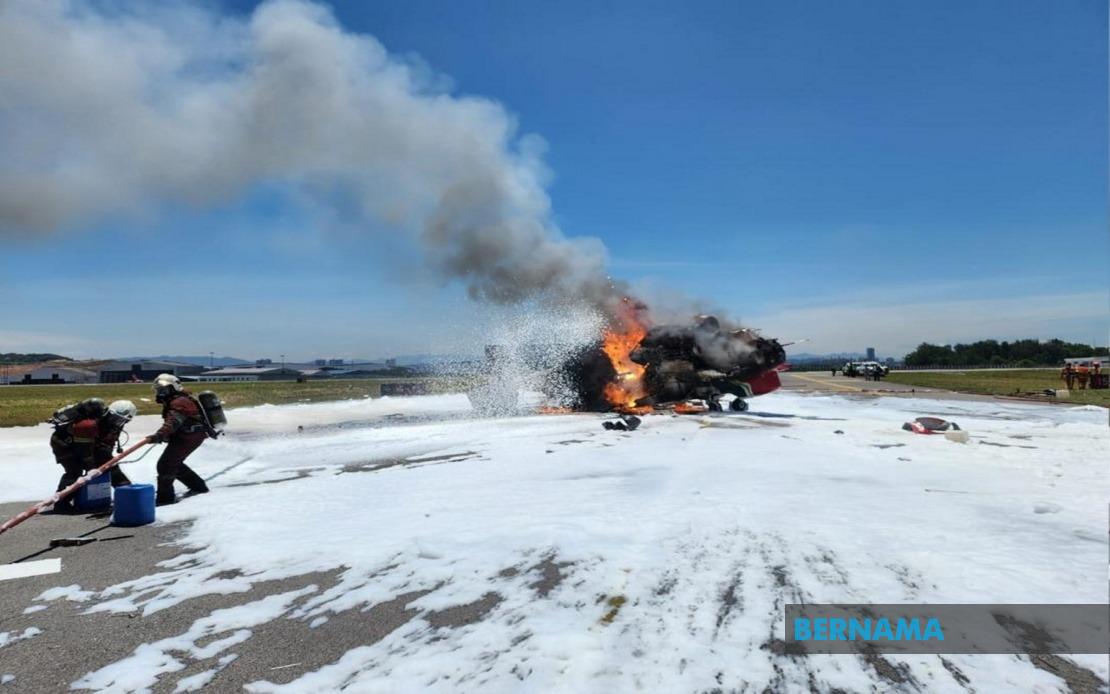
The runway at Sultan Abdul Aziz Shah Airport in Subang returned to full operational status on the afternoon of August 15 following a temporary closure triggered by a helicopter fire incident during maintenance activities. Malaysian Civil Aviation Authority chief executive officer Capt Datuk Norazman Mahmud confirmed that air traffic resumed at 2.57 pm after the airport implemented swift safety protocols and cleared the affected area.
The incident unfolded at approximately 12.28 pm when a Kamov KaV-32S helicopter registered to a Ukraine-based company caught fire while undergoing engine run-up testing. The aircraft was stationed at Taxiway Victor, where a crew of four Ukrainian nationals—consisting of the pilot, co-pilot, and two additional maintenance personnel—were conducting routine ground maintenance. One team member sustained minor injuries from debris that was dislodged during the explosion, though the injury did not require immediate hospitalization.
The unexpected nature of the incident prompted airport authorities to implement a precautionary suspension of all flight operations until the scene could be secured and investigated. During the approximate two-and-a-half-hour closure period, the disruption to scheduled services rippled across the airport's operations. Eight aircraft that were approaching Subang for landing had to be diverted to alternative airports across Malaysia, while three flights scheduled for departure experienced delays as ground crews worked to restore normal runway conditions.
CAAM's rapid response to the emergency was evident in its prompt reopening announcement and communication with affected carriers. Norazman advised all passengers travelling through Subang to consult directly with their respective airlines for revised flight schedules and updated departure or arrival information. The airport's flight information displays were adjusted to reflect the new timing for multiple international and domestic services, ensuring travelers could access accurate details about their journeys.
The incident at Sultan Abdul Aziz Shah Airport underscores the critical importance of maintenance protocols in aviation operations, particularly when working with specialized aircraft like the Kamov KaV-32S, a heavy-lift helicopter commonly used across Eastern Europe and international operations. While engine run-up tests are standard practice for ensuring aircraft readiness and safety compliance, they do occasionally present unforeseen risks that require rigorous safety supervision and emergency preparedness from ground crews and airport authorities.
For Malaysia's aviation sector, the incident highlights how well-established emergency response systems and inter-agency coordination can minimize passenger disruption when unexpected situations arise. The airport's ability to restore operations within a manageable timeframe demonstrated the effectiveness of its contingency planning and the capacity of regional airports to absorb temporary diversions without cascading delays across the broader aviation network.
The presence of international maintenance crews at Malaysian airports is not uncommon, as specialized helicopter servicing often requires expertise from the aircraft's country of origin or established international maintenance centers. However, incidents involving foreign-registered aircraft underscore the importance of ensuring that all personnel operating within Malaysian airspace comply with local safety regulations and CAAM oversight, regardless of their nationality or the aircraft's point of registration.
The August 15 incident also reflects broader considerations for airport infrastructure management during the monsoon season and peak travel periods, when weather conditions and operational pressures can compound safety challenges. Sultan Abdul Aziz Shah Airport, serving the greater Klang Valley region, handles significant traffic volumes and must balance operational efficiency with uncompromising safety standards—a balance that authorities appear to have maintained effectively during this disruption.
As investigations into the cause of the helicopter fire continue, stakeholders in Malaysia's aviation industry will likely review maintenance procedures and ground safety protocols to identify lessons that could enhance preventive measures across similar operations. The swift containment of the incident and the absence of fatalities represent positive outcomes that reflect the professionalism of emergency responders and airport personnel who managed the situation from initial alert through full operational resumption.
Looking ahead, the incident serves as a reminder to both airport operators and aircraft maintenance organizations of the importance of comprehensive insurance coverage, detailed incident reporting, and continuous improvement in ground safety procedures. For travellers using Subang Airport, the resumption of normal operations within hours of the emergency provides assurance that Malaysia's aviation infrastructure maintains robust safeguards against disruptions, whether planned or unexpected.

