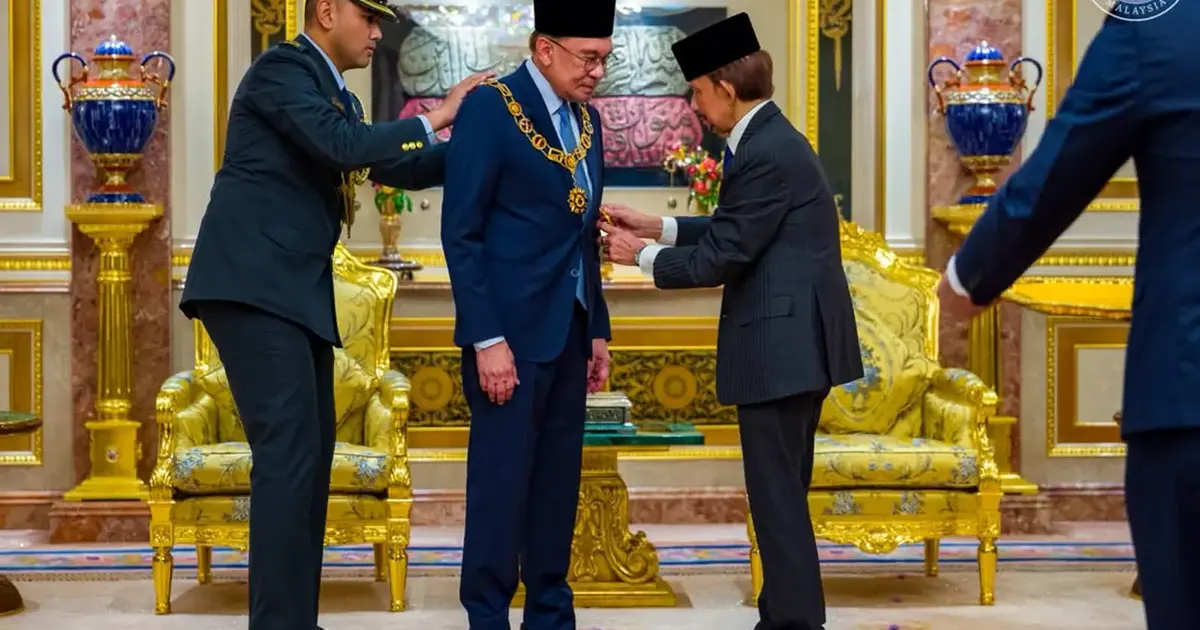
Prime Minister Anwar Ibrahim has been invested with the Darjah Kerabat Laila Utama Yang Amat Dihormati by Sultan Hassanal Bolkiah, marking a significant moment in bilateral relations between Malaysia and Brunei. The conferment of this honour reflects the deep diplomatic bonds and mutual respect between the two Southeast Asian nations, with the accolade serving as tangible recognition of Malaysia's premier on the international stage.
The Darjah Kerabat Laila Utama Yang Amat Dihormati, or D.K., ranks among Brunei's most esteemed honours within its royal honours system. Such decorations are typically bestowed upon distinguished figures who have demonstrated exemplary leadership and contributed meaningfully to regional stability and cooperation. The distinction underscores the elevated position Anwar Ibrahim holds within ASEAN circles and beyond, reflecting his stature as a significant political leader shaping Southeast Asian affairs.
This honour arrives at a particularly pertinent juncture in Malaysia-Brunei relations. The two nations share extensive historical, cultural, and economic connections, with regular high-level engagements forming the backbone of their bilateral framework. Royal honours such as this serve diplomatic purposes beyond ceremonial value, often signalling commitment to strengthened partnerships and reinforcing existing cooperative arrangements across multiple sectors.
Sultan Hassanal Bolkiah, who has reigned since 1967, maintains an active role in Brunei's foreign policy and regularly utilises the honours system to cultivate relationships with regional and international leaders. The timing and nature of such conferments are rarely coincidental in diplomatic protocol, typically aligned with milestones in bilateral engagement or moments when nations wish to affirm their commitment to shared interests.
For Malaysia's Prime Minister, the recognition carries strategic implications. International honours enhance a leader's diplomatic credentials and reinforce their government's standing within regional bodies like ASEAN. Within ASEAN's consensus-driven framework, such gestures from fellow member states carry weight in deliberations, potentially amplifying Malaysia's voice on regional issues ranging from economic integration to security concerns affecting the broader Indo-Pacific region.
The broader context reveals Malaysia-Brunei cooperation extending across diverse domains. Trade relations, defence partnerships, maritime cooperation, and people-to-people exchanges form the substantive foundation beneath ceremonial gestures. Educational initiatives, cultural exchanges, and business forums regularly bring citizens from both nations together, creating networks that transcend governmental structures and strengthen societal-level bonds.
Brunei's Negara Brunei Darussalam has increasingly sought to deepen its engagement within ASEAN despite its smaller population and economy. Strategic partnerships with larger neighbours like Malaysia represent crucial components of this approach, enabling Brunei to amplify its influence within regional forums while accessing larger markets and expertise. The honour conferred upon Anwar Ibrahim reflects Brunei's interest in maintaining robust channels with its most populous neighbour.
For Malaysian audiences, such diplomatic recognitions serve as barometers of their nation's standing internationally. A prime minister receiving honours from foreign heads of state signals respect and credibility on the world stage, factors that resonate domestically and contribute to perceptions of effective leadership. These moments, while ceremonial in appearance, often generate goodwill and reinforce national pride.
The investiture also occurs within Malaysia's broader foreign policy trajectory, which under Anwar Ibrahim's leadership has emphasised strengthened ASEAN cohesion, pragmatic engagement with both Western and Asian powers, and commitment to multilateral institutions. Brunei features prominently in this framework as both a fellow ASEAN member and a nation with substantial energy resources and strategic geographic positioning along critical sea lanes.
Regional observers frequently scrutinise bilateral gestures between ASEAN members as indicators of the bloc's internal dynamics. A deepening of Malaysia-Brunei relations, as symbolised by such honours, contributes to a narrative of ASEAN cohesion and collective resilience. This carries particular importance given contemporary regional complexities involving major power competition, territorial disputes, and questions surrounding maritime security and economic interdependence.
Moving forward, the honour may presage expanded cooperation between the two nations across specific sectors. Historical patterns suggest that elevated diplomatic recognition often precedes announcements of new bilateral initiatives, whether in infrastructure development, energy collaboration, or enhanced security arrangements. Malaysian stakeholders, including business communities and diplomatic corps, typically monitor such signals for potential opportunities.

