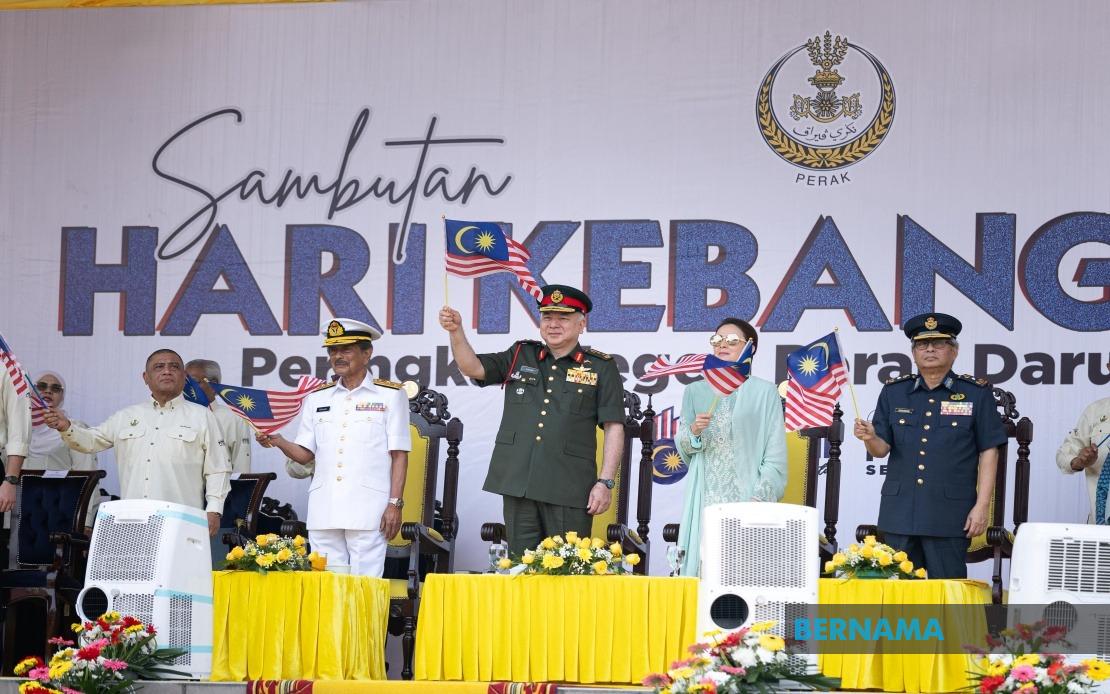
At a solemn ceremony in Ipoh on Saturday, Sultan Nazrin Shah of Perak recognised the exceptional contributions of 11 military and police personnel who have sacrificed in defence of Malaysia's security and sovereignty. The Perak-level National Day 2026 Awards Presentation Ceremony, held at Dewan Bandaran Ipoh, saw the Sultan and Raja Permaisuri Tuanku Zara Salim paying tribute to soldiers and law enforcement officers whose service has shaped the nation's protection and stability. Menteri Besar Datuk Seri Saarani Mohamad accompanied the royal couple, alongside senior state officials and members of the State Executive Council.
The composition of awardees reflected the breadth of Malaysia's security apparatus. Six personnel from the Malaysian Armed Forces received recognition, joined by two from the Royal Malaysia Police and three from the Royal Malaysian Navy. Each recipient walked away with RM1,000 in cash alongside a certificate of appreciation, tangible symbols of national gratitude for often invisible service. The gesture acknowledged not merely ceremonial duty but genuine sacrifice—many of those honoured carry the physical and psychological marks of their commitment to national defence.
Among the most poignant presentations was that of Warrant Officer 2 Mohamad Razali Din, whose service during Operation Naga in Banding required amputation of his left leg below the knee after he stepped on a landmine. His presence at the ceremony embodied the profound personal cost borne by those who defend the nation from insurgency and security threats. Such injuries, while visible, represent only a fraction of the burden carried by frontline personnel who face constant danger in remote operations across Malaysia's frontier regions.
Warrant Officer 2 Megat Abdullah Megat Othman received particular commendation for eliminating three communist terrorists during Operation Batu Kawah in Sri Aman, earning both a commando knife and certificate of appreciation. These specific operational achievements, documented and recognised at the highest state level, underscore Perak's historical significance as a theatre of counter-insurgency operations and the ongoing vigilance required along Malaysia's borders. The recognition of such direct combat achievements signals continued emphasis on security personnel's frontline roles.
The broader group of MAF recipients—Staff Sergeant Idris Ismail, Corporal Mokhtar Sulaiman, Lance Corporal Khairul Anuar Abdul Hamid and Lance Corporal Alias Abd Wahab—represented the enlisted ranks whose daily contributions often escape public attention. Retired sub-inspector Omar Jayus and retired Sergeant Major Abdul Malek Nordin from the police force carried decades of law enforcement experience, their presence highlighting how recognition extends to those who have completed their service. Naval representatives included retired First Admiral Mohamad Imran Abd Hamid, retired Commander Mohd Akhbar Mohd Yusof, and retired Warrant Officer 2 Ahmad Safwi Shaari, acknowledging maritime security's critical role.
Beyond individual recognitions, the ceremony incorporated broader National Day festivities, with Sultan Nazrin presenting prizes for the National Month parade and beautification competitions. This integration of military honouring with civic celebrations emphasised how national defence and national identity intertwine in Malaysia's civic fabric. The dual focus—recognising sacrifice while celebrating community participation—reinforces the connection between security infrastructure and social cohesion.
Menuteri Besar Saarani's address during the ceremony pivoted toward deeper philosophical terrain, emphasising that Malaysia's foundation rests upon conscious commitment to pluralism rather than homogeneity. He articulated a vision of the nation built through deliberate choice rather than inevitable consensus, noting that diversity has historically been Malaysia's defining characteristic. This framing matters particularly in contemporary Malaysia, where periodic tensions around identity, religion and ethnicity occasionally surface in public discourse.
Saarani's warnings about the erosion of national unity carried particular weight. He cautioned that treating differences as primary—seeing race, religion or group affiliation before recognising individual humanity—creates psychological and social distance that ultimately threatens the bonds holding the nation together. The Jalur Gemilang flag, the Federal Constitution, the Malay language and the institution of the Malay Rulers form concrete anchors he identified, yet he emphasised these institutional frameworks require constant reinforcement through interpersonal recognition and respect.
The Menteri Besar's observation that neighbour becomes stranger and friend becomes adversary when filtered through divisive categories speaks to anxieties about social fragmentation that periodically surface in Malaysian public life. His argument—that distance gradually blurs the unifying elements previously taken as foundational—suggests that unity requires active maintenance rather than passive assumption. In this reading, honouring those who have sacrificed for national security and sovereignty serves not merely as historical recognition but as renewal of the social contract binding Malaysians together.
Perak's National Day ceremony therefore operated on multiple registers simultaneously. It honoured specific individuals whose courage shaped national security; it celebrated the military and police institutions upon which state capacity depends; and it reaffirmed philosophical commitments to pluralism and shared nationhood. The combination of personal recognition and civic-level reflection suggests that for Malaysia, national identity remains an ongoing project requiring periodic recommitment and renewed attention to the underlying principles—especially diversity, inclusion and mutual recognition—that enable coexistence across religious, ethnic and linguistic lines.

