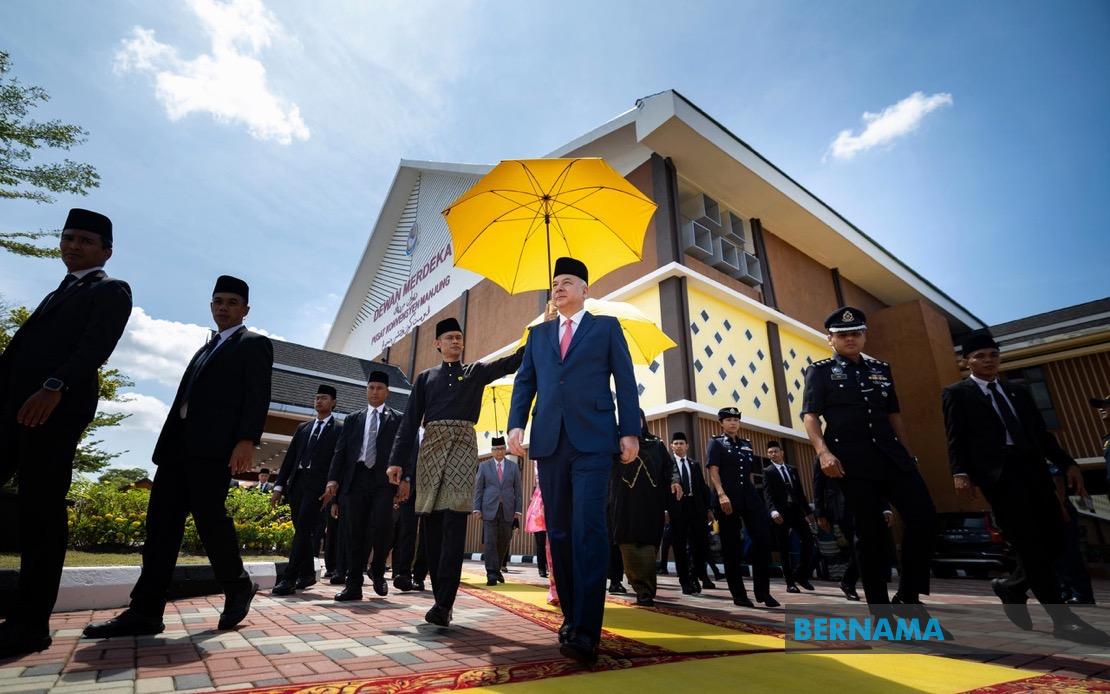
Sultan Nazrin Shah, the reigning monarch of Perak, presided over the opening of Manjung Municipal Council's new Merdeka Hall in Lumut on Monday, an event that carried symbolic weight beyond the mere inauguration of a new public venue. Accompanying His Majesty were senior royalty including Tuanku Zara Salim, the Raja Permaisuri of Perak, and Raja Iskandar Dzurkarnain Sultan Idris Shah, the Raja Di Hilir. The ceremony also drew Perak Menteri Besar Datuk Seri Saarani Mohamad and federal Higher Education Minister Datuk Seri Dr Zambry Abd Kadir, underscoring the national significance attributed to the project.
The RM12.7 million facility represents more than a simple infrastructure investment for the Manjung district. Designed to accommodate 2,500 guests, the hall will function as a multipurpose venue for official ceremonies, business conferences, and community gatherings, positioning itself as a central hub for civic life in the municipality. The scale of the investment and capacity reflect the local government's ambitions to elevate Manjung's profile within the state and region, creating infrastructure capable of hosting significant events that previously may have required venues outside the district.
Menteri Besar Saarani articulated the project's significance through three interconnected developments that converge at this moment. The initiative to construct the hall originated in 2016, representing a seven-year journey from conception to completion—a timeline that itself speaks to the complexities of planning and securing funding for major public works in Malaysia. The hall's opening therefore marks the successful realisation of a vision held across multiple state administrations, demonstrating continuity in governance priorities regardless of electoral shifts.
The timing also coincides with Manjung Municipal Council's silver jubilee, having operated in its current municipal status for exactly 25 years since its upgrade from a district council on August 1, 2001. The original establishment of the district council dates back even further, to January 1, 1980, meaning the broader administrative entity has now served the community for over four decades. This convergence of milestones—infrastructure completion, administrative anniversary, and forward-looking strategic goals—allowed state leadership to position the opening as a watershed moment for the district's trajectory.
Crucially, the Merdeka Hall opening integrates with Manjung's declared aspiration to achieve Tourism and Maritime City status by 2030. This designation reflects a deliberate economic strategy to leverage the district's geographical advantages and maritime heritage. Perak's coastline, particularly in the Manjung region, offers potential for both tourism development and maritime industries, yet such ambitions require supporting infrastructure. The new hall provides exactly this kind of foundational facility—a place where conferences on maritime commerce can convene, where tourism forums can be hosted, and where cultural events celebrating the region's heritage can be staged.
The federal government's role in funding this project, as Saarani emphasised, highlights the collaborative relationship between Putrajaya and state administrations in realising developmental objectives. The allocation approval from the federal level demonstrates confidence in Manjung's potential and signals willingness to support state-identified priorities. For Malaysian readers tracking infrastructure distribution across regions, such federal backing often precedes broader economic initiatives, making this a potential indicator of larger development plans for the Manjung area.
Menteri Besar Saarani's remarks about the Merdeka Hall's nomenclature offered a deeper philosophical dimension to the inauguration. He characterised the hall's name as perpetually reminding visitors that independence represents a sacred trust requiring continuous protection and renewal. This rhetorical positioning transforms the venue from mere bricks and mortar into a symbol of national values, suggesting that the space should be animated not just by logistics and scheduling but by a commitment to democratic principles, consensus-building, and public good. Such framing reflects broader political discourse in Malaysia emphasising stewardship and intergenerational responsibility.
The Menteri Besar's vision for the hall's role extends beyond hosting events. He imagined it becoming a crucible where knowledge flourishes, where diverse perspectives converge in mutual understanding, and where consensus emerges from dialogue. This aspirational language suggests expectations that the venue will catalyse community engagement and collaborative problem-solving around district-level challenges. Whether such hopes materialise depends substantially on how local stakeholders utilise the space and what programming the municipal council develops.
For stakeholders in Manjung and broader Perak, the opening addresses a long-standing infrastructure gap. Many smaller municipalities across Malaysia lack adequate facilities for large-scale gatherings, forcing communities to travel significant distances for events requiring substantial capacities. The 2,500-seat configuration positions Manjung competitively within the state hierarchy of venue availability, potentially attracting conventions and conferences that previously bypassed the district in favour of larger urban centres like Ipoh or Kuala Lumpur.
The project timeline also bears examination within Malaysia's development context. Seven years from initiation to completion reflects typical bureaucratic and construction timelines for major public infrastructure, yet such duration sometimes frustrates stakeholders expecting faster delivery. The fact that the project persisted through multiple state elections and administered changes suggests genuine commitment, though it also illustrates how political continuity matters for long-term initiatives in Malaysia's federal-state framework.
Moving forward, success of the Merdeka Hall will ultimately be measured not by its inauguration but by the frequency and quality of activities it hosts. The facility's contribution to Manjung's tourism and maritime aspirations will depend on deliberate marketing, competitive event acquisition, and integration with other district development initiatives. Municipal leadership must actively programme the space rather than allow it to remain merely available.
The opening ceremony itself reflects broader patterns in Malaysian governance where royal patronage legitimises major civic projects. The presence of Sultan Nazrin, Tuanku Zara Salim, and Raja Iskandar Dzurkarnain underscores the symbolic importance of royal institutions in validating public infrastructure and emphasising its service to the broader social contract. Such ceremonial dimensions matter significantly in Malaysian political culture, where traditional institutions continue wielding substantial soft power.
Looking ahead, the Merdeka Hall opens an important chapter for Manjung's development trajectory. Its success could catalyse additional investment in complementary infrastructure, reinforcing the district's transition toward high-value tourism and maritime sectors. Conversely, underutilisation would represent a missed opportunity and tie up significant capital in an under-performing asset. The coming months and years will reveal whether the ambitious vision articulated at Monday's ceremony translates into tangible community benefits.

