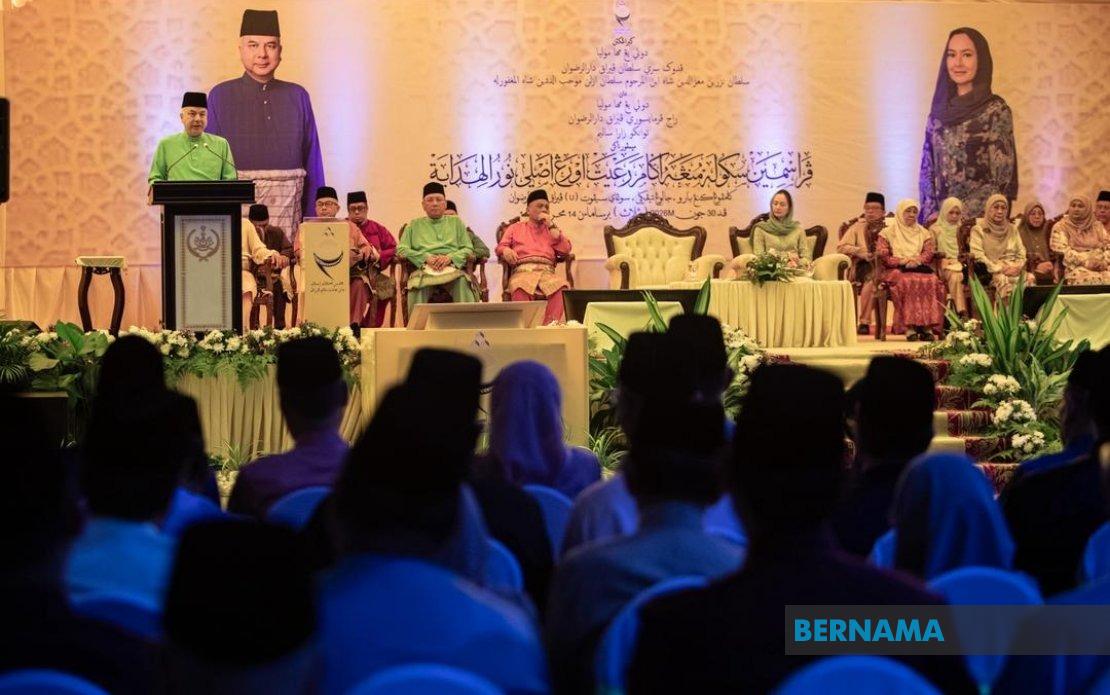
Sultan Nazrin Shah, the reigning Perak monarch, formally inaugurated Sekolah Menengah Agama Rakyat (SMAR) Orang Asli Nurul Hidayah in Kampung Kenang, Sungai Siput Utara, on June 30, recognising the school as a watershed moment in advancing educational access and human capital development for the Orang Asli population across Perak. The ceremony drew senior royalty and government figures, underscoring the significance placed on the institution's opening by state leadership and religious authorities.
The distinguished gathering included Raja Muda of Perak Raja Jaafar Raja Muda Musa and Raja Di Hilir Perak Raja Iskandar Dzurkarnain Sultan Idris Shah, alongside Perak Menteri Besar Datuk Seri Saarani Mohamad and officials from the Perak Islamic Religious and Malay Customs Council (MAIPk) and Islamic Religious Department (JAIPk). The high-level attendance reflected the event's importance to state governance and religious education policy.
What distinguishes SMAR Orang Asli Nurul Hidayah is its historic status as Perak's—and indeed Malaysia's—pioneering secondary religious school designed specifically for the indigenous community. The institution represents a deliberate policy shift toward integrating academic rigour with Islamic instruction, a model that began decades earlier as a grassroots dakwah and religious learning centre before evolving into a fully accredited secondary establishment. This trajectory demonstrates how community-level initiatives can mature into formal educational institutions when supported by sustained commitment.
In addressing the gathering, Sultan Nazrin framed the school's establishment as fundamentally transcending bricks-and-mortar construction. Rather, he characterised it as a strategic investment securing generational prosperity and opportunity for Orang Asli youth, whose educational outcomes and socioeconomic mobility have historically lagged behind national averages. The Ruler's language underscored a recognition that marginalised communities require targeted institutional support to access the same educational pathways available to others.
The school's operational model carries particular relevance for Malaysia's education policy landscape. By weaving together conventional academic curricula with Islamic religious education and moral instruction, SMAR Orang Asli Nurul Hidayah addresses a longstanding tension between technical skill acquisition and values formation. This integrated approach aligns with broader national educational aspirations articulated in various policy documents, which increasingly emphasise holistic human development rather than rote academic achievement alone.
Sultan Nazrin emphasised that the school has demonstrably succeeded in producing not merely academically proficient students but also individuals grounded in religious conviction and ethical principles. Notably, some alumni have returned to serve their communities, becoming educators and advocates within Orang Asli settlements. This returnee phenomenon signals that the institution has generated sufficient local pride and sense of purpose to inspire graduates toward community leadership roles—an outcome rarely measured in conventional school performance metrics but profoundly important for indigenous empowerment.
The Ruler's wider educational philosophy, as articulated during the ceremony, rests on understanding schooling as a multidimensional process spanning intellectual, spiritual, emotional and physical dimensions. This conception diverges from narrower views that reduce education to knowledge transfer or credential acquisition. Instead, Sultan Nazrin positioned schooling as character formation grounded in both intellectual rigour and religious values, designed to cultivate citizens capable of meaningful social contribution. For policymakers, this framing offers a counterweight to instrumentalist approaches that prioritise only economic productivity.
The establishment of SMAR Orang Asli Nurul Hidayah carries implications extending beyond Perak's borders. Indigenous groups across Malaysia confront persistent disadvantages in educational access, completion rates and economic outcomes. Successful models developed in Perak may offer templates for replication elsewhere, particularly in states with significant Orang Asli populations such as Pahang, Johor and Kelantan. The school's existence demonstrates that targeted, culturally-sensitive educational approaches can function effectively within Malaysia's federal system, provided adequate resourcing and institutional commitment materialise.
For the Orang Asli community of Kampung Kenang specifically, the school represents tangible recognition of their educational aspirations and religious values. Too often, indigenous communities experience state institutions as mechanisms of cultural dilution or assimilation. A school deliberately designed for and staffed with understanding of Orang Asli contexts offers a different model—one centring rather than marginalising indigenous identities while providing genuine pathways to broader opportunity.
Sultan Nazrin's emphasis on the school's infrastructure improvements deserves attention as well. Physical learning environments profoundly influence educational quality and student morale. Enhanced facilities signal institutional seriousness and provide the foundation for improved pedagogical practice. For rural and indigenous communities accustomed to resource scarcity, such investments carry symbolic weight beyond their immediate functional utility.
Moving forward, the school faces the challenge of sustaining excellence while managing growth. As enrolment potentially increases and community expectations rise, maintaining teaching quality, staff development and cultural relevance will prove essential. The Ruler's expressed hope that improved infrastructure will catalyse pedagogical enhancement suggests awareness that facilities alone cannot guarantee educational success without corresponding investments in teacher capability and curriculum development.
The broader policy narrative emerging from this ceremony positions education not as a privilege but as a fundamental entitlement for all Malaysian children regardless of ethnicity, geography or socioeconomic circumstance. Realising this aspiration demands precisely the kind of targeted intervention represented by SMAR Orang Asli Nurul Hidayah—institutions designed with explicit attention to historically disadvantaged communities' specific needs, values and aspirations. Whether Malaysia's education system will multiply such models across the country remains an open question, but this Perak institution provides a tested, locally-rooted example of what such commitment can achieve.

