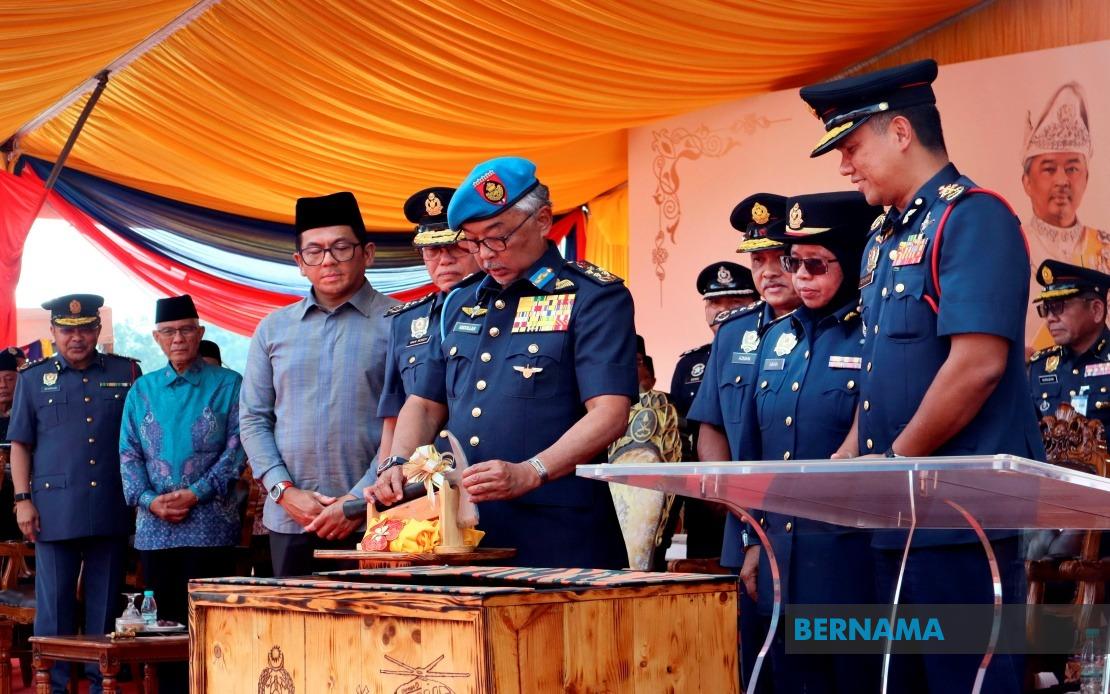
The Sultan of Pahang, Al-Sultan Abdullah Ri'ayatuddin Al-Mustafa Billah Shah, has publicly acknowledged the commitment of both the federal government and Pahang's state administration to infrastructure development that serves the rakyat, with particular emphasis on projects designed to reduce flood risk and strengthen disaster response capacity across the sultanate.
Speaking at the official opening of the Sungai Lembing Fire and Rescue Station in Kuantan on July 2, the Sultan underscored the strategic importance of investing in flood mitigation infrastructure, describing such expenditure as essential given the monsoon cycle that regularly threatens low-lying and riverine communities. He highlighted Sungai Lembing as a bellwether area for flooding in the region, noting that its vulnerability during the monsoon season often foreshadows broader inundation risks across Kuantan and surrounding districts.
The development of flood defence infrastructure carries particular significance for Pahang, a state whose geography exposes it to recurring monsoon floods. Large-scale mitigation projects require sustained capital investment and intergovernmental coordination, making the Sultan's public gratitude a signal of institutional alignment between Putrajaya and the state capital on this shared priority. Such acknowledgement can strengthen public confidence in the machinery of government at a time when Malaysians frequently express frustration over infrastructure delays and unfulfilled promises.
Beyond mere thanks, the Sultan issued a directive that rivers and waterways proximate to residential areas be deepened as a proactive measure to improve drainage capacity and reduce overflow risk during extreme rainfall events. This instruction reflects an understanding that preventive infrastructure—undertaken during periods of normalcy—offers better outcomes than emergency responses mobilised after disasters strike. The order carries the weight of royal authority and may accelerate bureaucratic processes, though implementation will depend on technical feasibility studies, environmental assessments, and budgetary sequencing.
The gathering included Pahang Menteri Besar Datuk Seri Wan Rosdy Wan Ismail, Deputy Housing and Local Government Minister Datuk Aiman Athirah Sabu, and Deputy Economy Minister Datuk Mohd Shahar Abdullah, who also represents Paya Besar in Parliament. The presence of federal ministers signals national-level engagement with state-level infrastructure, though the layering of multiple government agencies involved in flood mitigation and emergency response continues to raise questions about coordination efficacy and resource allocation efficiency.
The Sultan also commended the personnel of the Fire and Rescue Department, characterising their work as essential to public safety and disaster response. He noted his own practice of visiting fire stations and disaster scenes to acknowledge their efforts, framing such visits as both gesture of recognition and opportunity to understand operational challenges at firsthand. This hands-on approach by the Sultan contrasts with more distant forms of patronage and reflects a regional trend among senior figures toward demonstrating direct engagement with frontline workers.
The Fire and Rescue personnel face varied and often unpredictable demands, from structure fires and road accidents to flood rescue operations and industrial emergencies. The Sultan's acknowledgement of their round-the-clock readiness speaks to a reality that emergency services personnel operate under sustained stress, often with incomplete information and high stakes. Public recognition of their sacrifice, particularly from figures of influence, can affect workforce morale and retention—concerns that periodically surface in Malaysian emergency services.
Crucially, the Sultan expressed hope that a volunteer fire brigade be established in Kampung Bantal, within Ulu Tembeling in Jerantut, an isolated locality where response times from centralised stations may be unacceptably long. The proposal for community-based volunteer brigades reflects a pragmatic response to the geography of rural Pahang, where distances and terrain can impede rapid deployment of professional fire and rescue teams. Volunteer brigades, common in developed nations and increasingly introduced in Malaysia, require training infrastructure, equipment provision, and sustained community mobilisation—elements not always readily available in remote settlements.
The initiative at Sungai Lembing represents infrastructure consolidation in a high-risk area, providing a permanent base for emergency services and signalling long-term commitment to disaster preparedness. Such stations anchor broader regional resilience planning and offer employment and training opportunities for local residents. The opening ceremony, though ceremonial in character, also functions as public communication about government responsiveness to identified risks.
For Malaysia and Southeast Asia more broadly, the Pahang experience illustrates the enduring challenge of balancing development investment across geographically diverse territories where natural hazards pose recurring economic and human costs. Flood mitigation remains comparatively underfunded relative to its frequency and impact, despite recognition by policymakers of its criticality. The Sultan's public advocacy may help rebalance priority-setting and budget allocation in favour of preventive infrastructure.
Intergovernmental collaboration on disaster risk reduction remains institutionally fragmented across Malaysian jurisdictions. State and federal agencies must coordinate funding, technical standards, and operational procedures, yet formal mechanisms for such coordination remain weak. The Sultan's appeals for river deepening and volunteer brigade establishment, while welcome, ultimately depend on whether relevant agencies possess budgets, expertise, and administrative will to translate royal directives into implemented outcomes.
The remarks also come at a moment when climate scientists project intensifying rainfall variability across Southeast Asia, potentially rendering historical flood frequencies and magnitudes obsolete as predictive baselines. Forward-looking infrastructure design must account for these projections, raising the stakes for decisions made now about river management and emergency capacity in states like Pahang.

