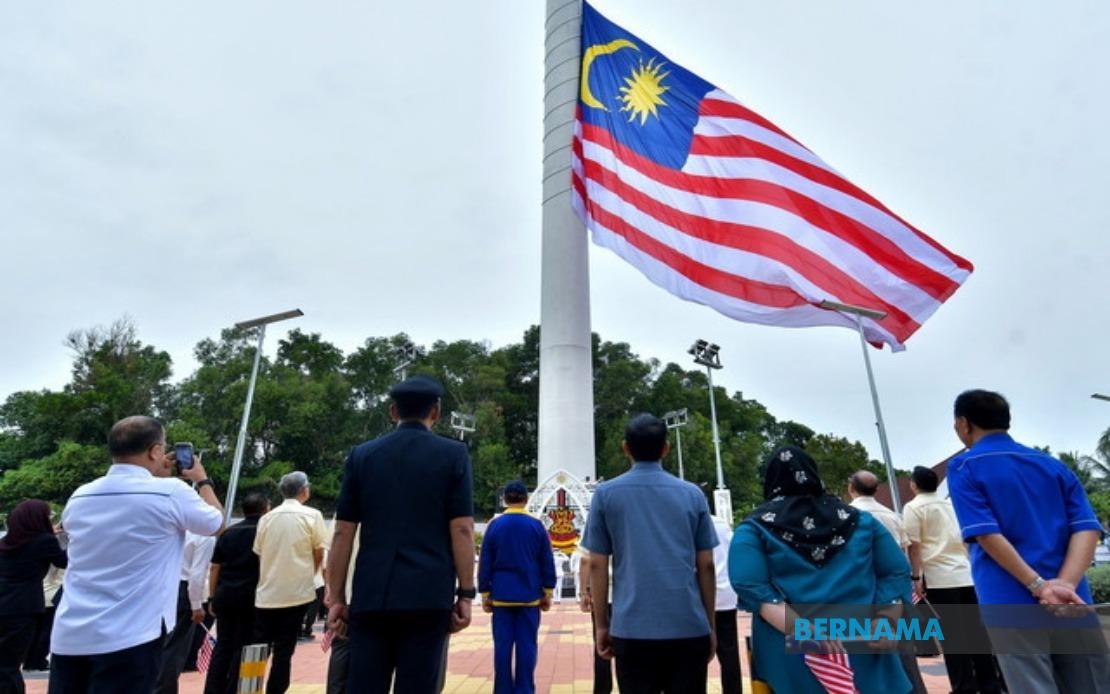
The Sultan of Selangor, Sultan Sharafuddin Idris Shah, has called on Malaysians to recognise the Jalur Gemilang as far more than ceremonial bunting displayed during August festivities. Speaking during a flag-hoisting ceremony at Dataran Selangor on August 26, His Royal Highness articulated a vision of the national flag as a living emblem of collective belonging that transcends the deepest social divisions fragmenting the nation. The remarks arrive as Selangor flies the Jalur Gemilang from August 26 through September 17 to mark both National Day and Malaysia Day celebrations, yet the Sultan's message suggests that genuine patriotism demands engagement stretching well beyond the calendar.
Central to His Royal Highness's address is the proposition that despite the profound differences characterising Malaysian society, the flag serves as a tangible reminder of shared citizenship and common national destiny. Malaysians diverge across multiple fault lines—ethnicity, faith, language, and political ideology—yet the Jalur Gemilang acknowledges none of these divisions. This symbolic neutrality, the Sultan argued, should anchor the national consciousness, particularly when communities appear fractured and political rhetoric often weaponises difference. By positioning the flag as a unifying force that embraces Malays, Chinese, Indians, Kadazan-Dusuns, Ibans and all other groups equally, Sultan Sharafuddin offered a counternarrative to divisive politics that has gained traction during recent years across Malaysia.
Yet the Sultan tempered expectations about what flag ceremonies alone can accomplish. He acknowledged the straightforward logistics of distributing thousands of flags throughout the National Month, but highlighted that the substantially harder challenge lies in constructing a genuine Malaysian society where citizens of every background feel authentically valued and secure. This distinction carries particular relevance in Malaysia, where symbolic nationalism sometimes masks underlying communal tensions and periodic outbursts of inter-ethnic friction. The Sultan's observation essentially warns against conflating ceremonial patriotism with substantive national cohesion, a lesson increasingly pertinent as Malaysia navigates demographic change and competing narratives about national identity.
His Royal Highness directed specific counsel toward the country's political and institutional leadership. Leaders and politicians, he maintained, must model the virtues of moderation, tolerance and compassion, actively resisting the temptation to exploit religious, racial or political grievances for electoral advantage or factional gain. This appeal holds particular weight given Malaysia's history of communal tensions that political actors have occasionally inflamed for short-term benefit. The Sultan's assertion that leaders should refrain from weaponising difference positions the Selangor monarchy as a voice for institutional restraint in an environment where competitive politics sometimes erodes social cohesion.
Education and generational transmission of values emerged as another critical theme in the Sultan's intervention. He stressed that younger Malaysians require deliberate instruction in respecting people of different religions, races and cultural backgrounds. This pedagogical emphasis acknowledges that tolerance and pluralism cannot be assumed to develop naturally; they demand intentional cultivation through formal and informal education. For a nation with significant youth unemployment and rapid social change, the Sultan's focus on shaping how the next generation understands national identity carries implications extending beyond ceremonial occasions to shape Malaysia's long-term social trajectory.
The timing of Sultan Sharafuddin's remarks merits consideration within Malaysia's broader political landscape. National unity messaging has intensified following periods of heightened communal tension, particularly surrounding religious affairs, constitutional interpretations and the position of Islam within the federation. The Sultan's intervention from the Selangor palace—one of the most economically significant and demographically diverse states—carries particular resonance, signalling that traditional custodians of Malaysian identity and governance structures maintain commitment to pluralistic principles despite centrifugal pressures.
The Sultan's framing also contains an implicit critique of how independence celebrations are sometimes weaponised for partisan purposes. By emphasising that the true significance of independence lies not in ceremonial observance but in building a functional multiethnic state, His Royal Highness redirects focus from political actors' claims on National Day toward citizens' lived experience of belonging and security. This reorientation challenges Malaysian political culture to assess national progress not through rhetorical appeals to unity but through measurable indicators of inter-communal trust and institutional equity.
The ceremony at Dataran Selangor thus functioned as more than routine flag protocol. It provided a platform for articulating constitutional principles about Malaysian statehood that underpin the Federal Constitution's fundamental provisions, particularly Article 153's bargain combining Malay-Muslim constitutional privileges with guarantees of non-Malay citizenship and religious minority rights. The Sultan's language implicitly reasserts this foundational compact, warning against any interpretation of national identity that privileges particular communities or relegates others to subordinate status.
For Southeast Asian observers monitoring Malaysia's trajectory, the Sultan's intervention offers insight into how traditional institutions continue attempting to navigate the tension between increasingly pluralistic societies and occasional political voices advocating narrower conceptions of national belonging. Selangor, as Malaysia's wealthiest state and home to substantial communities of all major ethnicities and faiths, represents a microcosm of the pluralism the Sultan defended. The monarchy's continued articulation of inclusive nationalism suggests that institutional forces remain mobilised to counter more restrictive visions of Malaysian identity, even as political competition occasionally tests these commitments.
The Sultan's statement ultimately positions independence anniversary celebrations as opportunities for recommitting to founding principles rather than occasions for celebrating past achievements. By defining National Day through the lens of ongoing nation-building—constructing a society where all citizens experience genuine respect and belonging—His Royal Highness offers a framework for understanding patriotism as demanding continuous work rather than periodic observation. This conception of nationalism proves particularly consequential in diverse societies where unity cannot be imposed through state power alone but must be perpetually renewed through deliberate cultivation of mutual respect and institutional fairness.

