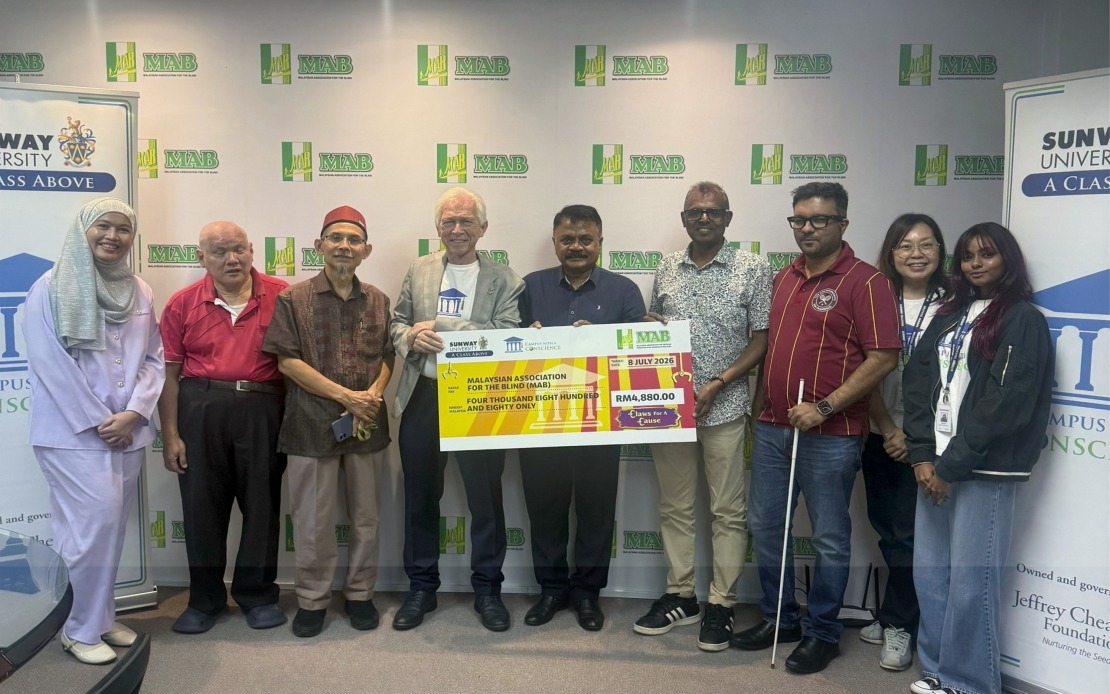
Sunway University has successfully concluded a week-long fundraising drive that generated RM4,880 in support of the Malaysian Association for the Blind, demonstrating how tertiary institutions can mobilize their campus communities towards meaningful charitable objectives. The "Claws For A Cause" initiative, executed in partnership with entertainment company Space Panda, transformed an interactive gaming experience into a vehicle for social impact, allowing students and staff to contribute through their voluntary participation.
The campaign operated under Sunway University's broader Campus With A Conscience programme, which frames community engagement as an integral component of the institutional mission rather than a peripheral activity. By converting a claw machine—typically associated with recreational entertainment—into a fundraising mechanism, the initiative bridged the gap between student leisure activities and charitable giving, creating an accessible entry point for widespread participation across the campus community. This model of activating existing campus infrastructure for social good has gained traction among Malaysian universities seeking to deepen student involvement in civic responsibilities.
Sunway University's leadership framed the initiative within the institution's positioning as a mission-driven, fifth-generation university. According to President and Vice-Chancellor Professor Sibrandes Poppema, the campaign exemplified the university's conviction that educational excellence must be accompanied by demonstrable commitment to community welfare. Poppema emphasized that the institution's mandate extends beyond traditional academic functions to encompass research collaboration, technological innovation, and structured engagement with external communities, positioning social fundraising as a natural extension of institutional values rather than an ancillary undertaking.
The partnership with Space Panda represents a growing trend among Malaysian educational institutions to leverage private sector resources and expertise in advancing social objectives. Rather than positioning corporate entities as passive donors, the collaborative model allowed Space Panda to contribute operational support and infrastructure while Sunway University provided the institutional platform and student mobilization capacity. This reciprocal arrangement typically generates goodwill benefits for both parties while maximizing the efficiency of charitable fundraising efforts.
Space Panda's decision to support the Malaysian Association for the Blind underscores corporate recognition of visual impairment as a significant social welfare concern requiring sustained attention. The organization's focus on empowering individuals with visual disabilities aligns with broader national conversations about inclusive employment, educational access, and social integration for persons with disabilities. By directing corporate social responsibility initiatives toward MAB's work, Space Panda contributed to initiatives that extend beyond immediate relief toward systemic support for disabled persons' economic and social participation.
The RM4,880 raised through the initiative, while modest in absolute terms, carries strategic significance within Malaysia's nonprofit fundraising ecosystem. Many charitable organizations operating at the grassroots level depend on numerous small-to-medium fundraising efforts rather than single large donations, making community-based campaigns like Claws For A Cause valuable for sustaining operational budgets. For student populations, participation in such campaigns cultivates awareness of local charitable needs and normalizes voluntary giving as an expected component of campus culture.
Sunway University's initiative reflects broader trends among Malaysian tertiary institutions to embed social responsibility within campus life. Rather than treating charitable giving as an optional extracurricular activity, universities increasingly design their institutional infrastructure—from student orientation programmes to campus facilities—to create regular touchpoints for community engagement. This systematic approach generates higher participation rates and reinforces the normalization of charitable consciousness among younger Malaysians who will carry such values into their professional careers.
The collaboration between academia and private enterprise demonstrated through this campaign addresses a persistent challenge in Malaysian civil society: generating sustainable funding streams for organizations serving vulnerable populations without exhausting donor fatigue. By creating innovative mechanisms that make giving convenient and low-friction—students simply engage with an entertaining activity rather than being directly solicited for donations—the initiative removed psychological barriers to participation that often reduce contribution rates in traditional fundraising approaches.
For the Malaysian Association for the Blind, campaigns of this nature provide crucial funding while simultaneously elevating public awareness of issues affecting visually impaired persons. Student exposure to MAB's mission during the Claws For A Cause week potentially generates future volunteers, advocates, and informed citizens who understand blindness-related policy matters when they arise in public discourse. This awareness-building function often proves as valuable as the financial contribution itself in advancing long-term social change.
The initiative also speaks to evolving expectations around corporate social responsibility in Malaysia's business environment. Companies increasingly recognize that meaningful community engagement requires integration with institutional partners who possess credibility, reach, and established relationships within target communities. By partnering with Sunway University rather than conducting unilateral charitable activities, Space Panda accessed the university's student base and institutional brand reputation while demonstrating authentic commitment to causes rather than performative corporate benevolence.
Looking forward, the Claws For A Cause model offers replicable infrastructure for other Malaysian universities and corporate partners seeking to create scalable fundraising mechanisms. The simplicity of the concept—transforming ordinary campus activities into charitable vehicles—lowers barriers to institutional adoption while maintaining capacity for customization to suit different causes and campus environments. As Malaysian society increasingly expects corporations and educational institutions to demonstrate tangible social impact, such innovative partnership models will likely proliferate across the higher education sector.

