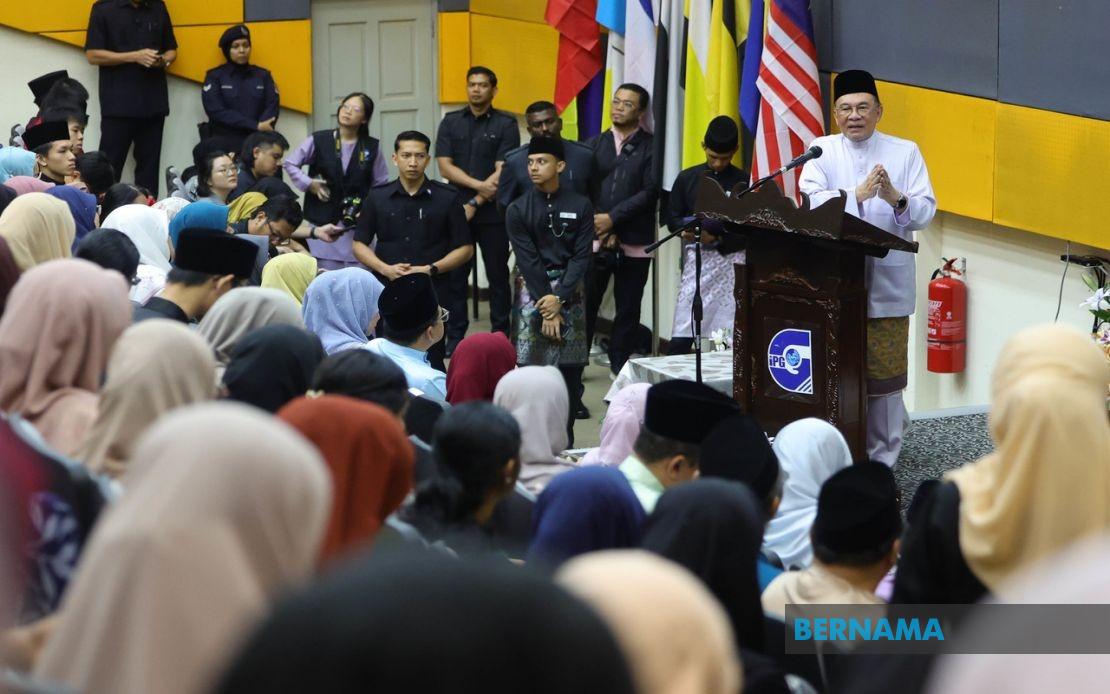
Prime Minister Datuk Seri Anwar Ibrahim has singled out institutional resistance and the protection of vested interests as the fundamental barrier to Malaysia's reform agenda, overshadowing concerns about technological capacity or professional competence. Speaking at a youth engagement session in Nilai, the Prime Minister articulated a diagnosis of the reform challenge that extends beyond technical implementation difficulties, instead pointing to human reluctance within governance structures to abandon established patterns of behaviour. This framing suggests that Malaysia's pathway to administrative modernisation depends less on acquiring new capabilities and more on overcoming entrenched opposition from those who benefit from the status quo.
Drawing on his experience across more than three years at the helm of government, Anwar highlighted the consistent pushback encountered when attempting to restructure institutions and dismantle corruption networks. His observations reflect the accumulated frustration of an administration attempting to execute substantial change within bureaucratic systems shaped by decades of particular practices. The Prime Minister's public articulation of these obstacles signals recognition that reform momentum faces internal constraints that cannot be easily overcome through policy announcements or technical upgrades alone. Instead, the government must contend with deliberate obstruction rooted in personal interest and organisational inertia.
The Prime Minister acknowledged that efforts to strengthen governance transparency and accountability, while administratively necessary, generate discomfort among constituencies with investment in existing arrangements. This friction between reform imperatives and institutional comfort represents a persistent tension in modernising governments across developing democracies. Anwar's willingness to name this dynamic publicly suggests a calculation that transparency about reform difficulties may help build public understanding and support for sustained pressure on resistant elements within the system. Rather than presenting reform as a technical management challenge, he has reframed it as a values question about whether Malaysia intends to institutionalise better practices.
The Prime Minister observed that resistance emerges not necessarily from those lacking modern sensibilities, but from individuals and groups whose contemporary presentation masks fundamentally conservative institutional interests. This distinction matters because it suggests that resistance to reform cannot be attributed simply to ignorance or backwardness, but rather reflects calculated defence of arrangements that serve particular interests regardless of broader public benefit. The characterisation implies that modernisation in surface aspects—attire, technology adoption, international engagement—can coexist with resistance to deeper systemic change, particularly where such change threatens established advantages.
Anwar framed systemic reform as a religious, cultural and civilisational imperative rather than merely a technical administrative requirement. This rhetorical positioning attempts to elevate reform beyond technocratic discussion into the sphere of fundamental values and national identity. By invoking religious and cultural foundations for continuous improvement, the Prime Minister seeks to mobilise moral arguments alongside institutional ones, suggesting that Malaysia's foundational commitments—whether Islamic principles, cultural traditions, or civilisational progress—all point toward the necessity of better governance. This approach aims to delegitimise arguments that present resistance to reform as tradition-preserving.
The corruption culture that has become normalised within parts of the administrative apparatus represents, in Anwar's analysis, perhaps the deepest impediment to reform. When corrupt practices become embedded in institutional routines and expectations, they acquire a veneer of legitimacy that makes them difficult to dislodge through formal policy changes alone. The Prime Minister's emphasis on this normalisation suggests an understanding that combating corruption requires not merely prosecuting individual violators, but fundamentally disrupting the institutional cultures within which corrupt behaviour appears routine. This cultural challenge extends beyond enforcement capacity into questions of institutional identity and acceptable conduct.
The venue for these remarks—a teacher education institution—carries significance for how Malaysia positions its reform agenda. Educational institutions train professionals who will shape national development across coming decades, making them critical sites for instilling commitment to reformed systems and ethical conduct. By articulating reform challenges to students and educators, Anwar appears to be investing in the formation of a cohort less habituated to existing problematic arrangements and potentially more committed to different institutional cultures. This generational approach to reform acknowledges that systemic change may require cultivating constituencies with different values and expectations.
Anwar's framing implicitly rejects narratives that position Malaysia's governance challenges as primarily technical or financial in nature. Rather than seeking additional resources, expertise or technologies, the Prime Minister's diagnosis suggests that Malaysia possesses sufficient capability but lacks sufficient will within institutional hierarchies to deploy that capability toward reform. This assessment has implications for how Malaysia approaches development assistance, technical partnerships with other nations, and domestic resource allocation. If the constraint is political will and institutional courage rather than capacity, then international technical assistance, while potentially helpful, cannot substitute for internal commitment to change.
The political economy of resistance that the Prime Minister describes reflects familiar patterns in reform efforts across the region. Southeast Asian governments attempting administrative modernisation frequently encounter similar dynamics where established interests protect themselves against change regardless of public benefit. Malaysia's experience contributes to regional understanding that governance transformation requires sustained political commitment capable of withstanding institutional pressure from those defending existing arrangements. The willingness of a sitting Prime Minister to publicly name these obstacles suggests either genuine frustration with progress or strategic calculation that public pressure on resistant elements might advance reform goals.
For Malaysian civil society and reform advocates, Anwar's articulation of the problem creates both opportunities and challenges. On one hand, explicit prime ministerial acknowledgment of resistance validates the experience of reformers who have encountered bureaucratic obstruction. On the other hand, the framing places substantial responsibility on the government itself to overcome its own institutional resistance, raising questions about the extent of genuine commitment to transformation throughout the administration. The extent to which the government can overcome the resistance patterns the Prime Minister describes will likely determine whether Malaysia's reform agenda achieves meaningful institutional change or remains substantially incomplete despite rhetorical commitment.

