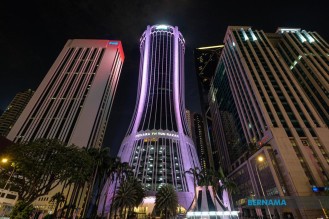
Finance Minister II Datuk Seri Amir Hamzah Azizan has disclosed to Parliament that the controversial acquisition by Lembaga Tabung Haji of a 30 per cent stake in Putrajaya Perdana Bhd took place under problematic circumstances, with sworn testimony establishing that the company was under the control of Low Taek Jho, better known as Jho Low, throughout the entire approval process in 2014. The revelation emerged during a special parliamentary sitting convened to examine the Royal Commission of Inquiry report on Tabung Haji's management and operations, opening a fresh chapter in scrutiny over how the hajj savings body deployed depositors' funds in ventures connected to the controversial financier and his networks.
According to evidence presented in the SRC International case, control of Putrajaya Perdana was exercised through Utama Banking Group Bhd, a vehicle linked to Jho Low, and remained in place until April 13, 2015, when the sale to new ownership was finally completed. This critical detail establishes that when the Investment Panel approved the transaction on July 24, 2014, when the Tabung Haji board endorsed it on August 25, and when the Finance Minister granted formal approval on August 27, Jho Low's influence over the company's direction and operations was unquestionably active. The formal sale and purchase agreement was subsequently signed on December 3, 2014, meaning every stage of Tabung Haji's decision-making architecture operated within this window of exposure.
Testimony from Putrajaya Perdana director Datuk Rosman Abdullah, recorded under oath in proceedings related to SRC International, revealed that the firm had channelled RM170 million into Putrajaya Perdana's subsidiary, Putra Perdana Construction, through three separate payments between July and August 2014. This flow of funds occurred precisely when the acquisition was being processed through Tabung Haji's approval systems, suggesting a timing that raises fundamental questions about the interconnection between the two transactions and whether decision-makers understood the full picture of financial relationships underpinning the deal.
However, Amir Hamzah carefully qualified the statement by noting that no court has yet made a formal finding that Jho Low was the beneficial owner of Putrajaya Perdana at the time, underscoring that these remain matters of sworn testimony rather than judicial determination. This distinction is important for legal accuracy, though it does not diminish the significance of the sworn accounts now part of the court record, which Malaysian investors and policymakers are entitled to weigh carefully.
The minister's exposition revealed a pattern of governance failures that extend beyond mere association with questionable figures. Tabung Haji's Research Division initially valued the 30 per cent stake at between RM124 million and RM155 million, yet the Investment Panel and board ultimately approved a purchase price of RM193.5 million. Critically, no written justification was ever provided for accepting a valuation substantially higher than the professional recommendation, nor was any documented rationale offered for increasing the stake from an originally proposed 25 per cent to 30 per cent. These decisions proceeded without the paper trail one would expect in a disciplined institutional framework.
A further layer of mismanagement emerged from the fact that due diligence procedures were conducted only after all approvals had already been secured, meaning decision-makers lacked proper investigative findings when they committed Tabung Haji's resources. Neither the Investment Panel nor the board of directors reviewed due diligence findings before the sale and purchase agreement was executed, inverting the logical sequence of prudent institutional practice. The 2023 fact-finding assessment subsequently recorded that four other investments similarly failed to undergo required due diligence procedures, suggesting systemic rather than isolated failures in Tabung Haji's investment governance architecture.
What decision-makers apparently never learned was a fact that fundamentally altered the transaction's rationality: the seller had acquired the entire equity stake in Putrajaya Perdana for RM260 million in 2012, meaning a 30 per cent stake would have been valued at approximately RM78 million at that time. By 2014, Tabung Haji was paying RM193.5 million for the same percentage holding, representing a markup of nearly 150 per cent in just two years despite no apparent operational transformation or major business achievement to justify such appreciation. For Malaysian depositors whose savings were being invested, this escalation should have triggered heightened scrutiny rather than administrative approval.
The promised returns that justified this premium acquisition never materialised. Tabung Haji had acquired the stake based on two explicit commitments: that Putrajaya Perdana would be relisted on the stock exchange within a year and that it would achieve RM86 million in profit during 2015. Neither pledge was fulfilled, leaving the investment bereft of the fundamental business case that had underpinned the board's approval. Adding to the complications, the chairman of Tabung Haji at the time simultaneously served as chairman of Putrajaya Perdana, creating a potential conflict of interest that muddied accountability lines and decision-making independence.
When the promised outcomes failed to emerge, Tabung Haji sought to recover its position through a put option exercised in March 2018, demanding that the seller repurchase the shares at RM210.7 million. The seller refused to honour this obligation, leaving Tabung Haji holding an investment that had collapsed in economic value. By financial year 2024, the entire RM193.5 million investment has been fully impaired, written off as a complete loss against Tabung Haji's financial statements. For a body established to safeguard the hajj savings of ordinary Muslim Malaysians, this outcome represents not merely a failed investment but a breach of fiduciary responsibility that demands accountability.
The hajj savings institution is now pursuing legal recovery through the court system, having filed a writ and obtained a Mareva injunction to freeze assets held by the defaulting seller. Court-directed mediation was scheduled for August 11, though a full trial is not anticipated until June 23, 2027, meaning resolution lies years in the future. For Malaysian depositors awaiting their hajj journey, the knowledge that their savings have been locked in litigation over a contaminated investment adds practical frustration to the underlying governance failures.
The parliamentary discussion was prompted by questions from multiple MPs, including representatives from Muar, Putrajaya, and Port Dickson, concerning the documented links between Putrajaya Perdana and Jho Low. The renewed public focus reflects broader Malaysian concern about whether institutions managing public resources have adequately insulated themselves from exposure to figures and networks implicated in major financial scandals. The Putrajaya Perdana transaction occurred during the period when awareness of Jho Low's influence over 1MDB and associated structures was intensifying, raising the question of whether better intelligence and more cautious governance protocols should have been in place at that moment.

