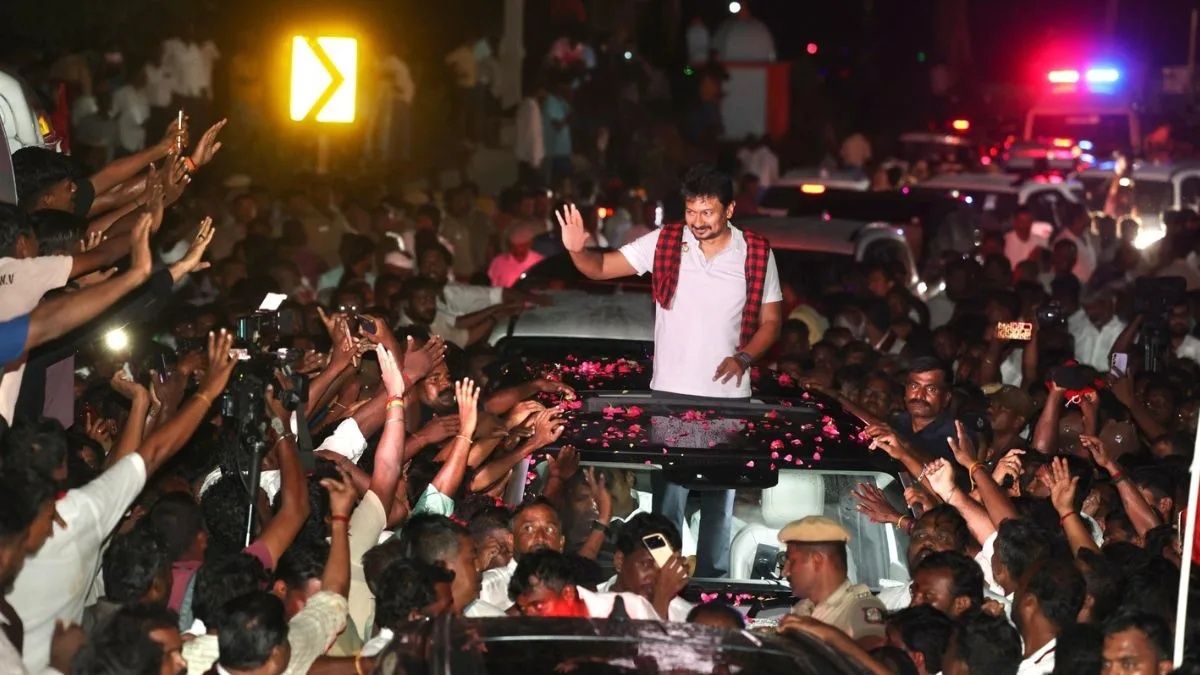
Tamil Nadu's opposition Leader Udhayanidhi Stalin walked free on station bail late Tuesday after undergoing extended questioning by police over remarks he made during a recent public gathering. The former deputy chief minister's release came after intense scrutiny from authorities investigating allegations that his comments constituted offensive remarks directed at actress Trisha Krishnan. Stalin's arrest and subsequent release have intensified the political temperature in the state, reflecting deepening tensions between the DMK and Chief Minister Vijay's newly formed TVK government.
DMK loyalists descended on Sengipatti police station to celebrate Stalin's release, with hundreds gathering to accord him a hero's welcome. The gathering quickly transformed into an anti-government demonstration, with supporters chanting slogans criticising Chief Minister Vijay and his administration. The show of strength underscores the DMK's attempt to frame Stalin's detention as political persecution rather than a legitimate law enforcement action, a narrative that carries significant weight among the party's grassroots base.
Addressing supporters and journalists at a hurried press conference following his release, Stalin categorically denied any wrongful intent behind his words. He characterised his arrest as a diversionary tactic employed by the ruling government to distract public attention from substantive policy failures, particularly regarding agricultural welfare. Stalin's defence strategy hinged on reframing the incident as an attack on his freedom to advocate for farmers' interests, positioning himself as a victim of governmental overreach rather than acknowledging the controversy itself.
The origin of the controversy traces back to a DMK protest held in Thanjavur where Stalin was addressing supporters on agricultural policy, specifically criticising Chief Minister Vijay's handling of the Cauvery water dispute and Karnataka's planned Mekedatu dam project. During his speech, supporters in the crowd spontaneously chanted the name of actress Trisha Krishnan, widely perceived as being politically close to the ruling TVK leader. When Stalin heard the actress's name, he paused, smiled, and responded with a remark about water that observers interpreted as carrying sexual innuendo: "Wherever water comes, whether it comes or not, water should come there."
The ambiguous nature of Stalin's comment created space for competing interpretations. Supporters argued the statement represented innocent commentary on water policy, merely acknowledging the crowd's interjection while maintaining focus on the serious issue of water scarcity. Critics, however, viewed the deliberate pause, smile, and carefully constructed double meaning as deliberate sexual harassment wrapped in ostensible policy discussion, using a public protest to mock both the actress and undermine her political associations.
The ruling TVK responded swiftly and aggressively to the controversy, filing formal complaints with both the National Commission for Women and state police authorities. The government's response framed Stalin's remarks as "verbal harassment" and the objectification of a woman, positioning itself as defender of women's dignity against political opposition misogyny. This counterattack proved effective in shifting the narrative from water policy to gender-based conduct, compelling police to register cases and initiate investigation.
Stain's arrest from his Chennai residence on Wednesday morning signalled the government's determination to pursue the matter through formal channels, though the relatively quick release on station bail suggests either insufficient evidence for more stringent custody or potential political calculation regarding the optics of prolonged detention. Station bail, a less onerous form of release compared to regular bail, allows accused persons to be released from police custody on the spot with conditions, avoiding formal court proceedings.
The incident reflects broader turbulence in Tamil Nadu politics following the emergence of Chief Minister Vijay's TVK as a significant electoral force. The ruling party's aggressive stance toward DMK legislators and leadership signals its intent to challenge the DMK's traditional political dominance in the state. Stalin's characterisation of the TVK government as a "circus" rather than legitimate governance exemplifies the rhetorical escalation accompanying this power transition, with both sides employing confrontational language and institutional mechanisms against their opponents.
For Malaysian observers, the Tamil Nadu controversy illustrates how regional Indian politics increasingly weaponises gendered language and women's representation for political advantage. Both the DMK and TVK leveraged the controversy to mobilise their respective support bases, with the DMK portraying Stalin as a victim of political persecution and the TVK presenting itself as defender of women's dignity. Such manoeuvres reflect the sophistication of modern Indian electoral politics, where character assassination and institutional action intertwine seamlessly.
The timing and intensity of the response also raises questions about the extent to which India's federal investigative and prosecutorial systems remain insulated from political pressure. The rapid police action, coordinated government complaints, and public statements suggest a coordinated strategy rather than spontaneous law enforcement response. While independent judicial systems exist to ultimately adjudicate such matters, the incident demonstrates how political actors can deploy formal institutional mechanisms to delegitimise opponents and mobilise constituencies.
Stain's release, rather than resolving the controversy, likely represents merely its opening chapter. The DMK's mobilisation around his detention suggests the party intends to maintain the issue as a rallying point against what it frames as TVK authoritarianism. Conversely, the TVK appears committed to prosecuting the case vigorously to establish its credentials as a defender of public morality. This protracted legal-political struggle will continue shaping Tamil Nadu's fractious political environment for months ahead.

