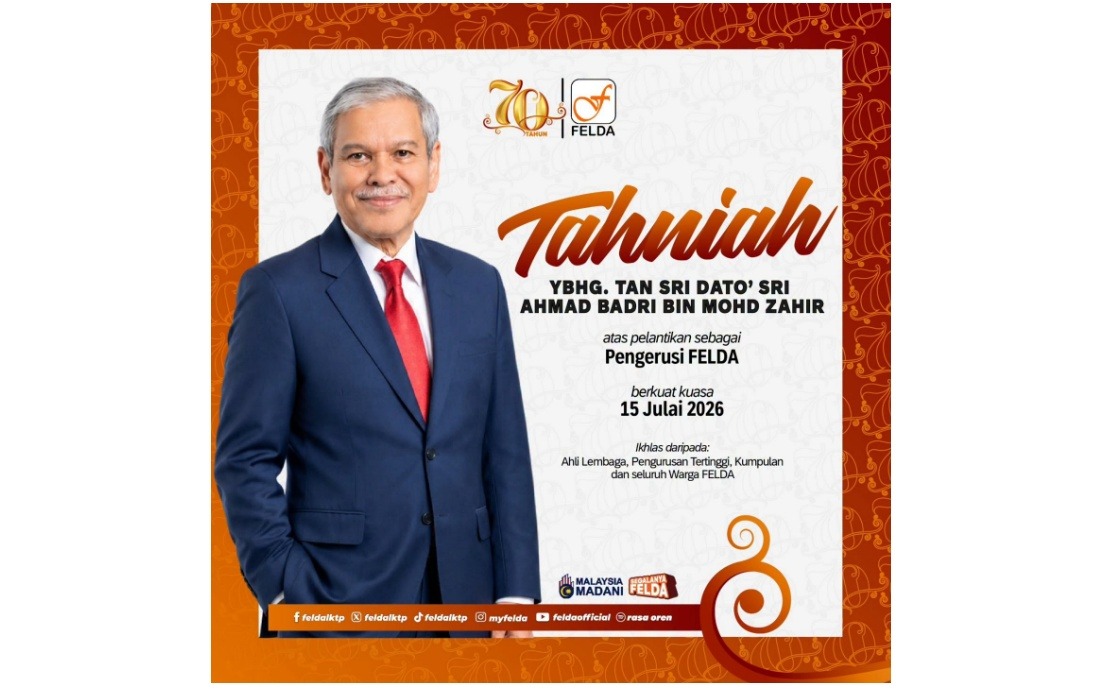
The Federal Land Development Authority (FELDA) has appointed Tan Sri Ahmad Badri Mohd Zahir as its new chairman, marking a significant leadership transition for one of Malaysia's most influential agricultural development agencies. The appointment, which reflects confidence in Ahmad Badri's track record across Malaysia's public and private sectors, comes as FELDA embarks on an ambitious transformation agenda aimed at modernising its operations and strengthening its role in the country's sustainable development framework.
Ahmad Badri brings more than thirty years of experience spanning both government and corporate environments, having commenced his career with the Ministry of Finance in 1989. His trajectory through the public sector culminated in his tenure as Treasury Secretary-General from 2018 to 2020, a position that positioned him at the centre of Malaysia's fiscal policy and economic planning during a period of considerable national change. This extensive background in financial management and strategic governance has been identified by FELDA leadership as essential to navigating the complex challenges facing agricultural development in an increasingly competitive global market.
Prior to his FELDA appointment, Ahmad Badri chaired the Employees Provident Fund (EPF), one of Malaysia's largest institutional investors with assets managed in the hundreds of billions of ringgit. His stewardship of the EPF demonstrated his capacity to manage institutions with profound implications for millions of Malaysians' retirement security and financial wellbeing. This responsibility underscored his ability to balance competing stakeholder interests whilst maintaining institutional integrity and sound financial practices—qualities deemed crucial for leading FELDA's operational transformation.
Beyond his roles in government-linked companies, Ahmad Badri has maintained active involvement with several of Malaysia's most strategically important organisations. He has served on the boards of Bank Negara Malaysia, the nation's central bank; Permodalan Nasional Berhad, a key vehicle for Malaysian equity participation; and Tenaga Nasional Berhad, the country's largest power utility. These appointments reflect the confidence that Malaysian policymakers and institutional leaders have placed in his judgment and expertise across disparate sectors of the economy.
Currently, Ahmad Badri holds the chairmanship of RHB Bank Bhd, one of Malaysia's major financial institutions, and the Malaysian Rubber Board (LGM), positioning him at the intersection of financial services and primary commodity production. He also serves as a board member of Sime Darby Bhd, Malaysia's largest listed conglomerate with substantial operations in plantations, manufacturing, and logistics. This portfolio of concurrent responsibilities demonstrates his capacity for managing multiple complex institutional mandates, a skill essential for FELDA given the Authority's diversified business interests spanning palm oil, rubber, cocoa, and downstream processing operations.
Academically, Ahmad Badri holds a Master of Business Administration from the University of Hull in the United Kingdom, complementing his undergraduate qualification in Estate Management from Universiti Teknologi MARA. His educational background in property and land management carries particular relevance for FELDA, an organisation whose core mandate involves optimal utilisation and development of agricultural land resources across Malaysia. The combination of technical expertise in land management with advanced business education positions him well to bridge operational realities with strategic business thinking.
FELDA's statement emphasising Ahmad Badri's appointment as a catalyst for strengthening governance and management excellence reflects the Authority's recognition that agricultural sector competitiveness increasingly depends on institutional quality and operational efficiency. The organisation serves more than three million settlers across various schemes throughout the country, making it not merely an economic entity but a social institution with profound implications for rural Malaysian livelihoods. Improving FELDA's governance structures and management practices directly translates to enhanced welfare for these communities and greater prospects for intergenerational prosperity within settler families.
The appointment arrives as global commodity markets evolve rapidly and climate considerations reshape agricultural production paradigms. FELDA faces the dual imperative of maintaining economic returns for settlers whilst adapting to environmental sustainability requirements and market pressures favourable to certified sustainable production. Ahmad Badri's experience navigating complex policy environments and institutional transformation positions him to chart a course that balances these sometimes-competing objectives. His background in treasury management during periods of fiscal consolidation suggests familiarity with cost discipline and operational efficiency—critical capabilities for maximising returns from FELDA's substantial asset base in an era of commodity price volatility.
For Malaysian investors and agribusiness observers, Ahmad Badri's appointment signals institutional continuity mixed with reform momentum. His reputation for maintaining relationships across government, banking, and corporate sectors suggests he will likely pursue collaborative approaches to solving FELDA's strategic challenges, whether through partnerships, technology adoption, or market development initiatives. His tenure at institutions like BNM and EPF indicates comfort with evidence-based decision-making and stakeholder engagement, approaches that could differentiate FELDA's transformation from purely top-down restructuring.
The appointment also reflects broader positioning of FELDA within Malaysia's economic development priorities. As the country pursues higher-value agricultural production and rural development objectives aligned with sustainable development goals, leadership selection sends signals about institutional direction. By appointing someone with Ahmad Badri's financial acumen and experience managing large institutional portfolios, FELDA's appointing authority clearly prioritises financial sustainability, governance excellence, and alignment with national development frameworks. This suggests future FELDA strategy will emphasise prudent asset management, stakeholder returns, and institutional resilience alongside settler welfare considerations.
Moving forward, Ahmad Badri's leadership will be tested in addressing longstanding FELDA challenges including land productivity improvement, settler income enhancement, and competitive positioning relative to larger private plantations operators. His success in these areas will not only determine institutional performance metrics but will influence perceptions regarding whether Malaysian government-linked enterprises can successfully combine developmental mandates with commercial excellence—a question of significance well beyond FELDA itself.

