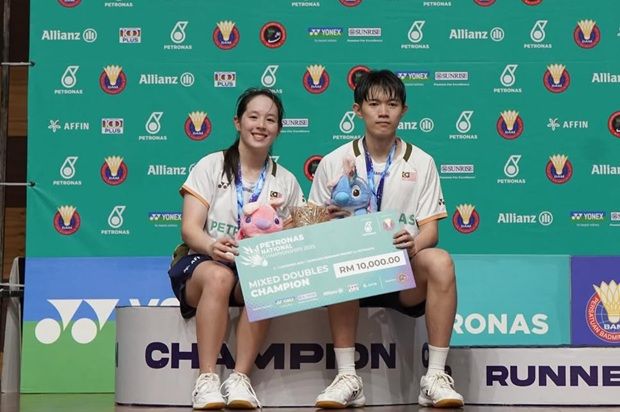
Clarissa San steps into the biggest stage of her badminton career carrying a straightforward mantra: remain composed and embrace the moment. The 20-year-old mixed doubles player will debut at the Japan Open next week alongside Chen Tang Jie, following an unexpected reshuffle that saw her elevated to compete at one of the Badminton World Federation's most prestigious tournaments on the international calendar.
The partnership emerged after Toh Ee Wei suffered an anterior cruciate ligament injury that has sidelined the original mixed doubles pairing. Ee Wei is currently undergoing rehabilitation in Melbourne, leaving Tang Jie without a partner at a crucial time in the season. Clarissa's selection as his replacement represents a significant opportunity for the Selangor-born shuttler, who has moved from the periphery of Malaysia's elite mixed doubles programme into the spotlight almost overnight.
Despite the magnitude of competing at such a major event, Clarissa is approaching the tournament with measured expectations. She acknowledges that this is uncharted territory and views the Japan Open primarily as a learning experience rather than a platform for immediate glory. Her preparation has been grounded in executing the technical and tactical work developed during recent training sessions, with a realistic understanding that refinement remains necessary across multiple facets of her game.
Tang Jie and mixed doubles head coach Nova Widianto have established a consistent message throughout their preparations: anxiety serves no purpose at a championship of this calibre. Both have reinforced the importance of managing pressure by maintaining focus on match execution rather than becoming preoccupied with external outcomes. This psychological framework reflects a coaching philosophy that recognises how premature expectations can undermine younger players' performances at their debut major tournaments.
Clarissa expressed genuine gratitude for the mentoring relationship that has developed with Tang Jie since their pairing was confirmed. She characterises him as both a guide and an elder figure within the partnership, someone who offers constructive feedback when technical or tactical lapses occur without creating an atmosphere of reproach. This supportive dynamic appears instrumental in building the newcomer's confidence as she prepares for her opening match against Taiwan's Yang Po-hsuan and Hu Ling-fang.
The Malaysian pair's first-round assignment presents a competitive examination without being prohibitively difficult. Taiwan's mixed doubles programme has developed several capable combinations, and this opening encounter will serve as a genuine test of Clarissa and Tang Jie's cohesion under tournament pressure. A successful result would validate the selection decision and potentially establish momentum for the subsequent matches scheduled in their tour itinerary.
Beyond this particular tournament, Clarissa is calibrating her development trajectory across a series of events planned with Tang Jie for the coming weeks. She views the Japan Open as the opening chapter in a longer narrative of partnership building rather than an isolated competition. This perspective reflects maturity in her approach, understanding that rapid advancement in mixed doubles depends on accumulated experience and growing understanding with a partner across multiple tournaments in varied contexts.
Malaysia's mixed doubles contingent faces a demanding schedule at the Japan Open. Jimmy Wong and Cheng Su Yin open their campaign against Japan's Yuichi Shimogami and Sayaka Hobara, while the independent pairing of Goh Soon Huat and Shevon Lai Jemie confronts Americans Chen Zhi Yi and Francesca Corbett. Wong Tien Ci and Lim Chiew Sien encounter a particularly challenging draw, facing China's fifth-seeded combination of Guo Xinwa and Chen Fanghui in their opening round.
The depth of Malaysia's mixed doubles representation underscores the programme's ongoing development, even as key personnel like Toh Ee Wei manage recovery from injury. The emergence of players like Clarissa into high-profile opportunities reflects the country's pipeline of talent, though the immediate priority remains supporting their transition into this elite level without overwhelming them with unrealistic expectations during their initial exposure to major world tour events.

