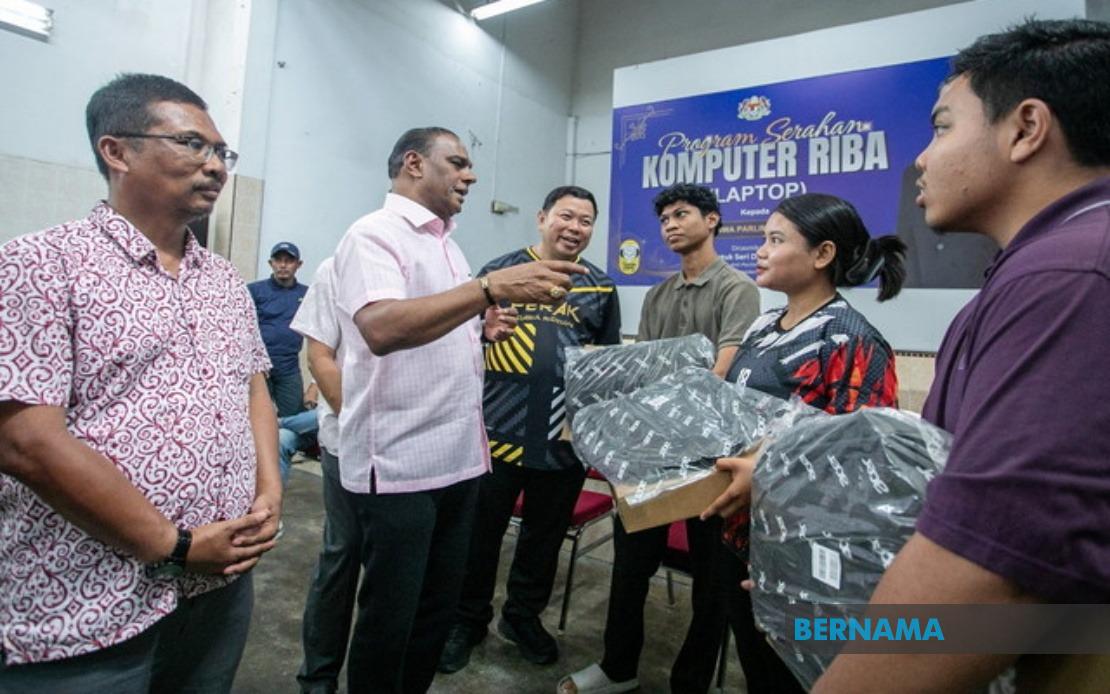
The Tapah parliamentary constituency has distributed laptops to 45 university students from B40 households, marking the latest phase of a sustained initiative designed to bridge the digital divide affecting Malaysia's economically disadvantaged student population. Datuk Seri M. Saravanan, the Member of Parliament for Tapah, oversaw the handover ceremony at Mahatma Gandhi Hall, underscoring his constituency's commitment to ensuring that financial hardship does not impede educational progress. Since the programme's launch in 2008, more than 1,000 students have benefited from this targeted support, demonstrating the scale and longevity of efforts to equip lower-income learners with essential technology.
The composition of this year's beneficiaries reflects Malaysia's diverse educational pathway system. The 45 recipients included 30 diploma-level students, five pursuing certificate qualifications, four enrolled in matriculation programmes, and three undertaking degree studies. Additionally, individual recipients were selected from the SPM, STPM, and foundation programme tiers, illustrating how the scheme encompasses the full spectrum of post-secondary education. This broad coverage acknowledges that technology gaps affect students across multiple educational stages, each facing distinct digital demands in their respective curricula.
Saravanan emphasised that laptops have transcended their status as convenience items to become fundamental tools for contemporary higher learning. The transition towards technology-driven pedagogies—from online submission systems to virtual collaboration platforms and digital research databases—has effectively rendered computer ownership a prerequisite rather than a luxury for university-level study. For B40 families already stretched across multiple financial obligations, the inability to procure a laptop can create tangible barriers to academic engagement and success, potentially widening existing inequality gaps in educational outcomes.
The selection process governing laptop allocation demonstrates institutional rigour in targeting assistance toward genuine need. A dedicated committee evaluated each application through a multi-layered verification approach, engaging both the District Education Office and local community leaders to authenticate eligibility claims. This methodological approach prevents misallocation of resources while building trust within the constituency that the programme operates with transparency and fairness.
Beyond immediate technological provision, Saravanan highlighted the broader socioeconomic transformations enabled by sustained educational investment in historically marginalised communities. Over two decades, the Tapah constituency has witnessed growing numbers of Orang Asli youth progressing into tertiary education and subsequently into professional occupations including medicine, law, and other specialised fields. This intergenerational mobility, while still incremental within broader demographic patterns, signals how access interventions can catalyse long-term shifts in community opportunity structures and aspirational horizons.
Aidil Iskandar Ramlan, an 18-year-old beneficiary, exemplifies the demographic profile typical of programme participants. As a recent SMK Syeikh Abdul Ghani graduate preparing to commence Diploma studies in Public Administration at Universiti Teknologi MARA's Raub campus, he represented students transitioning from secondary to technical-vocational education. His father's employment as a school security guard and his mother's homemaking responsibilities reflected household income patterns common among B40 segments, where parental wages remain insufficient to absorb additional expenses for educational technology without material family sacrifice.
For Aidil, the laptop allocation carries tangible financial implications extending beyond the individual. His recognition that the device eliminates pressure on parental resources—preventing them from redirecting funds needed for utilities, food, or healthcare—demonstrates how educational support programmes function as informal social safety nets. The psychological dimension merits equal consideration; students freed from anxiety about equipment shortages often report enhanced academic concentration and improved engagement with coursework.
Ea Endry Iana Aslan, a 19-year-old pursuing Early Childhood Education credentials at FELCRA College, similarly articulated how technological provision alleviates household financial pressure while improving her academic capacity. Her explicit gratitude toward Saravanan suggests that such targeted interventions generate political goodwill and reinforce community perceptions that elected representatives actively address constituent hardship. This relational dimension proves significant in Malaysian political contexts, where direct beneficiary relationships often influence electoral patterns and constituent satisfaction.
The Tapah laptop programme reflects broader Malaysian policy recognition that digital inclusion represents a contemporary dimension of educational equity. As tertiary institutions increasingly mandate online learning platforms, virtual submission requirements, and digital assessment tools, students lacking personal computing devices face systematic disadvantage. This programme acknowledges that formal educational access—mere enrolment in courses—constitutes an incomplete guarantee of genuine opportunity unless accompanied by technological parity enabling full participation in modern pedagogical practices.
For Southeast Asian policymakers observing similar socioeconomic disparities across the region, the Tapah model offers instructive lessons about sustained, constituency-level intervention. The programme's 16-year continuity suggests that durability and predictability of support prove more effective than sporadic, ad-hoc assistance in establishing confidence among vulnerable populations. Furthermore, the integration of local verification mechanisms through education offices and community leaders demonstrates how centralised resource allocation can leverage decentralised knowledge networks to improve targeting accuracy.
The concentration of recipients in diploma-level programmes—representing two-thirds of this year's allocation—reflects Malaysia's strategic emphasis on technical and vocational education as pathways for B40 students. Diploma qualifications offer more rapid labour market entry than university degrees while maintaining wage premiums over secondary certification, making them particularly valuable for families seeking early economic returns on educational investment. Continued support for diploma cohorts thus aligns with both individual household economics and national human capital development objectives.
Looking forward, the sustainability of such programmes depends on several factors. Political commitment across electoral cycles, adequate budgetary allocation despite competing priorities, and evolution of the initiative to address emerging technology needs—such as sophisticated software requirements or enhanced processing capabilities—will determine whether the programme maintains its relevance and impact. Additionally, complementary interventions addressing internet connectivity, technical support, and digital literacy training could amplify the benefit derived from hardware provision alone, transforming device distribution into comprehensive digital inclusion strategies.
Ultimately, the Tapah programme illustrates how targeted technological provision, when implemented with systemic attention to verification and sustained over extended periods, can materially influence educational trajectories for disadvantaged student cohorts. As Malaysia advances toward higher-income status and increased digitisation across sectors, ensuring that B40 populations maintain technological parity with advantaged peers becomes increasingly central to avoiding the emergence of a digitally marginalised underclass. Programmes like Tapah's laptop initiative demonstrate that such equity is achievable through committed resource allocation and thoughtful institutional design.

