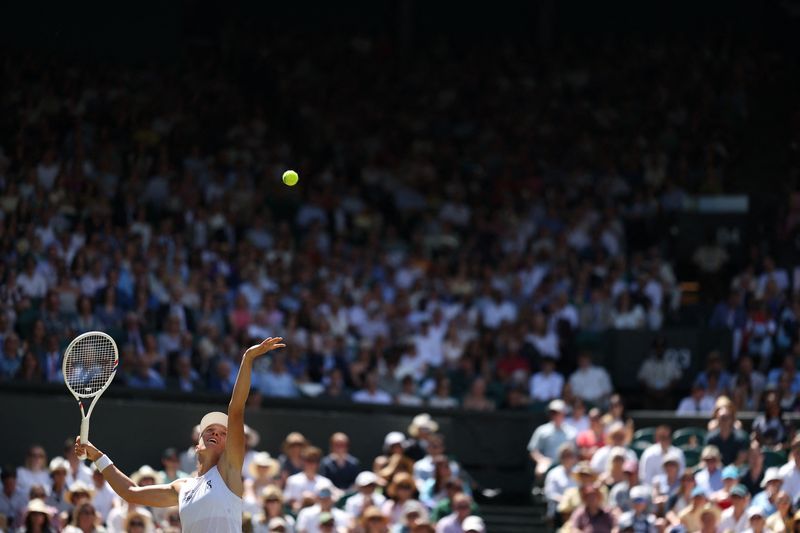
Defending champion Iga Swiatek's Wimbledon campaign ended in dramatic fashion on Saturday when rising Filipino star Alexandra Eala delivered a masterclass performance on Centre Court, securing a 7-6(9) 6-2 victory in the third round. The upset loss represents a significant stumble for the Polish third seed, who arrived at the All England Club seeking to build on last year's triumph but had struggled with consistency following an early defeat at the Bad Homburg warm-up event.
Swiatek's 2023 title win had finally silenced persistent doubts about her capacity to perform on grass, the sport's fastest and most unforgiving surface. Yet the 25-year-old's path through the early rounds at this year's tournament suggested she remained in search of her best form, despite solid victories over Taylor Townsend and Karolina Pliskova. Against Eala, however, she encountered an opponent operating at peak confidence and struck by inspired shot-making that proved too formidable to overcome in the afternoon sunshine.
The opening set proved a marathon encounter that exemplified the competitive intensity of the clash. Swiatek's customary composure momentarily wavered as she smiled at the end of the set, but her frustration soon manifested itself through vocal exchanges with her coaching team and a racket slam on her chair. Eala, meanwhile, fed off the crowd's energy and soaked in the Centre Court atmosphere, her powerful baseline game establishing early dominance that rattled her opponent from the outset.
For Eala, the moment transcended mere tennis achievement. The teenager's emotional address to the crowd revealed the profound personal significance of competing on sport's most hallowed court, where she had dreamed of playing since childhood. She spoke candidly of training with her grandfather and brother after school in the Philippines, describing the journey from wearing ruffled socks and light-up shoes to standing on Centre Court as an accomplishment that represented everything to her. Her humility was striking, acknowledging that while the achievement might appear modest to multiple Grand Slam champions like Serena or Venus Williams, for someone from the Philippines it constituted something transformative.
Eala's emotional vulnerability, however, masked a steely competitive resolve. She explicitly rejected the notion of satisfaction, immediately pivoting to focus on her fourth-round assignment against Jasmine Paolini, the 2024 Australian Open runner-up. This mental toughness—the ability to process a historic victory while maintaining forward momentum—suggested a maturity beyond her years and hinted at a career trajectory that could produce significant results in coming seasons.
The second set witnessed Eala's tactical dominance intensify. Her left-handed stroke production, particularly her aggressive baseline shot-making, created constant pressure that Swiatek struggled to neutralize. Eala secured a double break to establish a commanding 3-0 lead, seemingly cruising toward victory. Yet Swiatek demonstrated champion's mettle by retrieving one break and mounting a late challenge, briefly suggesting a potential comeback. The moment proved short-lived, however, as Eala maintained her composure and delivered a decisive forehand winner that secured her passage to the second week.
This victory gains additional resonance when considered against the historical context of tennis in Southeast Asia. The Philippines has produced accomplished players, but breakthrough performances at Grand Slams—particularly major tournament victories over seeded championship-holders—remain relatively rare. Eala's achievement thus carries significance extending beyond individual sporting accomplishment, potentially inspiring greater tennis participation and investment throughout the region and demonstrating that Southeast Asian players can compete at the highest levels of professional tennis.
The dynamic between Eala and Swiatek also reflects shifting generational patterns in elite tennis. Swiatek represents the established order—a multiple Grand Slam champion comfortable with championship expectations and title defence responsibilities. Eala embodies the emerging challenger, motivated by the rarity of opportunity and energized by the underdog narrative. Their previous meeting at Miami, won by Eala, had been followed by Swiatek's revenge victory on the clay courts of Madrid. Saturday's grass court encounter suggested that the Filipino player has evolved sufficiently to trouble even accomplished rivals across varying surfaces.
For Malaysian and Southeast Asian tennis enthusiasts, Eala's progress carries particular interest. The region has invested increasingly in tennis development, and the emergence of competitors capable of defeating world-ranked players at Grand Slams validates these efforts. Her fourth-round meeting with Paolini presents another opportunity to demonstrate that the upset victory was not a solitary flash of brilliance but rather evidence of genuine advancement in player quality and capability.
Swiatek's early exit at Wimbledon underscores the unpredictability that characterizes Grand Slam tournaments, where confidence fluctuations and surface-specific challenges can derail even the most decorated performers. Her absence from the tournament's latter stages also creates opportunities for lesser-seeded players like Eala to progress deeper into competition, potentially reshaping the title narrative away from the established elite. For Eala, the challenge now lies in maintaining the mental and physical intensity required to compete across multiple rounds, transforming a stunning upset into a genuine deep-tournament run that would further consolidate her rising status within professional tennis.

