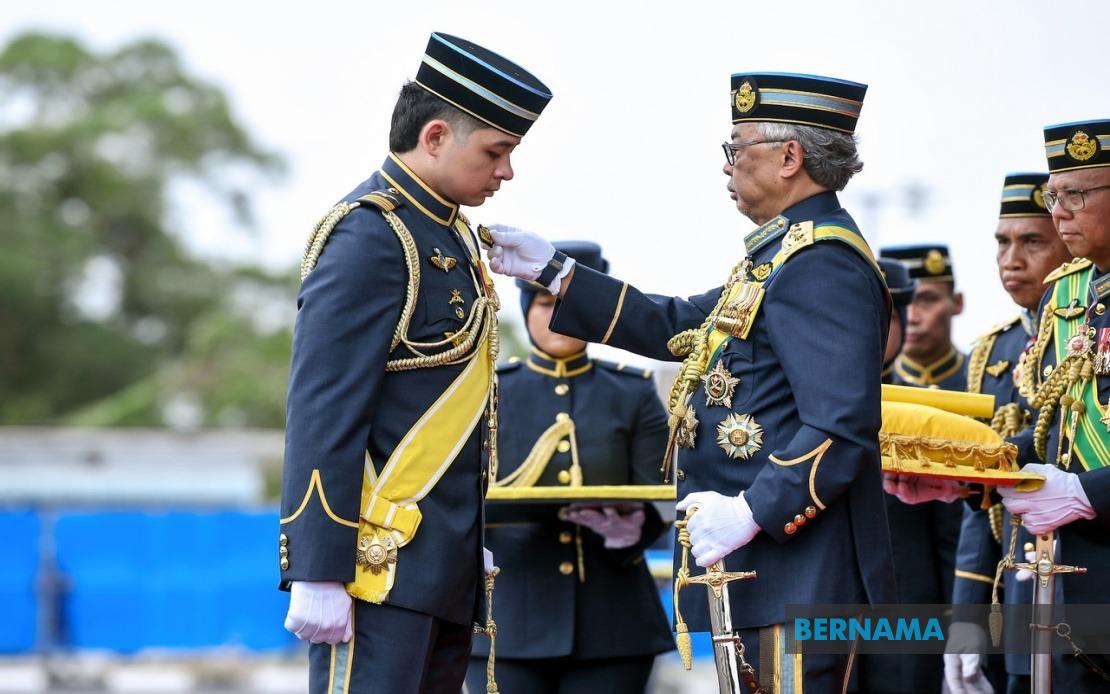
The Tengku Mahkota of Pahang, Tengku Hassanal Ibrahim Alam Shah Ibni Al-Sultan Abdullah Ri'ayatuddin Al-Mustafa Billah Shah, has created a significant milestone within Malaysia's royal institution by becoming the first member of the royal family to successfully complete and qualify from the Royal Malaysian Air Force's Basic Helicopter Flying Course. The historic achievement was marked at the 2026 Flying Wings Presentation Parade held at the RMAF Air College parade ground in Alor Setar, where he received his flying wings conferred by his father, the Sultan of Pahang, Al-Sultan Abdullah Ri'ayatuddin Al-Mustafa Billah Shah, who holds the ceremonial appointment of Colonel-in-Chief of the air force.
The Tengku Mahkota was among forty individuals who completed their aviation training and received official recognition for their accomplishment. Beyond his own achievement, the ceremony honoured thirty-nine graduates from the Malaysian Armed Forces, a cohort comprising thirty-seven newly qualified pilots and two weapons systems officers drawn from all three branches of the armed forces. This diverse representation underscored the air force's broader commitment to developing aviation talent across the military establishment, with graduates advancing through four separate flying training programmes simultaneously.
The Tengku Mahkota undertook the 67(A)/26 Basic Helicopter Flying Course, which spanned from June 2 through July 31 of this year. His training utilised the EC120B Colibri helicopter, a modern training platform widely employed by air forces across Asia-Pacific. During this intensive two-month programme, he demonstrated proficiency across multiple demanding assessment phases, successfully navigating the Basic Handling Test, which evaluates fundamental aircraft control techniques; the Instrument Flying Test, which certifies pilots' ability to operate safely using only cockpit instruments; the Final Navigation Test, which assesses cross-country flight planning and execution; and the Final Handling Test, which represents the cumulative evaluation of practical flying competency. His completion of all assessment phases with distinction reflected sustained effort and technical mastery throughout the course.
The broader ceremony recognised the achievements of graduates completing four distinct training tracks. The 67(A)/26 and 67/25 Basic Helicopter Flying Courses prepared rotary-wing pilots for operational service, whilst the 87/25 Basic Flying Course developed fixed-wing pilots for the air force's diverse mission set. The 01/25 Basic Weapon Systems Officer Course trained personnel in the sophisticated sensors, targeting systems, and tactical functions that modern military aircraft demand. This multi-track approach reflects the air force's structured approach to developing specialists across different aviation disciplines, ensuring a balanced force composition.
Air Force Chief General Tan Sri Muhamad Norazlan Aris addressed the assembled graduates and their families, emphasising that their successful completion resulted from sustained dedication, psychological resilience, and the unwavering discipline cultivated throughout the demanding training environment. He acknowledged the often-overlooked support structure surrounding military aviation training, recognising that parents and family members provide continuous encouragement and emotional sustenance that strengthens trainees during gruelling phases of instruction. The chief's remarks underscored the human dimension frequently absent from formal military announcements, highlighting how family bonds facilitate individual achievement within institutional settings.
Central to General Norazlan's message was the symbolic transition marked by receiving flying wings. He characterised the presentation ceremony not as a conclusion to a challenging journey but rather as an inauguration into a phase of substantially elevated responsibility and institutional trust. This distinction carries weight within military culture, where the award of wings represents admission into a professional fraternity and assumption of duties extending far beyond personal technical competency. Each pilot and systems officer present understood that their newly earned credentials carried implications for operational readiness, crew safety, and national capability.
The general's observation that "the wings worn on the chest carry with them the honour, hopes and trust of the service and the nation" articulated the responsibility dimension inherent in military aviation roles. This phrasing resonates particularly within the Malaysian context, where military institutions function as custodians of national security and symbols of national identity. The emphasis on collective trust rather than individual achievement reflects institutional values prioritising mission accomplishment and service dedication over personal recognition.
The Tengku Mahkota's participation in this training programme and successful completion carries implications extending beyond the individual achievement. The visible engagement of senior royalty in military aviation training sends institutional signals about the monarchy's commitment to defence modernisation and technological advancement. His willingness to undergo rigorous, standardised training alongside officers from lower ranks demonstrates the principle of meritocratic evaluation, wherein flying competency determines qualification regardless of status. This approach reinforces public confidence in the professionalism and technical standards within the armed forces.
For the broader Malaysian defence establishment, this cohort of forty newly qualified aviators represents concrete capability enhancement. The rotation of trained pilots and systems officers through the pipeline maintains operational strength and ensures continuity as experienced personnel progress to advanced roles or retire. The recognition ceremony itself, conducted with formal protocols and senior-level attendance, underscores the military's institutional importance within Malaysia's governance structure and its priority allocation of resources and attention.
The event also highlighted the RMAF Air College's role as a regional training centre of distinction. The institution's capacity to deliver standardised, internationally recognised aviation instruction maintains the Royal Malaysian Air Force's professional standards whilst supporting regional stability. As South-East Asia experiences expanding commercial aviation activity and evolving security challenges, the continued excellence of dedicated military training facilities contributes to overall regional aviation safety and security preparedness.
Looking forward, this graduating cohort enters an operational environment characterised by sophisticated aircraft systems, complex airspace management, and evolving security requirements across the South-China Sea and surrounding regions. Their training under demanding standards positions them to contribute effectively to the air force's missions encompassing territorial air defence, maritime patrol, disaster response, and humanitarian assistance operations. The emphasis on discipline, mental resilience, and technical proficiency during training prepares them for the multifaceted challenges inherent in modern military aviation.

