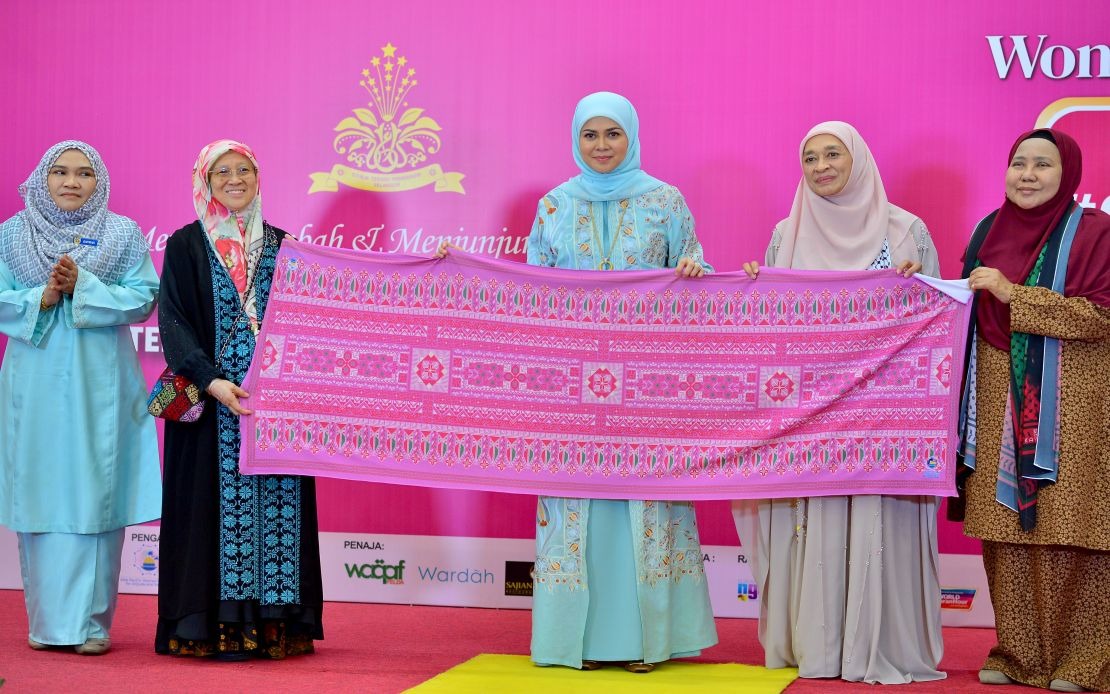
Tengku Permaisuri Norashikin of Selangor presided over the opening of the Women Summit & Women #QuranHour 2026 on June 24 at the Dahlia Auditorium within Sultan Salahuddin Abdul Aziz Shah Mosque in Shah Alam. The royal occasion underscored the significance of a programme designed to equip women with spiritual fortitude and character development rooted in Islamic teachings, drawing participation from some 400 women representing Selangor, Singapore, Indonesia and other nations across the Asia-Pacific region.
The initiative emerged from a partnership between Yayasan Warisan Ummah Ikhlas (WUIF) and the Asia Pacific Women's Coalition for Al-Quds and Palestine (ApWCQP), two organisations committed to advancing women's empowerment through religious education and community engagement. Upon her arrival at 9.30am, the Tengku Permaisuri was received by WUIF chief executive officer Marhaini Yusoff and ApWCQP president Dr Fauziah Mohd Hasan, setting the tone for what organisers envisioned as a landmark gathering for women's spiritual development across the region.
Centred on the thematic banner "Women of Grit", the programme drew deliberate inspiration from the experiences of Palestinian women, particularly those enduring the humanitarian crisis in Gaza. This conceptual framework was not merely symbolic; it reflected a broader intention to explore how faith and Quranic principles sustain women through profound adversity, encompassing loss, displacement, family fragmentation and the determination to preserve education and cultural continuity in circumstances of severe hardship. By anchoring the summit's philosophy in these lived realities, organisers sought to move beyond abstract spirituality toward practical applications of Islamic guidance.
The summit brought together recognised voices in Islamic scholarship and psychology to address the multifaceted dimensions of women's resilience. Among those present were 2014 International Quran Recitation Champion Tirmizi Ali, whose expertise in Quranic recitation and memorisation offered technical and spiritual insights, alongside Associate Professor Dr Nora Mat Zin from the International Islamic University Malaysia's Department of Psychiatry, whose presence bridged psychological science with religious teaching. This interdisciplinary approach reflected a growing recognition that addressing women's mental health and emotional wellbeing requires integration of both modern psychological frameworks and traditional Islamic wisdom.
According to Gharizah Hashim, director of the Women Summit & Women #QuranHour 2026, the programme targets a nuanced understanding of female strength that extends well beyond conventional notions of resilience. She articulated that "Women of Grit" encompasses not only the capacity to endure hardship but also the cultivation of inner tranquility, the development of discernment in decision-making, and the ability to navigate life's complexities with Quranic guidance as a compass. This holistic vision seeks to produce women capable of recovering from trials, functioning as stabilising forces within their families, and contributing meaningfully to both their immediate communities and the broader Islamic ummah.
Marhaini Yusoff, WUIF's chief executive, outlined an ambitious expansion strategy that would decentralise the summit's impact through the Rumah Ngaji network, a grassroots initiative providing free Quranic education classes sustained by local community sponsorships. This scaling mechanism represents a deliberate shift from a one-off metropolitan event toward an institutionalised, nationwide movement capable of reaching women across Malaysia's diverse states and urban-rural landscapes. By embedding the programme within community-based learning circles, organisers aim to ensure sustained engagement and cultural integration at the state level rather than relying on singular, centralised activities.
The presence of Rumah Ngaji representatives from multiple states at the Shah Alam gathering symbolised the beginning of what proponents envision as a structured, long-term initiative to systematically enhance women's understanding and application of Quranic principles. This structural approach acknowledges that sustainable empowerment requires institutional scaffolding and consistent reinforcement rather than episodic interventions. The emphasis on state-level implementation also reflects sensitivity to Malaysia's federal architecture and the varying needs of women across different economic, social and cultural contexts within the nation.
For Malaysian readers and policymakers, this summit holds particular relevance in the broader discourse surrounding women's agency, mental health and community cohesion. The programme's explicit linking of spiritual resilience to psychological wellbeing addresses a gap in how Malaysian society often treats religious education and mental health support as separate domains. By integrating Quranic teachings with contemporary understandings of emotional resilience and decision-making, the initiative models an approach that appeals to both traditionally-minded communities and those seeking contemporary relevance in religious practice.
The regional dimensions of the summit also merit attention. The attendance of women from Singapore and Indonesia indicates growing cross-border networks focused on Islamic women's empowerment within Southeast Asia. As the region grapples with diverse social challenges ranging from economic inequality to migration and family fragmentation, such collaborative platforms facilitate knowledge-sharing and mutual learning among women navigating shared regional contexts. This transnational dimension suggests that women's spiritual and intellectual development is increasingly conceptualised as a collective regional endeavour rather than isolated national initiatives.
Moving forward, the expansion of Women #QuranHour 2026 through Rumah Ngaji networks will test whether grassroots community structures can effectively sustain engagement with Quranic education over extended periods. Success will depend on consistent local sponsorship, volunteer commitment and the development of contextualised curricula that address the specific challenges women face in different Malaysian communities. The programme's early momentum, evidenced by royal patronage and significant initial participation, suggests serious institutional backing, but translating this enthusiasm into durable, decentralised networks will require sustained effort and resources beyond the inaugural summit.
Ultimately, the Women Summit & Women #QuranHour 2026 reflects a broader regional trend toward positioning women's spiritual and psychological development as essential components of societal stability and progress. Rather than viewing religious education as peripheral to contemporary governance or social policy, this initiative asserts that systematic engagement with faith-based resilience-building constitutes a legitimate and valuable response to the complex pressures women navigate in modern Southeast Asia. As the programme scales to state and community levels, it will offer instructive lessons for other faith-based and secular organisations seeking to empower women through integrated approaches combining spiritual, psychological and social dimensions.

