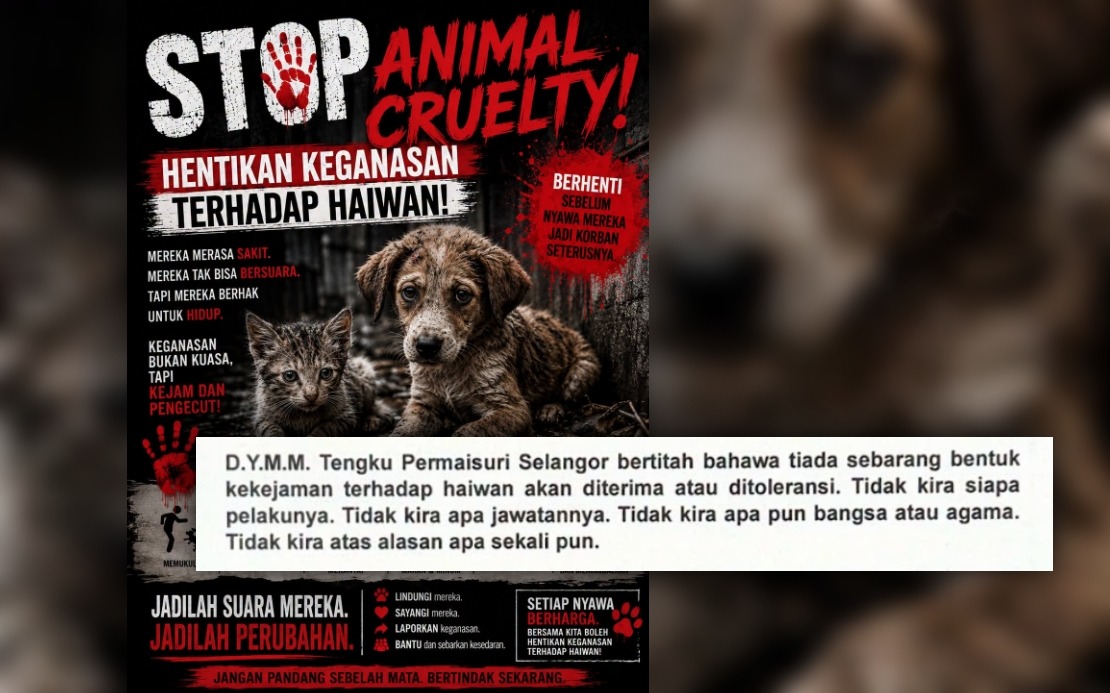
Tengku Permaisuri Norashikin of Selangor has publicly condemned the rising tide of animal cruelty affecting pets and strays, particularly dogs and cats, which has ignited considerable debate across social media platforms. Speaking from Istana Alam Shah, the royal patron articulated her position with particular emphasis on the broader societal implications of such acts, moving beyond simple legal violations to question what these incidents reveal about collective moral standards.
The Tengku Permaisuri has directed a formal request to the federal government to undertake a comprehensive review of the Animal Welfare Act 2015, signalling that existing statutory provisions require substantial reinforcement. This intervention from the palace underscores the political weight behind animal welfare discourse in Malaysia, where royal patronage frequently translates into meaningful policy consideration at federal and state levels. The proposal extends beyond mere penalty enhancement, encompassing broader enforcement mechanisms that currently exhibit inconsistency across different jurisdictions and enforcement bodies.
As Royal Patron of the Stray Free Selangor initiative, Tengku Permaisuri Norashikin has positioned animal protection within a comprehensive framework linking legal accountability to fundamental human values. Her statement emphasises that cruelty toward animals transcends legal categories; rather, it represents a failure to maintain compassion—a virtue she identifies as foundational to civilised society. This framing transforms what might otherwise remain a specialist animal welfare issue into a matter touching upon the nation's character and moral compass.
The palace declaration explicitly removes any possibility of exemption or mitigation based on perpetrator status. Whether offenders are private individuals, corporate entities, local authorities, or government enforcement personnel themselves, the royal position holds that all must face investigation and appropriate legal consequences. This universalist stance carries particular significance given occasional controversies involving enforcement agencies in animal-related incidents, effectively placing accountability expectations on state institutions themselves.
Tengku Permaisuri Norashikin has emphasised that public trust in enforcement institutions depends fundamentally on professional conduct characterised by integrity and compassion rather than unnecessary force. This stipulation carries implicit criticism of enforcement approaches that may inflict suffering in the process of apprehension or management, signalling that methodology matters equally as outcomes. For Malaysian enforcement agencies already navigating heightened public scrutiny, this royal guidance effectively establishes new performance standards linking procedural legitimacy to animal welfare considerations.
Among the substantive proposals forwarded by the palace, fostering community-wide compassion toward all animals represents a foundational objective. The recommendation encompasses humane rescue protocols, appropriate treatment frameworks, and comprehensive animal protection systems operating through cooperation between government agencies, local authorities, animal welfare organisations, and civil society. This collaborative architecture recognises that animal welfare cannot be achieved through regulatory instruments alone but requires sustained engagement across institutional and community boundaries.
The Tengku Permaisuri has stressed the necessity of embedding animal welfare considerations into policy formulation itself, ensuring that compassion forms the operational foundation for every decision touching animal management. This integration approach suggests that welfare protections should not remain peripheral additions to administrative processes but rather constitute central organising principles. Her emphasis on public recognition that individual acts of kindness toward animals accumulate into meaningful protection frameworks appeals to widespread but often dormant sentiments about human responsibility toward vulnerable creatures.
Educational interventions figure prominently within the royal recommendations, with particular emphasis on cultivating compassion toward animals from childhood through formal education, public awareness campaigns, and community mobilisation. This developmental approach recognises that patterns of animal treatment often reflect established cultural and social conditioning, suggesting that generational shift requires deliberate cultivation of different attitudes. The proposal implicitly critiques current educational frameworks for insufficient attention to animal welfare as an element of character formation.
The palace has advanced "Compassion. Care. Community" as an aspirational framework encompassing shared values essential for building Selangor as an exemplary society. This tripartite formulation connects abstract compassion to concrete care practices while rooting both within community contexts where implementation occurs. The construction positions animal welfare as inseparable from broader objectives of developing a responsible, caring, and civilised polity.
Tengku Permaisuri Norashikin has articulated a philosophical argument linking societal capacity for animal compassion to broader human flourishing. Her statement asserts that communities failing to extend compassion toward vulnerable creatures will ultimately erode compassion among human populations themselves, suggesting a progression from animal cruelty toward human indifference. This causal logic frames animal welfare not as separable from human interests but as foundational to maintaining social cohesion and ethical standards.
The royal position explicitly rejects interpretations framing compassion as indicative of weakness, instead asserting that societal capacity to protect the most defenceless populations represents a genuine measure of strength, maturity, and civilisation. This recalibration challenges alternative frameworks that might emphasise utility, hierarchy, or human prioritisation, instead positioning vulnerability-protection as the authentic marker of advanced societies. For Malaysia's positioning within regional and global dialogues about development standards, this royal articulation carries significance beyond immediate animal welfare concerns.
Tengku Permaisuri Norashikin has appealed to all stakeholders to extract lessons from recent cruelty incidents and commit to cooperative efforts ensuring Selangor maintains standards of humanity, justice, and responsibility toward all creatures. Her invocation of divine creation language—referencing "Allah's creations"—situates animal welfare within religious ethical frameworks, potentially broadening constituency support beyond secular animal rights advocates toward religiously motivated populations. This rhetorical approach recognises Malaysia's Islamic context while maintaining universalist welfare principles.

