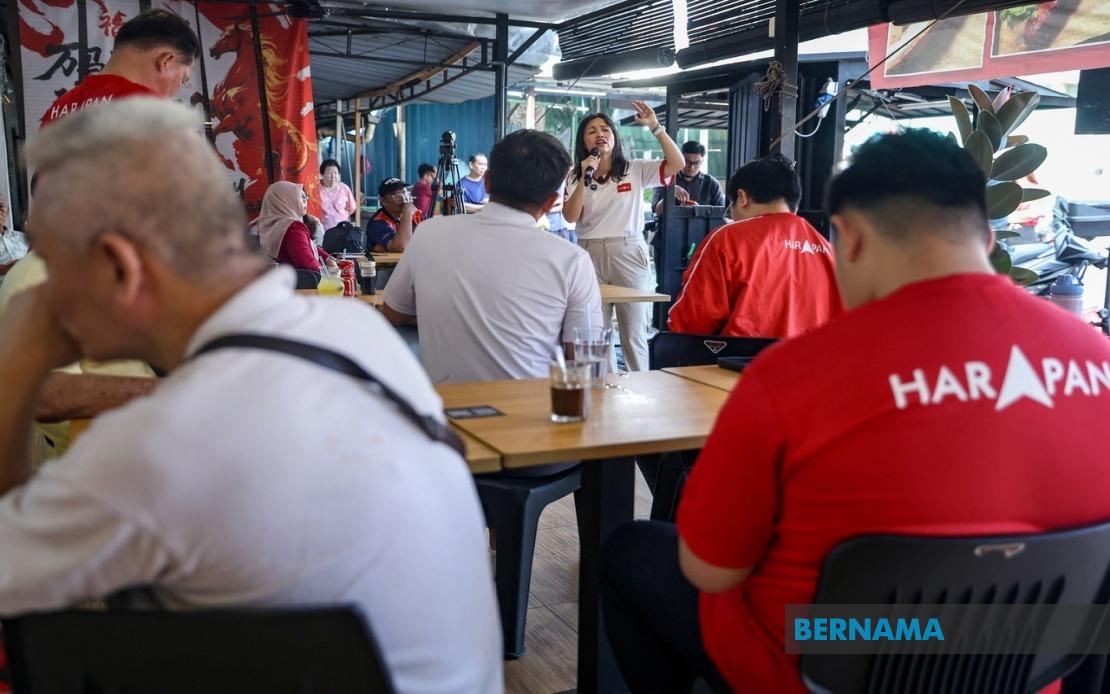
The intersection of government programming and political campaigning has become a flashpoint in the Johor state election, with the Democratic Action Party questioning whether a technical education event was improperly exploited for partisan purposes. Johor DAP chairman Teo Nie Ching has demanded that Menteri Besar Datuk Onn Hafiz Ghazi provide clarity regarding claims that students attending the Johor MARA TVET Roadshow at the Inland Revenue Board Hall in Kluang on July 4 were later subjected to campaign messaging for the Barisan Nasional candidate.
The controversy hinges on how the event was conducted and what took place within its confines. According to Teo's account, based on grievances lodged by both parents and students, attendees were initially informed that their presence was mandatory—with the implicit threat that absence would be recorded as non-attendance that could affect their academic standing. However, allegations suggest that the government programme subsequently transformed into a platform for political mobilisation, with Onn Hafiz purportedly urging students to vote for specific Barisan Nasional candidates by explicitly referencing candidate numbers. This blurring of institutional and partisan purposes raises fundamental questions about the appropriate use of state resources and venues during election periods.
Teo, who holds the additional portfolio of Deputy Communications Minister, articulated her concerns with precision, distinguishing between Onn Hafiz's attendance at a government function—which she characterised as unremarkable—and the alleged weaponisation of that occasion for electoral advantage. She stressed that if the Johor MARA TVET Roadshow was genuinely a government initiative designed to advance vocational education, it should have remained insulated from party political activities. Conversely, if the event was fundamentally a Barisan Nasional gathering, she questioned the propriety of utilising a facility owned by a federal government agency to conduct partisan political canvassing. This distinction reflects broader concerns about institutional impartiality during electoral contests.
The DAP has marshalled documentary evidence to substantiate its claims. Teo indicated that the party possesses multiple materials including the official programme schedule, correspondence mandating student attendance, and video recordings that allegedly capture campaign-related rhetoric from the event. The availability of such documentation suggests a deliberate effort to compile a factual record rather than simply voice suspicions. The specificity of these evidentiary claims places additional pressure on state government officials to respond substantively rather than dismissively.
Teo framed the matter not merely as a political dispute but as a question of appropriate conduct toward young people. She invoked a maternal perspective, asking audiences to consider how they would react if their own children were compelled to attend what appeared to be an educational programme, only to discover they had been positioned as an audience for political recruitment. This humanising dimension resonates particularly in Malaysian culture, where parental concern and child welfare command significant social weight and can influence voter sentiment beyond purely ideological considerations.
Regarding next steps, Teo indicated that Pakatan Harapan candidates would evaluate whether to escalate the matter through formal channels. The Election Commission represents a potential avenue for lodging official complaints, though such bodies typically operate within defined parameters and may face constraints in investigating allegations that emerge late in an electoral cycle. The decision to pursue formal complaints reflects calculation about whether such mechanisms can deliver meaningful accountability before voters cast their ballots on July 11.
Teo also broadened her critique to encompass Onn Hafiz's recent commentary on federal policies. The Menteri Besar has called for review of several national government initiatives, arguing they impose undue hardship on constituents. Teo countered that such selectivity—celebrating state government success while blaming federal authorities or opposition parties for unpopular measures—represents intellectual dishonesty. She reminded audiences that major policy decisions undergo Cabinet approval processes that transcend partisan control, meaning responsibility cannot be unilaterally shifted between governmental levels according to political convenience.
Lim Kit Siang, the veteran Pakatan Harapan figure whose presence at the Kulai forum underscored the significance of the gathering, took the occasion to advance a broader electoral message. He urged Johor voters to reject what he characterised as racial politics, instead consolidating support for what he termed the Malaysian Dream—a vision rooted in principles of equality, liberty, economic opportunity, and fundamental rights protections. Lim acknowledged that constructing such a united national project requires sustained effort and cannot materialise instantaneously, but called upon voters to concentrate rather than fragment their electoral choices to advance this longer-term aspiration.
The Johor state election encompasses 56 seats contested by 172 candidates across a competitive political landscape. Early voting proceedings took place on July 7, with main polling scheduled for July 11, meaning the TVET event allegations emerged at a critical juncture when voter preferences may still be forming. The timing of these revelations, occurring just days before citizens cast their ballots, amplifies their potential electoral significance and may influence perceptions about institutional impartiality and the conduct of state government.
For Malaysian observers and Southeast Asian watchers, the incident illuminates enduring tensions in developing democracies regarding the boundary between governmental legitimacy and partisan advantage. Educational institutions and their facilities occupy special status in public consciousness—they serve young people whose civic formation remains incomplete and whose vulnerability to coercion or social pressure is recognised. The alleged instrumentalisation of a TVET roadshow thus strikes at assumptions about institutional neutrality that underpin public confidence in state structures. Whether such allegations prove substantiated or represent political exaggeration, their emergence and circulation during an active electoral campaign reflect broader anxieties about maintaining institutional integrity amid intense partisan competition. The response from state authorities and the eventual voter judgment will signal whether such boundaries retain meaningful force in Malaysian politics.

