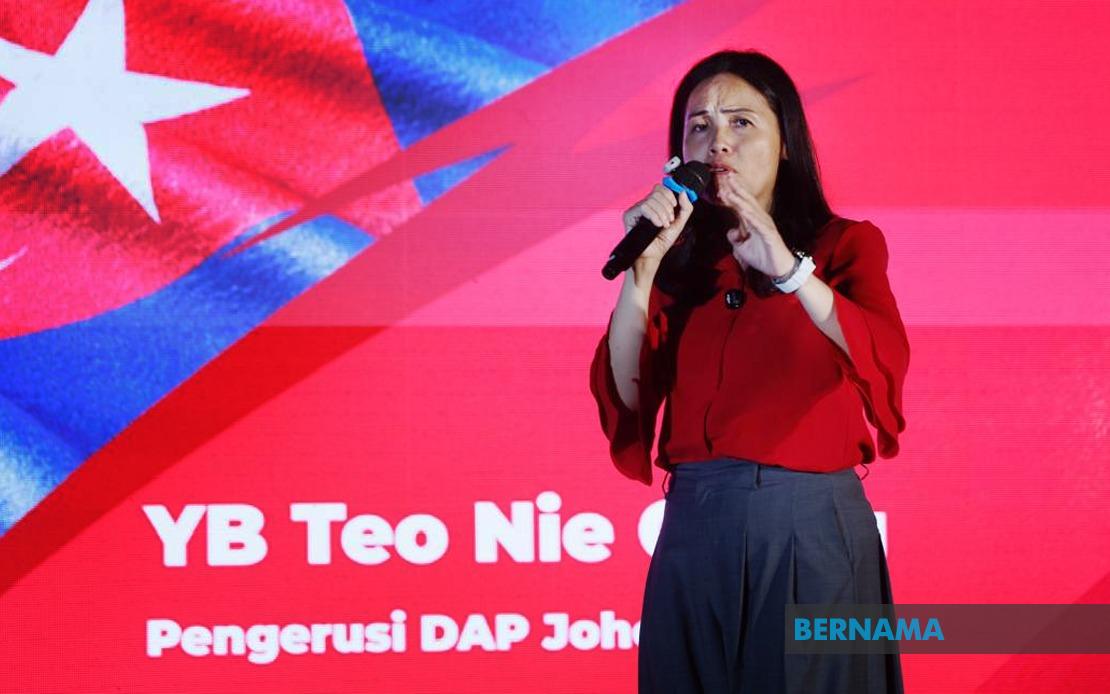
Johor DAP chairman Teo Nie Ching has intensified scrutiny of the state government's recently approved mechanism allowing the appointment of up to five state assemblymen, raising pointed questions about the true intentions behind such a departure from electoral democracy. Speaking at a Pakatan Harapan campaign rally in Paloh on Monday evening, Teo—who also serves as National DAP Wanita chairman and Deputy Communications Minister—cast doubt on the justification offered for the new provision, which the Johor State Legislative Assembly passed in May.
At the heart of Teo's critique lies a fundamental democratic concern: appointed representatives would bypass the electoral process entirely, never facing the scrutiny or mandate of voters. This mechanism, she argued, creates an opaque pathway to legislative representation that potentially weakens public accountability. Teo pressed the state administration to articulate a transparent rationale for the appointments and explain how such positions serve the public interest, warning that public confidence erodes when such significant structural changes lack clear justification.
The political context sharpening Teo's questioning centres on Johor's recent electoral dynamics. The state government received substantial support from PAS, the Islamic party, in the previous election cycle. Teo's rhetorical challenge to identify precisely whom the state intends to appoint—and whether these seats might reward political allies or accommodate defeated candidates—reflects broader coalition tensions. The question implicitly asks whether the appointed seats represent an extraconstitutional accommodation of power-sharing arrangements rather than a genuine institutional enhancement.
Despite her sharp criticism of the appointed assemblymen provision, Teo mounted a parallel defence of the federal Unity Government's broader agenda, particularly regarding education and welfare reforms initiated since the MADANI administration took office. She acknowledged frankly that the government falls short of perfection, characterising the current leadership's work as a long-term process rather than a completed project. This framing allows space for incremental progress while accepting legitimate critique of unfinished transformation.
Teo highlighted concrete educational achievements that speak directly to Malaysian constituencies historically underserved by previous administrations. The guaranteed placement of all SPM students achieving ten A grades into matriculation programmes represents a significant expansion of meritocratic access, removing financial and background barriers that previously constrained pathways to tertiary education. This policy reversal signals a philosophical shift toward broader educational inclusion, addressing longstanding grievances about unequal access to elite secondary institutions.
Expanded recognition of the Unified Examination Certificate (UEC) credentials marks another institutional reform with particular resonance for Chinese-medium education communities. Rather than treating UEC qualifications as alternative credentials of lesser standing, the Unity Government has moved toward substantive parity in university admissions, tackling a perennial point of contention within Malaysian society. Simultaneously, the government substantially increased funding for Chinese independent schools to RM20.16 million in the current fiscal year—a 68 percent increase from the RM12 million allocated in 2019—demonstrating tangible budgetary commitment to educational diversity.
These education policy reorientations represent systemic shifts rather than superficial gestures. By directing resources toward historically marginalised educational pathways and expanding access based on demonstrated academic achievement rather than administrative convenience, the Unity Government has moved beyond symbolic commitment toward substantive institutional change. Teo's emphasis on education emerged from her campaign platform at Paloh, a constituency where diverse linguistic and educational communities make such policies directly consequential for households and families.
The timing of Teo's remarks coincided with the final campaign stretch before the July 13 Johor state election, when 2.7 million voters would cast ballots to select 56 state representatives. The election represented the third major electoral contest under the Unity Government arrangement, providing voters an opportunity to assess whether the promised systematic reforms had translated into meaningful improvements in their daily lives. For constituencies like Paloh, where diverse communities coexist, education and welfare policies held particular electoral salience.
Teo's dual positioning—simultaneously criticising state-level institutional departures while defending federal reform efforts—reflects the complex negotiation required within coalition politics. She managed to hold the Johor government accountable on democratic transparency while anchoring her campaign message in tangible federal accomplishments. This rhetorical strategy acknowledged that voters reasonably expect both transparency in governance processes and measurable improvements in public services and opportunities.
The appointed assemblymen controversy illuminates broader tensions within Malaysian governance regarding the balance between representative accountability and administrative flexibility. While proponents might argue that appointed members could provide technical expertise or represent marginalised constituencies, Teo's challenge to articulate such rationale publicly reflects democratic expectations for transparent governance. In an era when institutional legitimacy depends partly on public confidence in procedural fairness, unexplained departures from electoral democracy inevitably generate skepticism.
Looking forward to the election and beyond, the appointed assemblymen mechanism remains likely to generate ongoing political contention. Opposition parties will scrutinise appointments closely, examining whether they reflect meritocratic or politically instrumental criteria. The inaugural cohort of appointees will face particular scrutiny regarding their backgrounds, qualifications, and whether their selection appears to reward coalition partners or accommodate electoral losers. This transparency challenge extends beyond Johor to the broader relationship between the Unity Government and public expectations for democratic integrity.
Teo's intervention demonstrates how state-level governance decisions feed into national political narratives. The Johor appointments, initially framed as technical administrative measures, became campaign fodder precisely because they raised substantive questions about democratic process. Her simultaneous defence of federal reforms suggests that while skepticism of particular institutional changes is warranted, the broader trajectory of governance reform deserves continued public engagement. The voter response in the July 13 election would provide insight into whether such governance debates resonate with electoral concerns or remain primarily elite-level political discourse.

