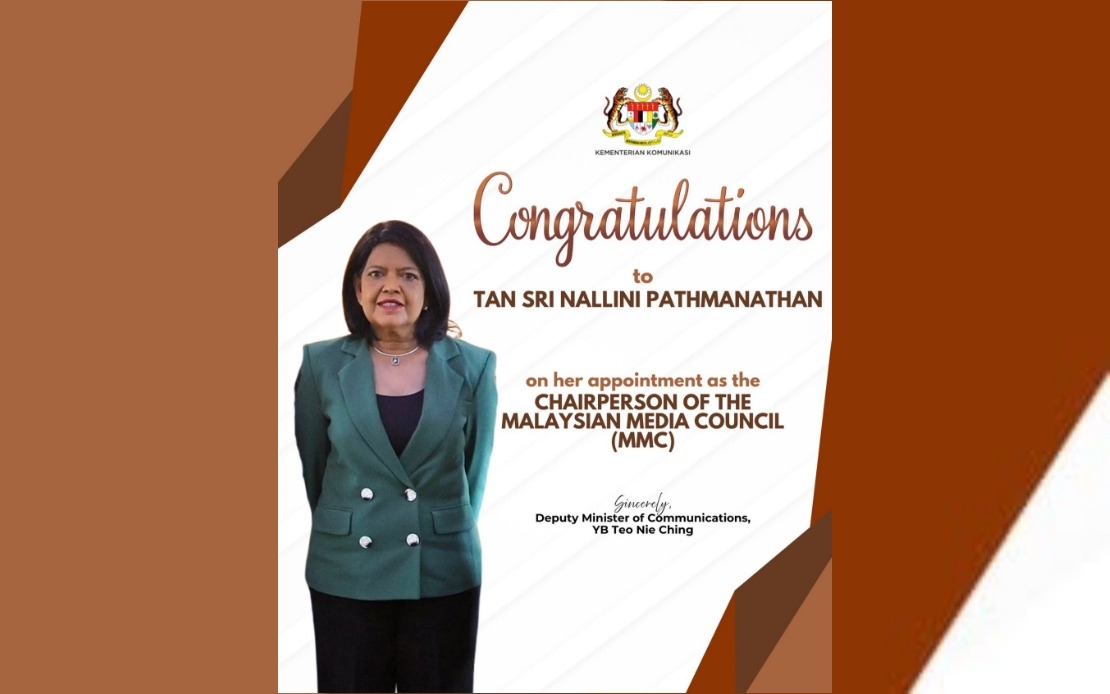
The Malaysian Media Council has appointed former Federal Court judge Tan Sri Nallini Pathmanathan as its inaugural chairperson, a development that has drawn strong endorsement from Deputy Communications Minister Teo Nie Ching. Teo's public support underscores the significance of the selection, emphasising Nallini's judicial credentials particularly in matters touching on media freedom and constitutional interpretation. The appointment was unanimously endorsed by the MMC Board at a meeting held on May 26, formally establishing leadership for the self-regulatory body created under the Malaysian Media Council Act 2025.
Teo's backing of Nallini rests substantially on the former judge's demonstrated commitment to protective jurisprudence around press freedoms during her time on the bench. In her Facebook post, Teo highlighted several judgments that she views as evidence of Nallini's progressive constitutional thinking. These decisions reveal a pattern of judicial reasoning that favours interpretations broadening rather than restricting fundamental rights, a quality Teo suggests will shape the council's direction.
Among the cases Teo cited was a contentious 4-3 split decision concerning Malaysian citizenship for children born out of wedlock to Malaysian fathers and foreign mothers. In this narrow ruling, Nallini authored a dissenting judgment that advocated for a purposive and compassionate reading of citizenship provisions in the Federal Constitution. Rather than adhering to a strict textual approach, her dissent pushed for an interpretation that recognised the human dimensions of constitutional law, an approach that Teo characterises as reflecting both legal foresight and humanitarian sensibility.
Equally significant in Teo's assessment is Nallini's dissenting judgment in a landmark case involving an online news portal. In that instance, Nallini ruled that the portal should not bear legal responsibility for comments posted by subscribers on its platform. This decision carries considerable weight in discussions about digital media regulation and the boundaries of publisher liability in an age of user-generated content. For Teo, such reasoning demonstrates that Nallini understands the structural challenges facing modern media operations and is disposed toward interpretations that do not unduly burden journalistic enterprises.
The establishment of the Malaysian Media Council itself represents a significant institutional development for the country's media landscape. Teo noted that the council's creation in 2025 culminates nearly five decades of sustained advocacy, formal petitions, and policy discussions among industry stakeholders. The lengthy timeline underscores how contentious and complex the path to self-regulation has been in Malaysia, requiring patient negotiation between government, media organisations, and civil society to build consensus around an appropriate regulatory framework.
Crucially, the council's design as a self-regulatory rather than state-controlled body reflects fundamental principles about media independence that Teo articulated in her statement. She emphasised that journalists occupy a distinctive position in democratic systems as the so-called fourth estate, a characterisation that grants them special standing but also distinctive vulnerabilities. Any regulatory framework perceived as emanating from state machinery, Teo argued, would inevitably be interpreted as an infringement on press autonomy, regardless of the government's actual intentions.
For Teo and other proponents of self-regulation, the council's independence from direct governmental control is precisely what makes it acceptable and effective. State intervention in media matters, however well-intentioned, carries inherent risks of political capture and the instrumentalisation of regulatory powers to suppress unfavourable coverage. By contrast, self-regulatory bodies allow the industry to establish professional standards and enforce ethical codes through mechanisms perceived as legitimate and insulated from partisan influence.
The appointment of Nallini to lead this new institution carries symbolic as well as practical weight. Her judicial background lends credibility to the council's claim of independence and expertise, particularly given her demonstrated judicial philosophy around fundamental rights. Her presence at the helm signals to both international observers and domestic stakeholders that the council will operate according to principled legal reasoning rather than informal or political considerations.
For Malaysian media practitioners, the council's launch under Nallini's leadership represents an opportunity to establish industry-wide standards and mechanisms for accountability without ceding control to external regulators. This model has precedents in other democracies where press councils operate as self-regulatory bodies, investigating complaints, issuing sanctions, and issuing guidance without statutory enforcement powers. The effectiveness of such bodies depends heavily on industry buy-in and the personal credibility of leadership figures, dimensions where Nallini's appointment may prove advantageous.
Regionally, Malaysia's establishment of a media council contributes to a broader conversation about how democracies can balance media freedom with accountability. Neighbouring countries and international media freedom advocates will be watching to assess whether the council functions as a genuine safeguard for editorial independence or becomes a tool for constraining critical reporting. Nallini's judicial record and Teo's explicit framing of the council as a bulwark against state overreach will be tested against observable outcomes in how the council handles complaints and controversy.
The practical success of the Malaysian Media Council will depend on multiple factors beyond leadership selection. Industry participation rates, the willingness of media organisations to accept council rulings, adequate resourcing, and the council's ability to navigate disputes between press freedom and individual rights protections will all matter substantially. Nallini's intellectual and legal background suggests capability to manage such complexities, but institutional effectiveness requires sustained commitment and stakeholder cooperation.
Teo's public endorsement of Nallini also reflects confidence in the broader self-regulatory framework that parliament has now put in place. By highlighting the judicial pathway that culminated in the council's creation and Nallini's appointment, Teo has situated the development within a trajectory of constitutional and institutional maturation. This narrative positions the council not as a novelty or temporary arrangement but as a considered institutional response to the genuine need for professional media standards.