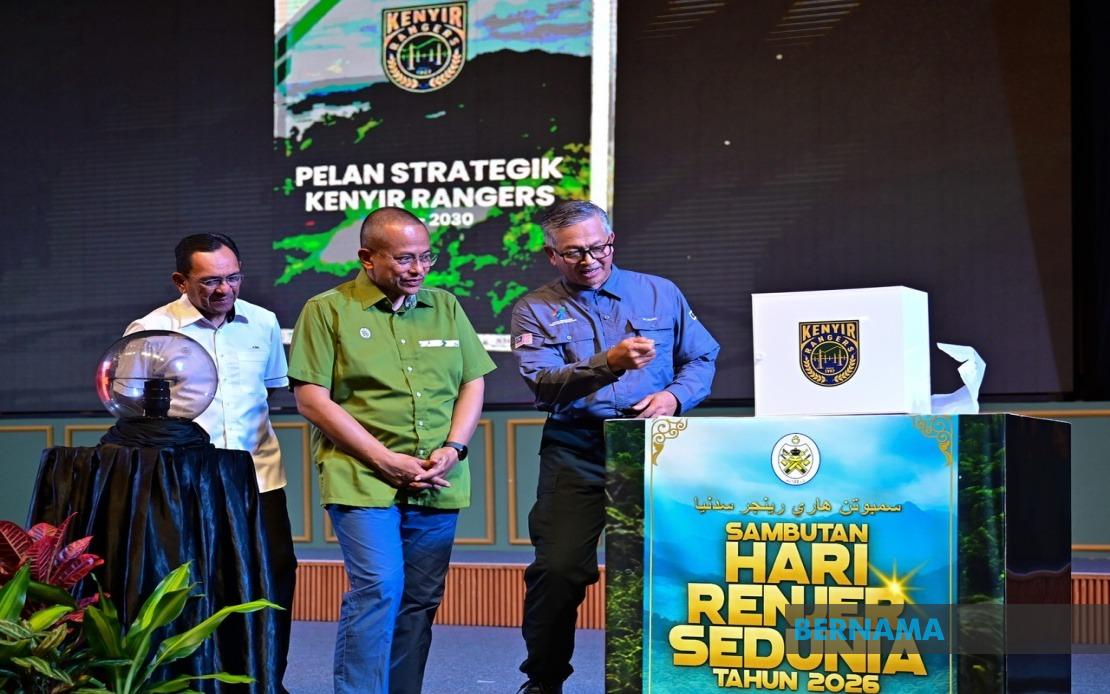
Terengganu Menteri Besar Datuk Seri Dr Ahmad Samsuri Mokhtar has underscored the critical need for coordinated action across multiple government agencies to address the mounting problem of human-wildlife conflicts in the state, particularly incidents involving elephants crossing or colliding with vehicles on major highways and expressways. His remarks came during the state-level commemoration of World Ranger Day 2026 at Wisma Darul Iman in Kuala Terengganu on August 10, signalling that the issue has risen to the highest levels of state administration and demands urgent, multi-stakeholder solutions.
The impetus for this call stems from a devastating collision that occurred on August 5 along the East Coast Expressway 2 (LPT2), where a couple travelling in a Toyota Estima collided with a herd of elephants at Kilometre 274.6, just after the Cheneh Toll Plaza on the stretch heading towards Kuala Terengganu. Both the man and his wife sustained injuries in the incident, a stark reminder of the tangible dangers posed when wildlife and human infrastructure intersect. Such accidents underscore not only the threat to motorists navigating these corridors but also the peril faced by displaced or migrating animal populations forced to traverse increasingly developed landscapes.
Ahmad Samsuri stressed the necessity of enhanced coordination specifically between the Wildlife and National Parks Department and the Malaysian Highway Authority, two entities whose mandates directly overlap in wildlife management and road safety. This institutional collaboration, he suggested, should form the backbone of any comprehensive strategy to mitigate future conflicts. The menteri besar framed the challenge not as a simple jurisdictional matter but as a shared responsibility requiring genuine partnership and resource alignment between organisations that have historically operated in separate spheres.
Among the concrete measures Ahmad Samsuri proposed are intensified patrols at identified conflict hotspots along expressways and the installation of electric fencing adjacent to wildlife habitats and known animal migration corridors. The rationale behind such measures reflects emerging best practices in wildlife management globally: strategic infrastructure improvements combined with consistent monitoring can significantly reduce encounters between humans and megafauna. However, the menteri besar acknowledged the fiscal reality that blanket fencing along the entire length of expressways would prove prohibitively expensive, necessitating a targeted approach that prioritises the most vulnerable sections.
Particular attention should be directed toward the rainy season, Ahmad Samsuri indicated, when animals abandon their habitats in search of shelter and food, increasing the likelihood of highway encounters. Seasonal variations in wildlife behaviour create predictable risk windows that can be anticipated and managed through temporary enhanced patrols and increased awareness campaigns. This temporal dimension of the problem suggests that solutions need not be permanent infrastructure investments alone; strategic deployment of personnel during high-risk periods could prove more cost-effective while still yielding meaningful results.
Technology emerged as a promising frontier in the menteri besar's strategic vision for tackling the conflict. Early warning systems capable of detecting wildlife movements and alerting highway users represent a longer-term investment with potential for significant impact. Such systems, still in exploratory phases across Malaysia, could harness sensors, thermal imaging, or other detection mechanisms to provide real-time alerts to both motorists and highway authorities, allowing drivers to exercise caution or reduce speed in dangerous zones. The integration of such technology with existing highway management infrastructure could create a more intelligent, responsive transportation system.
The framing of the issue by Ahmad Samsuri reveals an understanding that human and animal lives carry equal moral weight in the calculus of risk management. His explicit statement that "both animal and human lives matter" departed from the purely utilitarian approach some might adopt when weighing highway safety against wildlife conservation, suggesting that Terengganu's leadership recognises the interconnectedness of these concerns within an increasingly crowded landscape. The tragedy on LPT2 was characterised not merely as an inconvenience or accident but as a loss deserving of genuine sympathy and reflection.
For Malaysian readers and policymakers across the region, the Terengganu situation illustrates a broader challenge confronting Southeast Asia's rapidly developing economies. As expressways expand and penetrate previously remote areas, encounters between human infrastructure and wildlife habitats become increasingly inevitable. The solutions that emerge in Terengganu may establish templates applicable elsewhere in Malaysia and the region, where similar conflicts plague Peninsular Malaysia, Sabah, and Sarawak. The menteri besar's emphasis on institutional cooperation suggests that fragmented, agency-specific approaches have proven insufficient.
The East Coast Expressway 2 itself represents a crucial economic artery for the region, connecting Kuala Terengganu and surrounding areas to broader national networks. The expressway's continued safety and functionality depend partly on resolving wildlife conflict, making this not merely a conservation or animal welfare concern but an economic and public safety imperative. Disruptions caused by wildlife incidents, accidents, and subsequent investigations create ripple effects across supply chains and commerce in the region.
Looking forward, Ahmad Samsuri's vision suggests a transition from reactive crisis management—responding to incidents after they occur—toward proactive systems that anticipate and prevent conflicts. The invocation of technology, enhanced patrols, and strategic infrastructure reflects an integrated framework that combines traditional resource deployment with modern detection capabilities. However, implementation will require sustained political will, adequate budgeting, and the kind of inter-agency coordination that often proves elusive in practice.
The state government's openness to exploring varied approaches, from electric fencing to technological solutions, indicates flexibility and acknowledgment that no single intervention will solve the problem entirely. This pragmatism, grounded in the harsh realities demonstrated by incidents like the August 5 collision, provides a foundation upon which more detailed policy frameworks can be constructed. The challenge now lies in translating these principles into concrete action plans with clear accountability structures and measurable outcomes.

