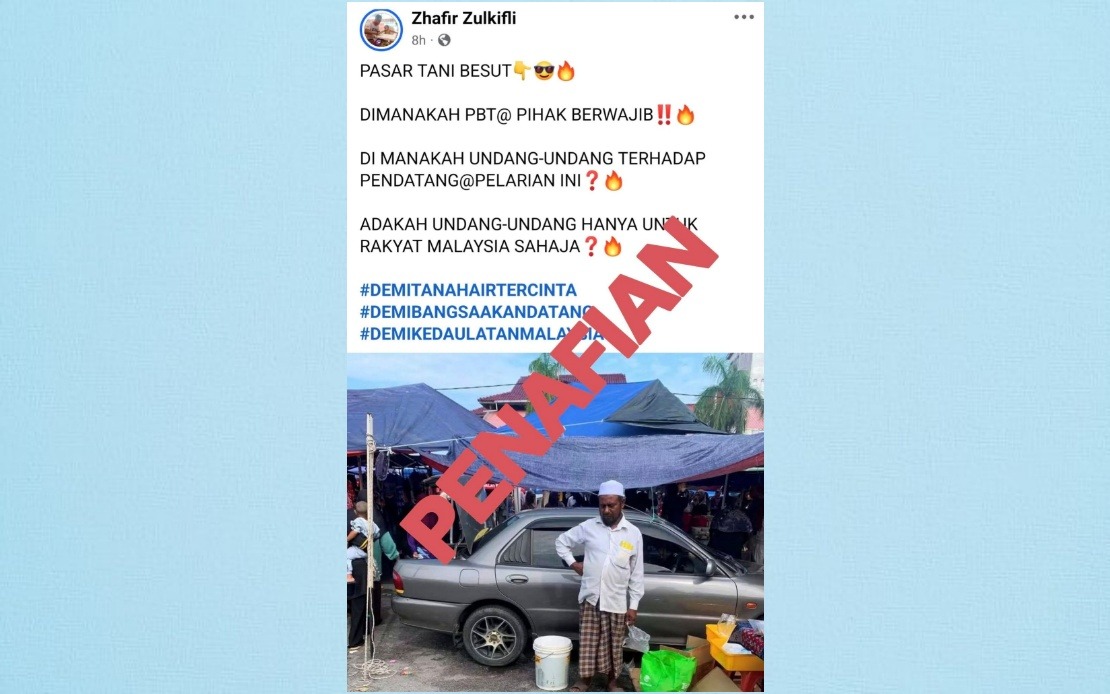
Terengganu's Federal Agricultural Marketing Authority (FAMA) moved swiftly to counter viral social media claims on Friday, denying that non-Malaysian traders had been granted access to farmers' markets operating under its management. The authority's statement came in response to a Facebook post that had gained traction, featuring images of what appeared to be a foreign national selling vegetables at a market in the Besut district, prompting concerns among residents about labour regulations and market oversight.
The specific incident referenced in the controversial social media post actually occurred at the Kuala Besut Morning Market, an establishment that falls outside FAMA's operational purview and management structure. This distinction proved critical to the authority's rebuttal, as it allowed the agency to separate its regulated operations from the broader informal market landscape that exists throughout Terengganu. By clarifying the location, FAMA sought to restore confidence in the governance and compliance standards maintained across its network of supervised trading venues.
Terengganu FAMA's jurisdiction encompasses only two officially designated farmers' markets within the Besut area, both of which operate on fixed schedules with clearly defined vendor criteria. The Jerteh Farmers' Market functions every Thursday morning from 7 am until 1 pm, serving as a regular touchpoint for local agricultural producers and consumers seeking fresh produce. Running parallel to this, the Alor Lintang Farmers' Market operates on Saturday mornings during the same hours, providing an additional weekly opportunity for farmers to sell their goods in a regulated environment.
The authority's response underscores broader questions about market management standards across Terengganu and how municipal authorities coordinate oversight of informal trading spaces. While FAMA operates under a structured framework with specific vendor registration requirements and trading permits, the morning market network exists in a more ambiguous regulatory space. This distinction matters considerably for policymakers attempting to balance market accessibility with labour law compliance and consumer protection standards.
The viral nature of the original post highlights how quickly unverified claims can circulate through Malaysian social media platforms, particularly when they touch upon sensitive issues around foreign workers and economic competition. In recent years, similar concerns have periodically surfaced across Southeast Asia as informal labour movements and cross-border trading have increased. The Besut incident, whether accurately portrayed or not, tapped into existing anxieties about employment displacement and the enforcement of work permit requirements in casual trading sectors.
Terengganu FAMA's clarification also reflects a broader institutional challenge facing Malaysian authorities: the difficulty in maintaining consistent oversight across formal and informal commercial spaces. Farmers' markets and morning trading venues serve as important economic outlets for smallholder producers, particularly in Terengganu where agricultural communities remain economically significant. However, the regulatory fragmentation between FAMA-supervised facilities and independently operated morning markets creates administrative gaps where compliance issues can emerge.
The authority's decision to issue a public statement demonstrates the importance placed on maintaining transparent communication with stakeholders and the general public. By proactively addressing the social media claims rather than allowing speculation to persist, FAMA sought to preserve institutional credibility and reassure vendors registered with its markets. This approach aligns with broader government communications strategies emphasizing rapid response to misinformation on digital platforms.
For traders operating legitimately within FAMA's framework, the clarification provided reassurance that their market access remains protected and that competition would continue to operate under established guidelines. Small-scale farmers and produce vendors depend on stable, predictable market conditions to sustain their livelihoods, and regulatory uncertainty can create operational disruptions. FAMA's intervention aimed to stabilize this environment by drawing clear boundaries around its operational sphere.
The incident also raises practical considerations about how Malaysian authorities should coordinate oversight of informal trading spaces that exist beyond formal regulatory structures. While FAMA can enforce standards within its designated markets, morning markets and casual trading venues operate under different administrative frameworks. This creates potential inconsistency in how labour laws, health standards, and vendor eligibility requirements are applied across similar retail environments within the same locality.
Looking forward, the Besut situation may prompt FAMA and local authorities to evaluate whether additional coordination mechanisms could strengthen oversight across all market types operating in Terengganu. Enhanced communication between FAMA, municipal councils, and labour authorities could help address compliance concerns proactively. Meanwhile, the viral nature of the original post demonstrates the importance of farmers' market issues in public discourse and the heightened attention now paid to who participates in Malaysia's informal trading economy.
The clarification from Terengganu FAMA ultimately serves as a reminder that distinguishing between fact and allegation matters significantly when evaluating claims about regulatory compliance. Market management remains a critical function for supporting rural livelihoods and ensuring fair competition, but effective governance requires careful attention to jurisdictional boundaries and transparent communication about how standards are maintained across different trading venues.

