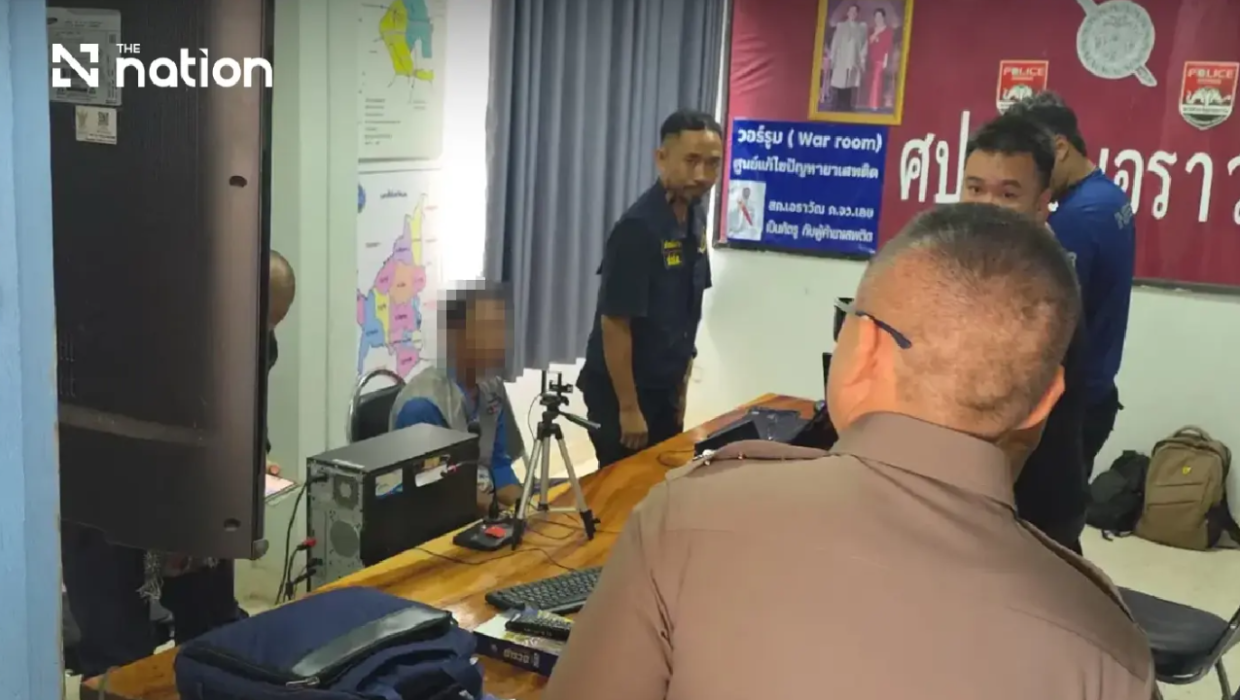
Thai authorities have arrested a married couple in Loei province as investigators expand their examination of what officials believe is a sophisticated transnational narcotics operation. The detention follows the apprehension of a Thai Airways flight attendant, known in Thai media reports as Mina, who was taken into custody by Australian federal police at Melbourne Airport on suspicion of attempting to transport approximately one kilogram of heroin concealed within her checked luggage.
The case represents a significant development in cross-border drug enforcement cooperation between Thailand and Australia. After detaining the flight attendant, Thai investigators redirected their efforts toward identifying and locating the individuals responsible for dispatching the illicit shipment. This investigative pivot has now yielded results in the remote northern province of Loei, where police agencies including the Office of the Narcotics Control Board have launched a coordinated operation to unravel the network's operational structure and supply chains.
On Thursday, July 2, officers from Chiang Khan Police Station initially proceeded to a residence in That subdistrict, acting on intelligence linking the suspects—identified as Athit, 43, and Thatsaphon, 42—to addresses within Chiang Khan district. When the pair were not located at the initial address, authorities expanded their search parameters. Police subsequently learned that both individuals had been employed as rubber tappers in Erawan district, a common occupation in the region that would provide legitimate cover for their movements across provincial boundaries.
Investigators traced Athit to Wat Tham Pha Mak Ho, a temple in Sri Songkhram subdistrict of Wang Saphung district, where he was reportedly working on repairs to the temple's roof. His removal to Erawan Police Station for questioning marked the beginning of a more intensive interrogation phase. According to police statements, Athit admitted during preliminary questioning that he had been engaged to dispatch multiple parcels to Bangkok on six separate occasions, receiving compensation of 8,000 baht—approximately US$240—per transaction from a Lao national handler.
The investigative trail reveals a methodical operational pattern. Of the six parcels Athit acknowledged sending, three were dispatched through a parcel service outlet in Chiang Khan itself, two originated from Ban That in That subdistrict, and one came from Erawan district. This geographic dispersal across different municipalities and through various intermediary points demonstrates deliberate attempts to obscure patterns and minimize detection risks. The most recent shipment, according to police records, left Thailand on June 28, 2026.
Thatsaphon's detention occurred following a separate lead that brought investigators to a black Mitsubishi Triton pickup truck bearing Loei registration plates. Officers discovered the vehicle abandoned in a rubber plantation within the Pha Nang-Pha Koeng area of Erawan district. The discovery led directly to the apprehension of Athit's wife, identified as a Lao national. During her initial police interview, Thatsaphon denied any knowledge of or participation in the alleged smuggling activities, positioning herself as an unwitting spouse unaware of her husband's criminal involvement.
The arrests now position both individuals within the Office of the Narcotics Control Board's formal questioning apparatus as the investigation enters a more sophisticated analytical phase. Thai authorities are now focused on identifying the higher-level operatives who orchestrated the scheme, recruited the participants, and financed operations. The investigation's trajectory suggests authorities believe this couple occupied a mid-tier position within a larger organizational structure, functioning as reliable distributors rather than decision-makers.
For readers across Southeast Asia, this case illuminates the evolving tactics employed by transnational drug syndicates adapting to heightened border security and international cooperation frameworks. By utilizing low-profile workers embedded in agricultural communities, leveraging family connections across borders, and employing civilian parcel services rather than direct courier mechanisms, these networks maintain operational resilience despite increased law-enforcement capacity. The involvement of both Thai and Lao nationals reflects the porous nature of cross-border criminal enterprises throughout the Mekong region.
The Office of the Narcotics Control Board's secretary-general emphasized that the case exemplifies contemporary trafficking methodologies that deliberately distribute responsibility across multiple jurisdictional levels. This approach deliberately complicates enforcement by ensuring that each participant possesses only partial knowledge of the complete operation. Such compartmentalization has proven effective at insulating higher-level operators from direct legal exposure while maintaining operational continuity despite periodic arrests of peripheral operatives.
Thai-Australian law-enforcement collaboration proved instrumental in breaking open this particular network. The fact that a flight attendant employed by a major Southeast Asian carrier became a conduit for international drug transport indicates the sophisticated infiltration of regional aviation infrastructure by criminal organizations. International airports, with their vast daily passenger volumes and time-pressured processing environments, present attractive targets for smuggling operations seeking to exploit systemic vulnerabilities.
Going forward, the Office of the Narcotics Control Board has committed to intensifying its investigative efforts and pursuing criminal charges against individuals at every hierarchical level of the operation. Thai authorities have also pledged enhanced coordination with international law-enforcement partners, particularly regarding interception of narcotics shipments, disruption of established trafficking routes, and asset seizure targeting the financial infrastructure supporting these networks. Such commitments align with the Thai government's broader drug-suppression policy initiatives.
The implications for Malaysia and other Southeast Asian nations are considerable. Criminal networks operating throughout the region frequently employ similar operational models, utilizing nationals from neighboring countries, dispersing shipment points across multiple jurisdictions, and leveraging legitimate commercial services. Malaysian authorities monitoring similar patterns would do well to examine how Thai investigators traced the Melbourne connection backward through provincial intermediaries, an analytical approach increasingly central to dismantling sophisticated transnational operations that have made the region a critical transit zone for global narcotics trafficking.

