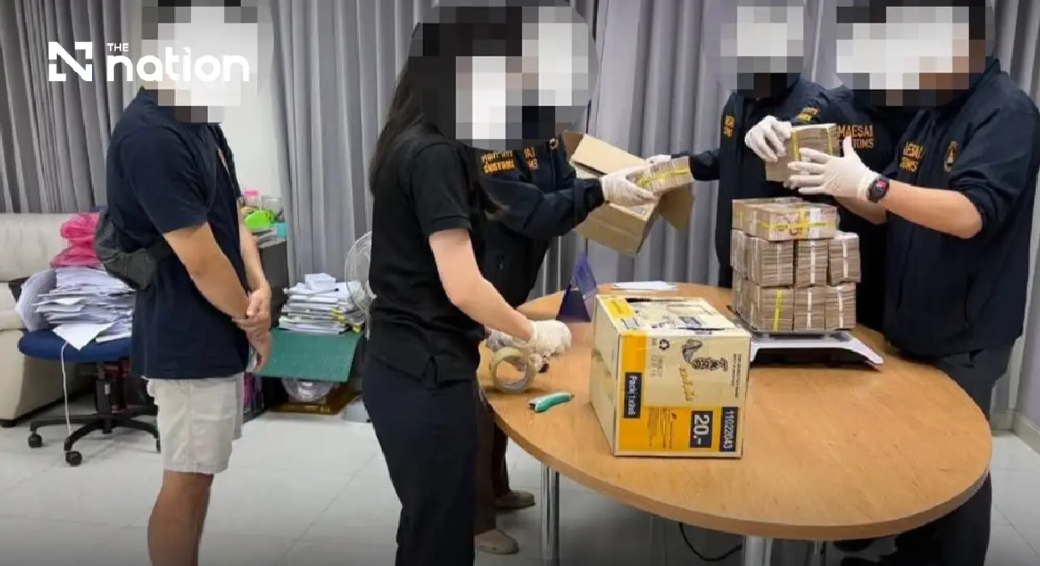
A significant currency smuggling operation has been disrupted at Thailand's northern frontier, as customs authorities in Chiang Rai intercepted more than 23 million baht in undeclared Thai cash attempting to cross into Myanmar. The seizure occurred at the Mae Sai border checkpoint on June 23, 2026, when officials discovered 23,023,000 baht in one-thousand-baht notes carefully concealed within two cardboard containers falsely labelled as fish-strip and potato snack products. The discovery underscores persistent challenges in controlling illicit financial flows through Southeast Asia's porous land borders, where cash smuggling remains a common method of moving money across jurisdictions to evade taxation and regulatory oversight.
The contraband was found in a Myanmar-registered vehicle that had been selected for routine inspection in the outbound lane approximately twenty metres from the actual border line. The driver, a 31-year-old Myanmar national, had already cleared immigration procedures with Chiang Rai authorities and was in the final stages of departure when customs officers opened the boxes for examination. The proximity to the border and the timing of the interception suggest that the operation was in its concluding phase, with the driver likely confident that the final checkpoint would prove a formality. Instead, the discovery triggered an immediate arrest and commencement of legal proceedings against the individual.
Authorities emphasize that the entire transaction violated multiple layers of Thai financial regulation. The cash had not been authorised by exchange-control authorities, nor had it been formally declared to customs officials as required under Thai law for any currency exports exceeding prescribed thresholds. This dual violation—both the failure to obtain exchange-control permission and the absence of customs declaration—transformed what might have otherwise been a simple currency movement into a prosecutable offence. The nature of the concealment, involving deliberate mislabelling of boxes, demonstrates an intentional effort to circumvent detection rather than a case of simple administrative oversight or forgetfulness.
The legal framework governing such cases in Thailand is comprehensive and stringent. The alleged smuggling violates Sections 242 and 252 of the Customs Act B.E. 2560, which establish procedures for controlled import and export of goods and currency. Additionally, the charge incorporates Section 80 of the Criminal Code, broadening the scope beyond mere customs violations to encompass criminal intent. The Exchange Control Act B.E. 2485 further criminalises the unauthorised movement of Thai currency, with Sections 8 and 8 bis specifically targeting currency export without proper authorisation. This multi-layered legislative approach reflects Thailand's determination to maintain control over capital flows and prevent the use of its currency in parallel or underground financial systems.
The Mae Sai crossing represents one of Thailand's busiest land border checkpoints, handling substantial daily traffic between the two countries. Located in Chiang Rai province in the Golden Triangle region, Mae Sai facilitates legitimate trade and tourism while simultaneously serving as a focal point for border enforcement. The checkpoint's position on a major commercial corridor connecting Thailand to Myanmar and beyond creates a constant tension between facilitating trade and intercepting contraband. Recent years have witnessed intensified scrutiny at such crossings as regional authorities grapple with transnational crime, money laundering, and the financing of illicit activities through informal money transfer networks.
The concealment method employed in this case—hiding currency within food product packaging—reflects a well-established smuggling technique. Such methods exploit the volume of legitimate cross-border trade in consumables, relying on the assumption that cursory inspections might miss contraband buried within innocuous merchandise. The choice of snack products is particularly strategic, as these items are cheap, commonly transported, and less likely to attract intensive scrutiny than high-value goods. However, the discovery demonstrates that Thai customs training has become increasingly sophisticated in identifying suspicious patterns and conducting thorough searches even of low-risk appearing shipments.
For Malaysia and other Southeast Asian nations, this seizure carries important implications regarding regional financial security. The movement of large untracked cash quantities across borders facilitates various illicit activities, including trade-based money laundering, financing of transnational criminal organisations, and circumvention of sanctions regimes. Thailand's enforcement action at Mae Sai reflects broader regional efforts to strengthen border controls and financial oversight. Malaysian authorities, particularly those at Perlis and Kedah border crossings with Thailand, maintain similar vigilance against currency smuggling and undeclared cash movements, recognising that loose enforcement in one jurisdiction creates vulnerabilities across the entire region.
The arrested driver now faces potential prosecution under the combined weight of these statutory provisions, with penalties likely including substantial fines and imprisonment. Thai courts typically take currency smuggling seriously, particularly when deliberate concealment demonstrates culpable intent. The case will likely proceed through standard criminal proceedings, with the seized funds held as evidence. If convicted, the driver may face sentences ranging from several months to several years, depending on judicial interpretation and aggravating or mitigating circumstances presented during trial.
This incident exemplifies ongoing challenges facing Thai authorities in managing the complex dynamics of a major transit country. While the successful interception demonstrates effective border management capabilities, the sheer volume of daily cross-border traffic means that determined smugglers inevitably succeed with some proportion of their operations. Intelligence analysis suggests that this single case represents merely a fraction of attempted currency smuggling through northern Thai borders. Customs agencies throughout the region continue advocating for enhanced resource allocation, improved inter-agency coordination, and technological upgrades to detection capabilities.
The Mae Sai seizure also highlights the continuing relevance of physical cash in regional underground financial systems. Despite increasing digitisation of commerce globally, large quantities of physical currency remain preferred by those seeking to move money without creating banking records or triggering reporting thresholds. This preference for tangible assets ensures that border customs agencies must maintain vigilance against currency smuggling indefinitely, even as electronic payment systems become increasingly sophisticated. Regional cooperation mechanisms, including information sharing between customs agencies and development of common detection protocols, represent essential tools for addressing this persistent challenge across Southeast Asia.

