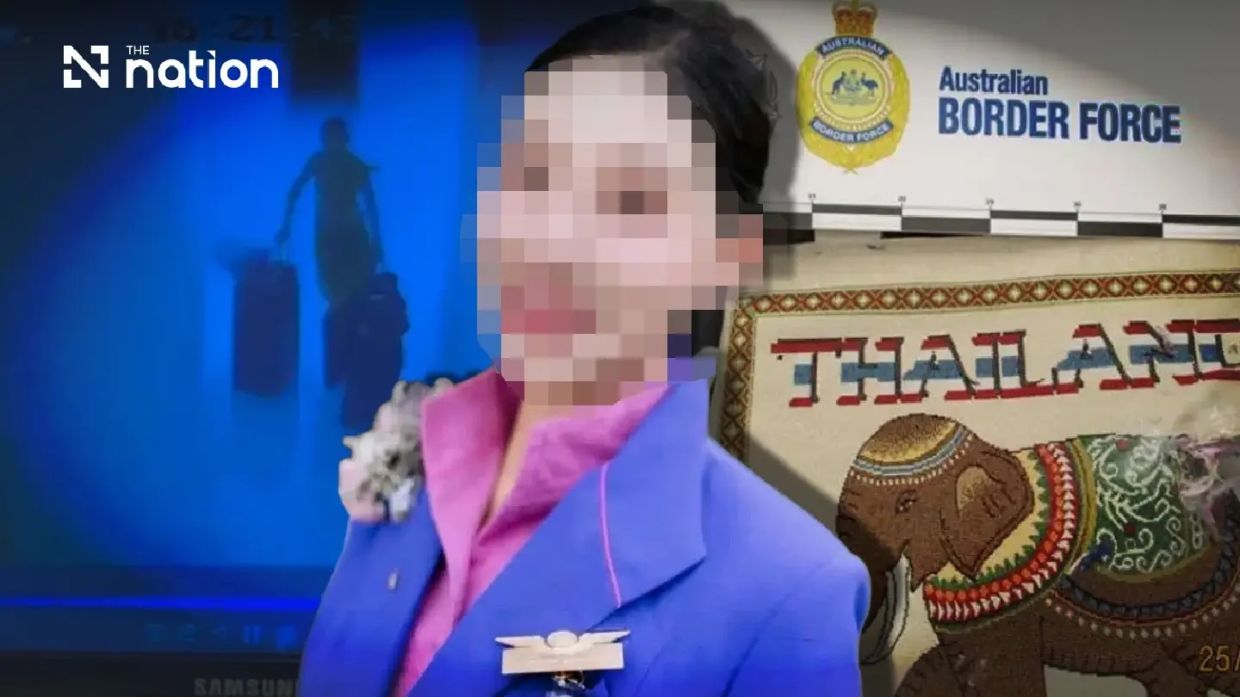
Thai authorities have substantially widened their investigation into the arrest of a flight attendant apprehended with 900 grammes of heroin at Melbourne Airport, working on the theory that she may have unwittingly become ensnared in an international smuggling operation orchestrated through deception and exploitation. The Office of the Narcotics Control Board, alongside security agencies, continues to treat the woman as a detainee rather than a formally accused person, while simultaneously coordinating with Australian police and diplomatic officials to build a comprehensive picture of her involvement and to support any legal proceedings on her behalf.
The investigation has revealed a sophisticated operational structure that appears to stretch across multiple jurisdictions and exploit vulnerable workers. Areepak Ngernbamroong, deputy secretary-general of the ONCB, explained that the network appears to function as a large-scale transnational criminal enterprise with distinct compartmentalised roles. Three to four related arrests made in Bangkok resulted in the seizure of more than 26 kilogrammes of heroin, with the Department of Special Investigation now taking the lead because of the cross-border nature and scale of the suspected organisation. This division of labour among Thai law enforcement agencies reflects the complexity of dismantling operations that span continents.
Central to the alleged scheme is a manipulation tactic targeting flight crews and frequent international travellers. Investigators believe criminal operatives create fake social media profiles and send mass messages offering payment for carrying parcels across borders, a tactic authorities believe has successfully ensnared multiple targets. The flight attendant herself appears to have been a victim of this approach, recruited through what appeared to be a straightforward commercial arrangement but which concealed illegal cargo. The discovery of a delivery rider who had transported heroin to her, coupled with the involvement of a Lao couple in the supply chain, suggests a well-established distribution methodology that separates production, transport, and delivery across different criminal actors.
Australian investigations have identified a key figure designated as "Dear", a Thai national with a decade-long residence in Australia whose status as citizen or permanent resident remains unconfirmed. Evidence suggests this individual has acted as the final recipient in multiple instances of similar smuggling activity. Thai authorities have already transferred substantial evidentiary materials to the Australian Federal Police to support their efforts in identifying the ultimate destination of seized narcotics and potentially higher-level organisers within Australian networks. The apparent repeat nature of Dear's receiving activities indicates either a longstanding established operation or a methodical testing of new smuggling routes and personnel.
Details emerging from interviews with the flight attendant's boyfriend provide insight into how the contraband entered the smuggling chain. The woman received a delivery of elephant-patterned bags ostensibly containing legitimate merchandise, which her boyfriend stated she examined carefully before packing into luggage. Both individuals claimed nothing suspicious was discovered during this inspection, and the suitcase subsequently passed through Thai airport X-ray screening without flagging concerns. This sequence of events has led investigators to consider whether the heroin may have been inserted into the luggage at a later stage, or whether the initial screening simply failed to detect it. The discrepancies in available evidence suggest either investigative gaps or possibilities that the woman was genuinely unaware of the contraband's presence.
Payment arrangements remain a significant evidentiary puzzle clouding the picture of her culpability. Australian police extracted information from mobile devices suggesting compensation of 8,800 baht, equivalent to approximately US$264, though Thai investigators report unverified accounts of two separate transfers of 1,700 baht each, supposedly contingent on receiving the goods and obtaining an air ticket. Critically, bank records examined by Thai authorities show no trace of these smaller transactions, and the flight attendant's account balance was notably modest. This gap between alleged payments and actual financial evidence could either indicate sophisticated money laundering that left minimal digital traces, or potentially suggest that promises of compensation were never fulfilled because the arrangement was deceptive from inception. The delivery rider himself acknowledged performing similar courier work three to four times previously but claimed this was his inaugural delivery to this particular flight attendant, a detail that could indicate either compartmentalised operational structure or suggest her unfamiliarity with such activities.
The connection to the Golden Triangle drug-producing region reflects shifting patterns in trafficking routes responding to enforcement pressure. Narcotics originating from production facilities in the mountainous region north of Thailand have traditionally flowed through northern border crossings, but intensified interdiction efforts have compelled networks to adapt their logistics. Criminal organisations have increasingly shifted focus toward northeastern Thailand's border with Laos, exploiting longer and less densely monitored stretches of the Mekong River spanning provinces including Nakhon Phanom, Bueng Kan, Loei, and Nong Khai. The width and geographic characteristics of these crossing points present formidable surveillance challenges, enabling incremental quantities of narcotics to enter the country for eventual consolidation and redistribution through commercial channels like international aviation.
Laotian nationals identified in the Bangkok arrests signal the involvement of neighbouring countries within this supply network, though Thai officials emphasised that this reflects criminal activity rather than state connivance. Thailand and Laos maintain intelligence-sharing protocols and coordinate border security initiatives, according to ONCB representatives, though the porous nature of the frontier and resource constraints inevitably allow some contraband transit. The typical operational pattern involves Golden Triangle producers packaging heroin before sequential transfers between intermediary groups, with storage facilities established within Thailand serving as waypoints in longer distribution chains. The flight attendant's suitcase represented merely a single outbound shipment within a presumably far more extensive trafficking architecture.
The absence of formal accusations against the flight attendant reflects investigative uncertainty about her knowledge and intentionality. Evidence that the rider had never previously delivered to her, combined with the failed detection of heroin during her own examination and airport screening, permits interpretations that she genuinely remained ignorant of the contraband. Conversely, the apparent sophistication of the recruitment mechanism and the specific targeting of flight crew raises questions about whether more experienced criminals would select couriers without establishing prior relationships, suggesting either careless operational security or a deliberate strategy of utilising first-time intermediaries to minimise traceability. Thai authorities are accumulating documentation and analysis to forward to the Australian Federal Police and Thai diplomatic missions, content intended to assist in her legal proceedings and potentially establish mitigating circumstances regarding culpability.
The case illuminates the vulnerabilities of Southeast Asian aviation networks to exploitation by transnational crime syndicates. Flight attendants represent particularly attractive targets for smuggling operations because their professional roles legitimise frequent international border crossings, they often travel with luggage that receives less intensive examination than cargo, and their financial circumstances may render modest compensation offers persuasive. Thailand's geographic position as both a production zone, transit corridor, and origin point for couriers has rendered it central to regional narcotics trafficking despite substantial governmental countermeasures. As networks respond to enforcement actions by adapting routes and methodologies, distinguishing between sophisticated manipulation of unknowing participants and genuine criminal complicity becomes increasingly complex for investigators and judicial systems alike.

