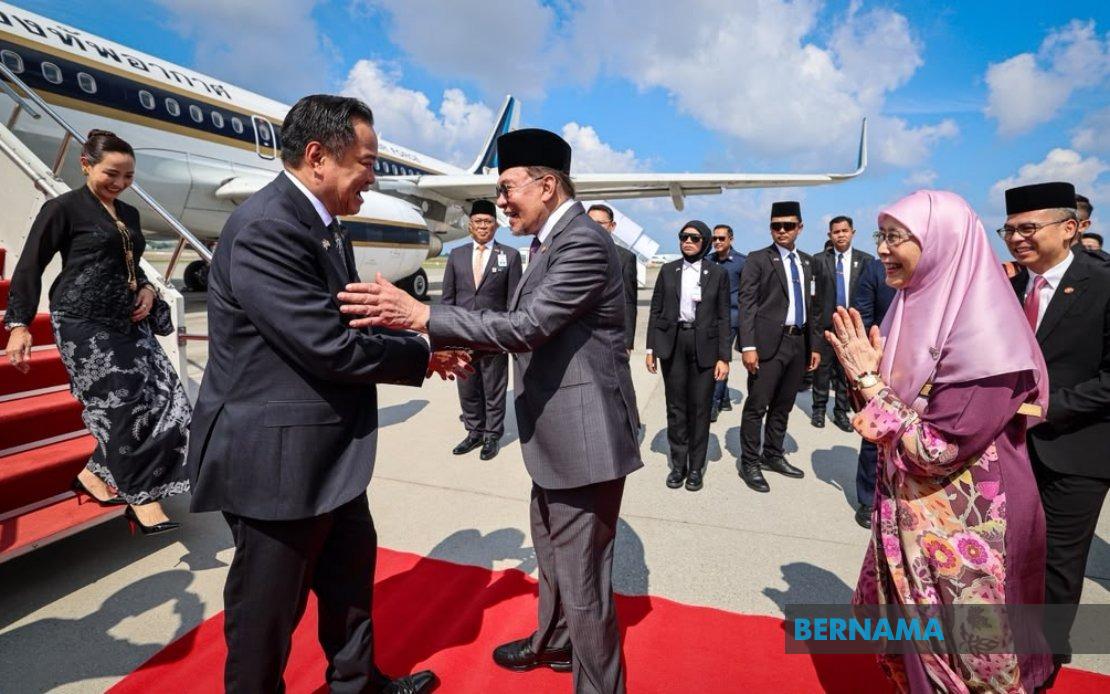
Thailand's Prime Minister Anutin Charnvirakul touched down at Kuala Lumpur International Airport on July 9 for a two-day official visit to Malaysia, marking his first journey to the country since resuming his role as head of government in March 2026. Accompanied by his spouse Thananon Charnvirakul, Anutin landed at the Bunga Raya Complex at 11.11 am, where Prime Minister Datuk Seri Anwar Ibrahim extended a warm welcome. The arrival underscores the significance Malaysia and Thailand place on their bilateral relationship, with senior Malaysian officials including Datuk Seri Dr Wan Azizah Wan Ismail and Communications Minister Datuk Fahmi Fadzil present to greet the Thai delegation.
The formal reception reflected the diplomatic importance of the occasion, with a full ceremonial welcome befitting a state visit of this calibre. A guard of honour comprising 34 officers and personnel from the First Battalion of the Royal Ranger Regiment, led by Major Muhammad Nur Addeen Mustaza, lined the arrival area. Both national anthems were performed in sequence, and Anutin was formally introduced to members of the Malaysian Cabinet and other senior government figures. Such protocols demonstrate the level of respect and protocol afforded to visitors of prime ministerial rank, signalling Malaysia's commitment to maintaining strong governmental ties with its northern neighbour.
The timing of Anutin's visit carries particular significance for Malaysia-Thailand relations. Having recently consolidated his position following his March 2026 reappointment, the Thai Prime Minister's decision to prioritise a visit to Malaysia indicates the strategic importance both governments attach to their partnership. The visit is structured around substantive bilateral engagement rather than ceremonial formality alone, with a packed schedule designed to address concrete areas of mutual interest and concern. This approach reflects a broader pattern within Southeast Asia where high-level visits are increasingly used to translate political goodwill into tangible outcomes across multiple sectors.
A cornerstone of Anutin's visit involves bilateral discussions with Anwar at Perdana Putra, where the two leaders will undertake a comprehensive review of Malaysia-Thailand relations. These talks will examine existing cooperation frameworks and identify new opportunities for collaboration. Beyond the customary diplomatic pleasantries, the visit will produce tangible results in the form of an agricultural cooperation memorandum of understanding to be signed during the bilateral meeting. This focus on agricultural partnership reflects recognition by both nations that food security and sustainable farming practices are increasingly critical issues in Southeast Asia, particularly given regional vulnerabilities to climate change and supply chain disruptions.
The agricultural MoU carries broader implications for the region's economic integration. Both Malaysia and Thailand possess substantial agricultural sectors, with complementary strengths and production capabilities. Deepening cooperation in this domain could facilitate more efficient regional food production, reduce dependence on distant suppliers, and create new trade opportunities for farming communities in border regions. For Malaysian readers, the agreement signals potential benefits ranging from improved agricultural technology transfer to enhanced market access for local produce in Thailand, a nation of over 70 million consumers.
An additional highlight of the visit involves a joint trip to Bukit Kayu Hitam in Kedah on July 10, where Anutin and Anwar will jointly inaugurate a critical cross-border infrastructure project. The opening of the road connecting Malaysia's Immigration, Customs, Quarantine and Security Complex in Bukit Kayu Hitam with Thailand's corresponding Customs, Immigration and Quarantine Complex in Sadao represents a tangible improvement in border infrastructure. Such connectivity enhancements facilitate smoother movement of goods and people across the border, reducing logistical costs and transit times. For the Kedah region specifically, improved border crossing infrastructure could stimulate economic activity and attract businesses seeking efficient gateways for regional trade.
The state visit carries significant economic dimensions. In 2025, Thailand ranked as Malaysia's sixth-largest global trading partner and second-largest within ASEAN, reflecting the depth of economic integration between the nations. The bilateral trade relationship generated approximately RM118.57 billion (US$27.73 billion) in 2025, underscoring the substantial commercial flows that depend on robust diplomatic and institutional frameworks. The first quarter of 2026 has already demonstrated momentum in this relationship, with bilateral trade reaching RM31.33 billion (US$7.90 billion) from January to March, representing a notable increase compared to the same period in 2025 when figures stood at RM27.35 billion (US$6.15 billion). This upward trajectory suggests that structural improvements in bilateral relations are translating into measurable economic benefits for businesses on both sides.
The growth in trade volumes carries implications for Malaysian manufacturers and exporters. A significant portion of this trade involves value-added products and intermediate goods, reflecting the integration of Malaysian and Thai supply chains across multiple industries. Enhanced cooperation stemming from Anutin's visit could further streamline customs procedures, reduce non-tariff barriers, and facilitate investment flows. For Malaysian enterprises operating in Thailand or Thai companies with operations in Malaysia, the diplomatic momentum generated by high-level visits often translates into faster resolution of regulatory issues and smoother business operations.
Anwar's hosting of a luncheon in Anutin's honour at Seri Perdana Complex extends beyond mere protocol, providing an informal setting for candid discussions between the Thai delegation and Malaysian political leaders. Such social engagements often serve as valuable opportunities to address bilateral issues in a more relaxed atmosphere, building personal rapport between officials who must work together on implementing agreed outcomes. The presence of both Prime Ministers' spouses underscores the personal dimension of state diplomacy, reinforcing the warmth and friendship between the two nations that underlies their more formal governmental interactions.
For Southeast Asia more broadly, Malaysia-Thailand cooperation demonstrates the ongoing vitality of ASEAN partnerships despite regional complexities. The focus on practical outcomes—infrastructure development, agricultural cooperation, and streamlined border procedures—reflects ASEAN's strength in translating regional community principles into concrete benefits for member populations. As the region navigates economic headwinds and geopolitical shifts, stronger intra-ASEAN relationships provide stability and opportunities for shared prosperity. Anutin's visit exemplifies how leadership changes, rather than disrupting regional ties, can provide moments to reinvigorate partnerships and set new directions for cooperation.

