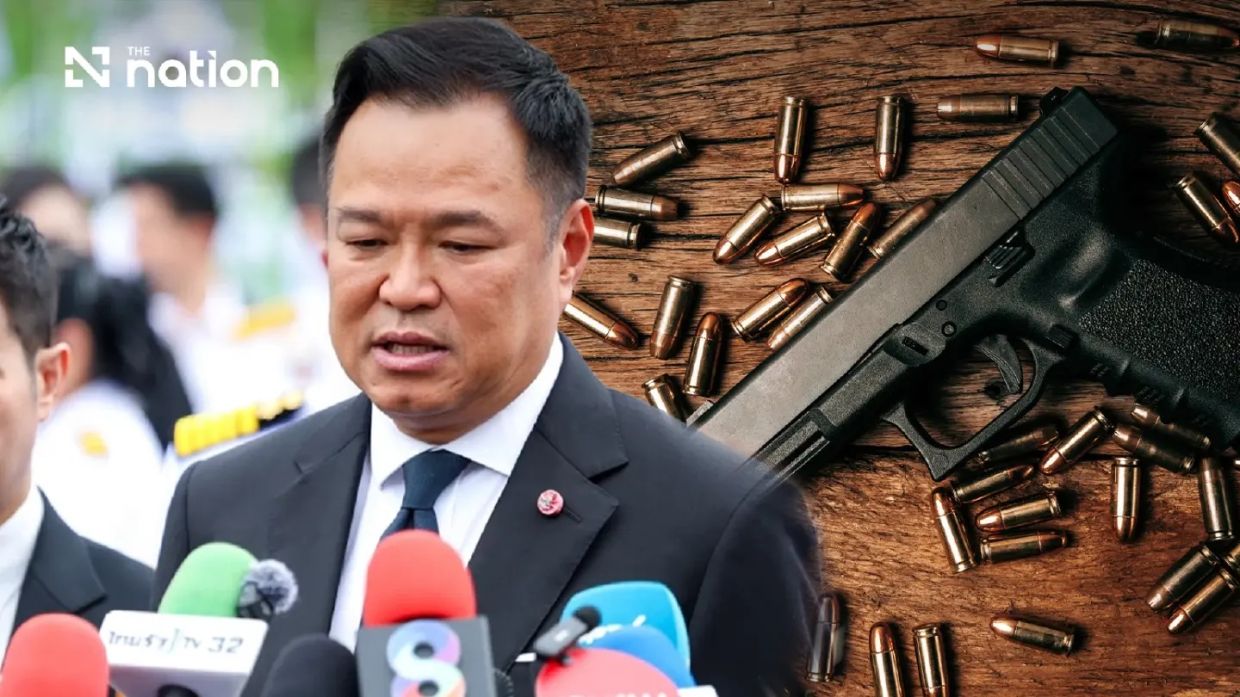
Thailand's government is moving to tighten firearms regulations in the wake of a devastating mass shooting at Debsirin Nonthaburi School. Prime Minister Anutin Charnvirakul, speaking after discussions with national police chief Pol Gen Kittharath Punpetch and a visit to the school premises, outlined a comprehensive approach to preventing gun violence that centres on legislative amendments and aggressive enforcement rather than distributing weapons more widely.
The Prime Minister made clear his opposition to one contentious proposal that has surfaced in the aftermath of the attack: allowing educators to carry firearms for protection. Anutin firmly rejected this idea, arguing that teachers are not law enforcement officers and therefore should not be armed. This stance reflects a broader principle he emphasised throughout his remarks: firearms should remain restricted to those with official duties and proper authorisation, with strict penalties for violations.
Anutin's enforcement strategy focuses heavily on random inspections and checkpoints in public spaces. Under his proposed framework, any individual found carrying a weapon outside their residence without legitimate official purposes would face serious legal consequences. The government intends to conduct thorough inspections across public places, vehicles, and residential areas to ensure compliance with firearms regulations, marking a significant escalation in enforcement activity compared to previous approaches.
The administration is also considering reviving an amnesty programme that would allow citizens to surrender illegal or unregistered firearms without legal penalty. However, Anutin qualified this proposal with a crucial caveat: any weapon that was already illegal cannot become lawful simply through continued possession. Those discovered with unregistered firearms would still face prosecution, underscoring the government's position that amnesty represents a one-time opportunity rather than a permanent loophole. This approach aims to reduce the number of illicit weapons in circulation while encouraging voluntary compliance.
For those who choose to keep firearms legally, Anutin outlined stringent storage and registration requirements. Homeowners must register all weapons, maintain them in secure storage locations inaccessible to children, and ensure that firearms never leave the residence without appropriate authorisation. Crucially, both the registered owner and anyone who uses a weapon in committing a crime would bear criminal responsibility, creating dual accountability that extends legal exposure to household members and authorised users alike.
The Prime Minister has directed relevant agencies to establish clear pathways for surrendering illegal weapons. Citizens can now deliver unregistered firearms to the Department of Provincial Administration, district offices, or police stations, where officials will create official records documenting the surrender. This infrastructure aims to remove the practical barriers that might otherwise prevent citizens from complying with the law, particularly in rural areas where access to government services may be limited.
Regarding the underlying causes of the shooting, Anutin called for restraint in public discourse until police investigations establish verified facts. He expressed concern that speculation about bullying as a motivating factor could fuel unfounded anxiety and potentially inspire copycat incidents. However, this cautious approach does not signal indifference to bullying concerns; rather, it reflects an effort to allow investigators to gather comprehensive evidence before the government shapes policy responses around established patterns.
The broader security framework extends beyond firearms regulation alone. Anutin indicated that police and other authorised enforcement agencies have received specific orders and policy directives to conduct comprehensive inspections in their jurisdictions. This multi-agency approach signals that the government recognises the shooting represents a systemic failure requiring coordinated responses across the security apparatus, not merely isolated law enforcement actions.
For Malaysian and Southeast Asian observers, Thailand's response offers instructive lessons about the challenges of controlling illicit firearms in societies where weapons ownership is culturally embedded and enforcement capacity varies significantly across regions. The Thai government's emphasis on registration, storage requirements, and accountability for multiple parties reflects an understanding that gun violence prevention requires both removing opportunities for misuse and creating consequences that deter illegal possession. Thailand's experience also highlights the political pressure authorities face to restore public confidence quickly, as well as the delicate balance between security measures and preserving civil liberties that citizens expect in democratic systems.

