Thailand's Prime Minister Anutin Charnvirakul and his wife Thananon Charnvirakul arrived in Malaysia on Thursday for a two-day official visit, marking the Thai leader's first trip to the country since his reappointment to the premiership in March 2026. The high-profile visit underscores both nations' determination to deepen economic and diplomatic cooperation while addressing shared regional interests that have increasingly defined Malaysia-Thailand relations in recent years.
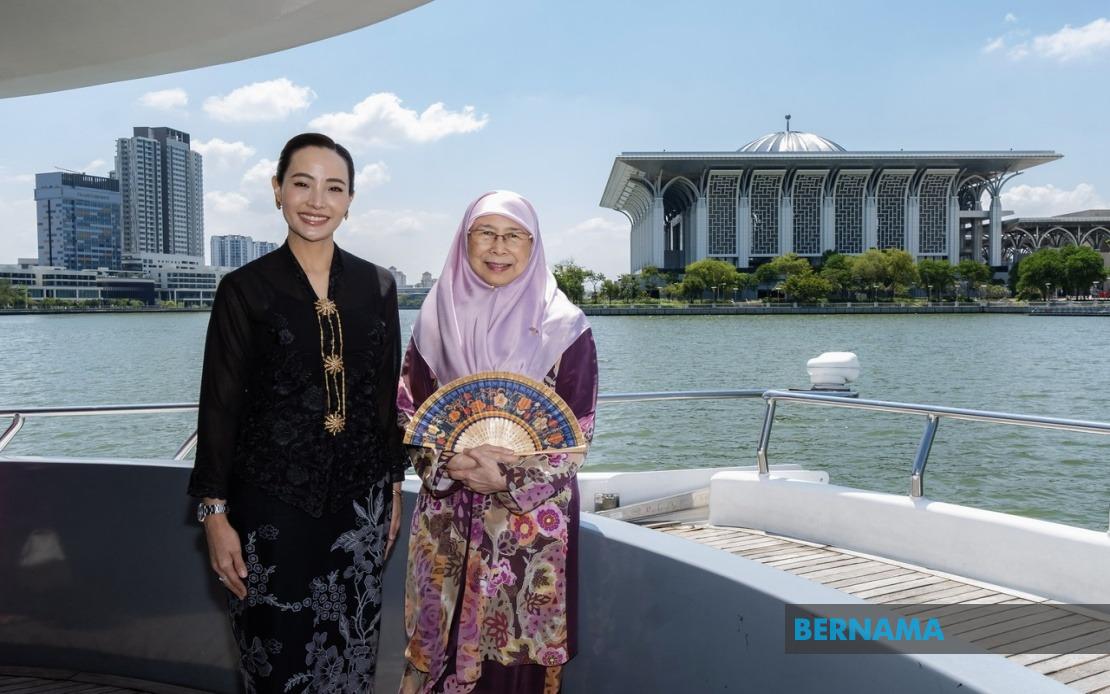
Thananon's itinerary included a distinctive cultural experience that provided glimpses into Malaysia's identity as a modern Southeast Asian nation. On Thursday afternoon, the Thai First Lady embarked on a leisurely 45-minute boat excursion across Tasik Putrajaya, the man-made lake that forms the centrepiece of the federal territory's urban design. Her vessel navigated past the area's most recognisable architectural and natural features, offering her a comprehensive visual introduction to how Malaysia has developed its administrative headquarters since the late 1990s.
The cruise reflected deliberate diplomatic scheduling, as Thananon was received by Datuk Seri Dr Wan Azizah Wan Ismail, wife of Prime Minister Datuk Seri Anwar Ibrahim. This pairing of spouses during cultural engagements has become standard protocol in modern state visits, allowing first ladies to build personal connections that often complement the formal negotiations conducted by their husbands at governmental levels. The two women spent the outing engaged in conversation while observing the landscape, creating informal space for dialogue that diplomatic events alone cannot provide.
Also accompanying the Thai visitor was Hannah Yeoh, Minister in the Prime Minister's Department responsible for Federal Territories. Yeoh's presence signalled Malaysia's commitment to showcasing Putrajaya's development and governance model to international visitors. The Federal Territories Ministry oversees the administration and promotion of the capital, making her participation particularly apt for welcoming foreign dignitaries interested in understanding how Malaysia's government functions from its physical headquarters.
Putrajaya itself has become an increasingly common destination for international delegations visiting Malaysia. The purpose-built administrative centre, established in the late 1990s to relieve congestion in Kuala Lumpur's city centre, represents a significant Malaysian development achievement. Its landscaping, monuments, and infrastructure embody the country's aspirations as a developing nation attempting to balance modernisation with environmental consciousness. For Thai officials, exposure to Putrajaya provides comparative insights into how neighbouring countries approach capital city planning and governance infrastructure.
Anutin and Thananon's arrival at Kuala Lumpur International Airport earlier that morning was marked by formal ceremony at the Bunga Raya Complex, where they received the traditional official welcoming procedures accorded to heads of state. This combination of formal state protocol followed by more relaxed cultural experiences typifies contemporary high-level bilateral visits between ASEAN nations, where both solemn diplomatic functions and informal engagement opportunities are integrated into official programmes.
The timing of this visit carries particular significance given Anutin's recent reconfirmation as Thailand's prime minister following elections and coalition negotiations in 2026. His decision to prioritise Malaysia for his first international visit since resuming office signals Thai foreign policy priorities tilted toward ASEAN solidarity and deepening ties with its most significant Malaysian neighbour. Thailand and Malaysia have shared interests spanning maritime security, economic integration, and cross-border governance that necessitate regular high-level engagement.
Malaysia-Thailand relations have historically been characterised by both cooperation and occasional tensions, particularly regarding maritime boundaries and the status of Thai Muslims in southern border regions. Bilateral visits of this nature, especially when they include cultural and social dimensions beyond purely official meetings, serve to humanise relationships between governments and remind officials of the broader people-to-people connections that underpin national ties. The leisure cruise on Putrajaya's lake represented exactly such an opportunity for building rapport.
The two-day visit was undertaken at Anwar's personal invitation, reflecting Malaysia's interest in maintaining momentum in Southeast Asian diplomatic relationships during a period of regional uncertainty. Thailand's role as a significant ASEAN economy and its geographical position in mainland Southeast Asia make it a natural partner for Malaysia in advancing collective regional objectives. These visits, even when they include seemingly routine activities such as scenic tours, contribute to the relationship-building that makes formal cooperation during crises or regional challenges more feasible.
For Malaysian observers, the visit also provides an occasion to reflect on how the country markets itself to regional peers and international guests. Putrajaya's lake cruise has become something of a signature experience for visiting dignitaries, offering both aesthetic appreciation and symbolic demonstration of Malaysia's modernisation and environmental stewardship. The structured yet relaxed setting allows conversation to flow more naturally than formal state banquets or conference room meetings, potentially enabling the Thai First Lady to gain genuine impressions of Malaysian governance philosophy and development priorities.

