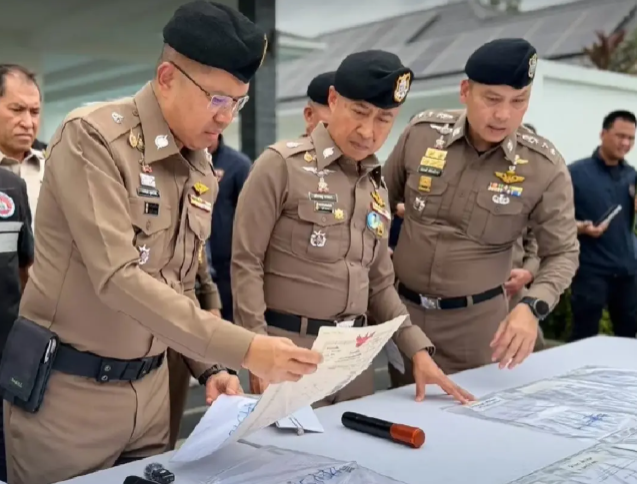
Thai police have intensified their crackdown on foreign property ownership schemes by arresting 13 foreign nationals during coordinated raids in the Prachuap Khiri Khan seaside town of Hua Hin. The operation, which unfolded across 15 locations on Monday, represents the sixth phase of a nationwide campaign targeting companies suspected of using Thai nationals as nominee shareholders to circumvent restrictions on foreign property ownership. The investigation has now expanded to cover 33 companies believed to control approximately 300 million baht in real estate, reflecting growing official concern about the scale and sophistication of these arrangements.
The Hua Hin operation mobilised more than 200 police officers and government officials coordinated by Deputy National Police Chief Pol Gen Samran Nuanma. Under arrest warrants issued by courts, authorities apprehended three British nationals, four Chinese nationals, and one each from Italy, France, the Netherlands, Austria, the Philippines and the United States. Additionally, police summoned 39 Thai nationals for questioning, while courts had approved 45 arrest warrants for foreign individuals implicated in the scheme. Those detained remain under investigation pending potential court charges, underscoring the systematic nature of the enforcement effort.
The raids concentrated on a residential development in Thap Tai subdistrict featuring detached houses and modern pool villas, each valued between 10 million and 20 million baht. Authorities identified six companies allegedly operating within this development as nominee entities, with four linked to the project's initial phase and two to a subsequent expansion. Evidence suggests these corporate structures were deliberately constructed to mask foreign control and beneficial ownership of properties that Thai law generally restricts foreigners from purchasing directly. Officers seized comprehensive documentation including company registration records, accounting files, computers, mobile phones and electronic data to trace the financial architecture underlying these arrangements.
According to police statements, foreign nationals questioned during the investigation acknowledged seeking to acquire property in Thailand but claimed they had relied on advice from law and accounting firms recommending the establishment of corporate entities as a supposedly legal pathway to ownership. This explanation reveals how sophisticated facilitators may have misrepresented Thai property law to their clients, potentially exploiting language barriers and unfamiliarity with local regulations. The firms referenced in these accounts remained unidentified, though authorities indicated they would be pursuing investigations into any professional advisors who assisted in structuring unlawful arrangements. The foreign nationals expressed belief that their corporate structures provided legitimate legal cover, demonstrating either genuine misunderstanding or deliberate misrepresentation of Thailand's foreign ownership prohibitions.
Thai nationals listed as nominee shareholders presented a consistent narrative to investigators indicating they had agreed to hold shares purely on paper without actual financial contribution, managerial involvement or knowledge of company operations. These individuals claimed never to have paid for their shareholdings, participated in management decisions or reviewed financial documentation related to their purported investments. Their testimony suggests a clear separation between nominal legal ownership and actual control, with foreign beneficiaries directing all substantive business and property decisions. This structural pattern points toward deliberate circumvention rather than inadvertent legal non-compliance, intensifying official scrutiny of what police characterise as corporate fraud designed to evade constitutional restrictions.
The investigation extends beyond individual foreign purchasers and Thai nominee shareholders to encompass potential complicity within government agencies. Thai authorities have signalled they will examine whether officials engaged in corruption or improperly facilitated these schemes, recognising that systematic property law violations often require enabling conduct from bureaucratic actors. This dimension reflects broader concerns about governance integrity alongside property law enforcement. Officers will scrutinise financial transaction trails to identify additional participants, potential beneficiaries and international networks that may have coordinated these activities across Thailand and overseas jurisdictions. The comprehensive investigative scope suggests authorities view these arrangements not as isolated incidents but as organised schemes requiring multi-layered enforcement.
The Hua Hin phase builds upon five preceding operations that have progressively expanded geographic reach and investigative intensity. The campaign commenced with investigations on Koh Phangan in Surat Thani, focusing on nominee companies, law firms and accounting networks allegedly controlling property and tourism enterprises. Subsequent phases expanded into Phuket, Phang Nga and Krabi, where authorities examined 89 land plots and buildings valued exceeding 1.05 billion baht. Phase 4 targeted Chonburi properties while Phase 5 investigated 31 companies and 29 land plots worth approximately 633 million baht across Chiang Mai. Cumulatively, the first five phases examined 233 land plots and buildings encompassing more than 160 rai—approximately 25.6 hectares—with combined estimated value of 2.539 billion baht.
Court approvals have yielded 133 arrest warrants across the earlier operation phases, with 20 cases progressing to conviction, establishing demonstrable legal momentum for enforcement efforts. These outcomes indicate prosecutorial willingness to pursue cases through completion and judicial receptiveness to charges against foreign nationals and Thai facilitators alike. The conviction rate, though representing a fraction of arrested individuals, suggests that Thai courts find sufficient evidence of intentional law violation rather than mere administrative irregularity. This jurisprudential pattern may embolden prosecutors to pursue more aggressively the Hua Hin suspects and future cases, potentially raising consequences for foreign nationals and Thai accomplices involved in nominee schemes.
Thailand's intensifying enforcement reflects official recognition that unrestricted foreign acquisition of property through nominee structures threatens national sovereignty over land ownership and creates governance challenges in tourist-dependent economies. The concentration of these schemes in resort destinations like Hua Hin, Phuket and Chiang Mai suggests foreign investment in vacation properties particularly attracts nominal ownership arrangements. Real estate transactions represent substantial wealth transfers, and the scale of property values involved—several billion baht across identified cases—indicates significant economic activity occurring outside legitimate regulatory frameworks. For Malaysian investors accustomed to clearer foreign ownership restrictions, these Thai developments underscore the importance of consulting qualified legal advisors and avoiding structures that might circumvent local property laws, which carry serious criminal penalties.
Police have emphasised that this campaign targets unlawful nominee networks rather than legitimate foreign investors complying with Thai regulations, attempting to distinguish between permitted foreign property engagement and prohibited circumvention schemes. This distinction matters for the broader foreign investor community and regional business confidence, though enforcement intensity creates practical uncertainty about what constitutes acceptable structures. Malaysian citizens and entities considering Thai property investments should recognise that nominee shareholding arrangements, regardless of subjective intent or professional advice received, face substantial legal jeopardy under current enforcement priorities. The Royal Thai Police have established reporting mechanisms including a dedicated hotline at 1599 available around-the-clock for public reporting of suspected illegal foreign business activity, signalling that authorities seek community participation in enforcement efforts.
The nationwide nominee crackdown reflects Thailand's determination to enforce constitutional property ownership restrictions through intensive, coordinated enforcement campaigns rather than passive administrative monitoring. This strategy prioritises prosecutorial outcomes and creates visible deterrence through high-profile arrests and convictions. For international business communities and foreign investors across Southeast Asia, these operations serve as cautionary examples of how governments may suddenly accelerate enforcement against previously tolerated practices, particularly when political circumstances or administrative priorities shift. Malaysian readers contemplating Thai property investments or engaged with property-related businesses should carefully examine their arrangements against current enforcement trends and seek updated legal advice regarding acceptable foreign participation structures.

