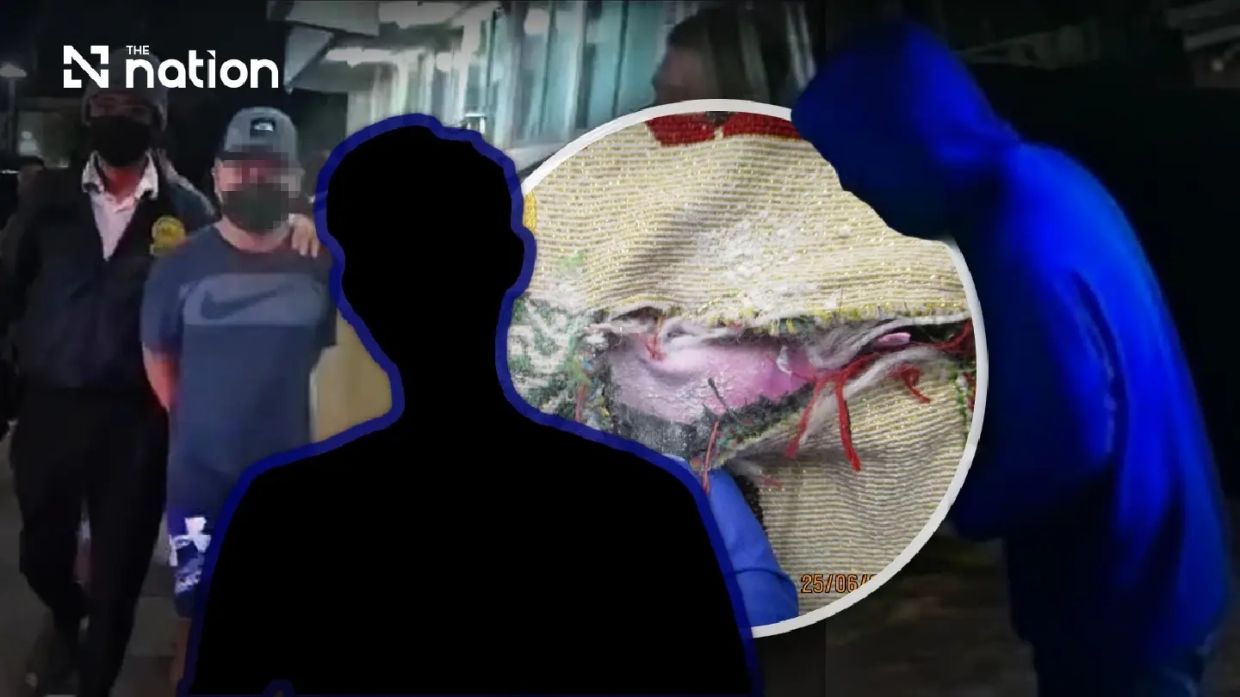
Thai law enforcement has escalated its investigation into an international heroin trafficking network after arresting a suspected courier and logistics coordinator in Phayao province overnight. The arrest of Ekkawit represents a significant breakthrough in dismantling what investigators believe is a sophisticated operation involving multiple layers of coordination and payment mechanisms designed to evade detection across Southeast Asia and towards Australia.
Deputy Commissioner Pol Maj Gen Theeradej Thamsuthee of the Metropolitan Police Bureau confirmed the arrest and outlined the alleged role of the suspect within the smuggling operation. According to police accounts, Ekkawit served as a critical intermediary who collected heroin-laden packages and orchestrated their transfer to subsequent handlers in the supply chain. The operation relied on encrypted chat communications and anonymous accounts to coordinate the movement of contraband across borders, with law enforcement tracking digital exchanges under the usernames "Rin Rin" and "Rose Rose."
The evidence suggests a structured delivery mechanism that began with the suspect procuring an elephant-print fabric bag in Chiang Mai at the direction of a person using the "Rose Rose" profile. After obtaining the bag, Ekkawit would notify his contact and deposit it at a prearranged kilometre marker along a highway. Associates would then retrieve the bag, arrange for heroin to be concealed within it—allegedly in Laos according to Ekkawit's account, though investigators harbour doubts about this claim—and return it to another designated location.
The financial structure of the operation reveals the compartmentalisation typical of professional smuggling networks. Ekkawit admitted during preliminary questioning that he received 100,000 Thai baht per operation, receiving payment in cash left at pre-arranged pickup points alongside the prepared package. He subsequently paid downstream operatives such as Uthai 60,000 baht through ATM cash transfers, reducing his exposure to direct contact and creating audit trails that are difficult for law enforcement to trace across financial institutions.
According to investigators, Ekkawit claimed he had executed similar tasks two or three times previously, suggesting this was not an isolated incident but rather part of an established routine. His involvement extended beyond simple delivery; he also provided police with information about "Rose Rose," revealing that this individual had directly contacted flight attendant Mina to recruit her as the final courier for transporting the bag to Australia. This indicates Ekkawit possessed knowledge of the entire operational chain, from procurement through to international transport.
Police discovered that Ekkawit maintained a family relationship with the person operating under the "Rose Rose" identity, both hailing from Phayao province. Photographic evidence reviewed by investigators showed the two travelling together, suggesting they had worked in close coordination. This family connection may have facilitated trust and information flow within the network, though it also provides law enforcement with investigative threads to pursue and additional persons of interest to question.
The arrest prompted an immediate request for deputy national police chief Pol Gen Samran Nuanma to personally question Ekkawit upon his transfer to the Narcotics Suppression Bureau, underscoring the case's significance within Thailand's drug enforcement hierarchy. Such high-level involvement typically indicates either the substantial quantity of narcotics involved or the network's operational sophistication. Authorities conducted site identification visits in Phayao before transferring the suspect, attempting to verify locations mentioned in his account and corroborate or challenge his statements through physical evidence.
Investigators remain sceptical about portions of Ekkawit's narrative, particularly his assertion that heroin was concealed in Laos rather than within Thailand. This scepticism reflects a wider investigative approach aimed at identifying where the actual drug preparation occurred and which individuals within the network possessed access to the narcotics before packaging. The discrepancy may indicate either deliberate deception to protect upstream suppliers or genuine ignorance of operational details deliberately compartmentalised by network leadership.
Parallel investigation of Uthai, the man in the blue hood arrested previously, has revealed additional operational depth. Uthai claimed involvement in five or six similar operations, but police believe this figure understates his actual participation given that he maintained a rented room in Phra Nakhon Si Ayutthaya province for at least five to six months. Investigators suspect this duration reflects significantly more courier runs than acknowledged, with Uthai potentially having operated from the province to facilitate transport logistics and maintain distance from Bangkok-centred authorities.
Crucially, police do not consider "Rose Rose" to be the network's mastermind despite this individual's apparent coordination role. Intelligence suggests a more senior organiser operates above this level, coordinating supply, recruitment, and international logistics. This hierarchical structure is characteristic of major trafficking operations that insulate senior members from direct contact with couriers or contraband, reducing their legal exposure and operational visibility.
The expanded investigation reflects recognition that the arrested individuals represent only mid-level operatives within a more extensive supply chain. Police are pursuing simultaneous threads involving the procurement of flight attendant Mina, the identity verification of "Rose Rose" despite use of anonymous accounts, and the location and questioning of individuals connected to Ekkawit through travel records and digital communications. For Malaysian authorities monitoring drug trafficking through the region, this case underscores how heroin networks exploit legitimate transportation channels and international air traffic to move product between source and destination countries, with Southeast Asian couriers serving as crucial vectors in the global drug supply network.

