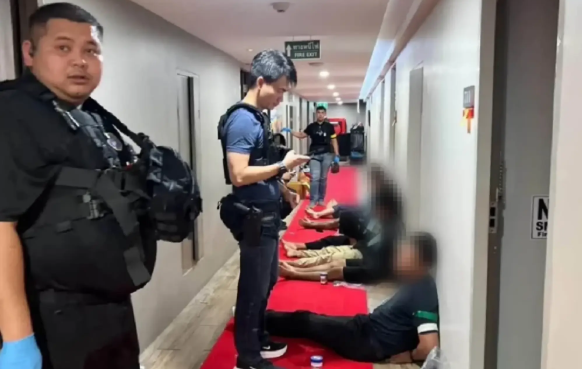
Thai authorities have conducted a significant raid on a luxury hotel in Nonthaburi province, resulting in the exposure of what investigators describe as a sophisticated underground operation involving drug trafficking, illegal gambling, and sex services allegedly catering primarily to Chinese clients. The Central Investigation Bureau's Crime Suppression Division executed the operation at a hotel on Ngam Wong Wan Road in Bang Khen subdistrict, Mueang district, deploying more than 100 officers to surround and search the premises under a Criminal Court-issued warrant. The coordinated action, dubbed Operation "Dragon Nest", represents a substantial enforcement effort against what police characterised as a hidden "grey dragon" network—terminology reflecting suspicions about involvement by organised Chinese criminal groups operating transnational illicit ventures.
The investigation commenced following public tip-offs alerting authorities to suspicious activity at the establishment. Residents and observers had noticed that the hotel was not operating as a conventional tourism venue, instead displaying patterns consistent with clandestine operations. Chinese nationals were observed entering and exiting the building at irregular intervals throughout day and night hours, suggesting activities beyond standard hospitality services. These observations prompted investigators to examine the hotel's actual operations more closely, eventually uncovering an elaborate scheme in which the entire building had allegedly been leased and converted by a Chinese capital group into a comprehensive underground facility with sophisticated security infrastructure designed to prevent detection and unauthorised access.
The operational structure that emerged from police investigation reveals a carefully compartmentalised system. Floors two through six functioned as residential accommodation for the clientele and operational staff, while the upper levels—specifically floors seven and eight—had been retrofitted to serve multiple illicit purposes simultaneously. These higher floors contained dedicated spaces for drug consumption parties, organised gambling activities, and arranged sexual services, all purportedly targeting wealthy Chinese nationals seeking such services outside their home jurisdiction. This integrated approach allowed operators to maximise revenue from a single controlled location while minimising exposure by keeping activities isolated from public view and restricting access to vetted clientele.
Police arrested a 33-year-old Chinese national on charges of trafficking ketamine, a Category 2 psychotropic substance under Thai narcotics classifications. The suspect faced formal charges encompassing possession of controlled substances for commercial distribution and facilitation of drug spread throughout the population. According to initial interrogation accounts, the detainee initially denied involvement in drug operations, instead claiming to occupy merely an employee position responsible for executing drug delivery instructions without decision-making authority. This deflection strategy, commonly employed by mid-level operatives in organised criminal networks, suggested a hierarchical structure with clear chains of command insulating senior organisers from direct culpability. Three Myanmar nationals were also apprehended during the operation, with authorities charging them under immigration statutes for unlawful entry and residency within Thailand. These individuals reportedly acknowledged during questioning that they had illegally crossed Thai borders to secure employment, indicating potential labour trafficking dimensions to the overall criminal enterprise.
The material evidence seized during the operation provided tangible proof of the scope and sophistication of the illicit activities. Officers recovered substantial quantities of ketamine alongside "happy water"—a colloquial term for GHB (gamma-hydroxybutyrate), another dangerous recreational drug frequently used in party settings. Beyond narcotics, investigators confiscated comprehensive gambling apparatus including poker chips, playing cards, various dice configurations, baccarat gaming sheets, and hi-lo equipment, indicating multiple gaming formats were being operated simultaneously. The discovery of sophisticated CCTV system data suggests operators maintained comprehensive surveillance infrastructure, presumably to monitor both internal security and external approaches. Additionally, police seized cash holdings and documentation relating to bank accounts, strongly implying considerable financial throughput and evidence of money laundering mechanisms. Mobile phone seizures indicated communication networks connecting the operation to external contacts, suppliers, and clients—digital traces potentially providing investigative leads for expanding the case beyond the immediate hotel location.
The incident exemplifies broader challenges confronting Thai law enforcement regarding transnational organised crime with distinctly Chinese characteristics. Sophisticated criminal networks operating across Southeast Asia increasingly employ the strategy of temporarily leasing legitimate commercial establishments and converting them into hidden operational bases serving diaspora clientele seeking illicit services. These operations leverage the region's significant Chinese populations and cross-border criminal networks developed through historical migration and trade patterns. The integrated nature of the alleged offences—combining drug trafficking, gambling, immigration violations, and sexual commerce within a single venue—reflects how modern criminal enterprises optimise profits by consolidating multiple illegal activities under unified management structures with shared security and logistics infrastructure.
The enforcement success carries implications for Malaysian authorities and regional counterparts confronting similar phenomena. The modus operandi documented in Nonthaburi—particularly the practice of fully leasing commercial properties to serve as underground operational bases—has proven effective for transnational criminal organisations seeking to evade detection. Malaysian hotels, particularly in major urban centres and tourist destinations, potentially face comparable risks from operators employing identical methodologies. The sophistication demonstrated through security measures, compartmentalisation, and multi-purpose facility design suggests that casual observations alone may be insufficient for identifying such operations, necessitating sustained intelligence collection and proactive investigation rather than purely reactive responses to complaints. The involvement of Myanmar nationals as operational staff indicates how regional labour migration flows create vulnerabilities exploitable by organised crime for staffing clandestine facilities with individuals possessing limited legal status and consequently heightened vulnerability to coercion or intimidation.
The Thai operation also underscores the persistent challenge of cross-border financial crime detection. The cash seizures and bank account documentation suggest meaningful money flows, yet identifying the ultimate beneficiaries and tracing funds through international banking systems requires sophisticated financial investigation capabilities often exceeding resources available to individual national agencies. The regional dimension—Chinese organised crime groups operating in Thailand for foreign clientele—necessarily involves international coordination among law enforcement bodies with varying institutional capacities and legal frameworks. Interpol and bilateral police cooperation mechanisms play crucial roles, yet significant coordination gaps persist, particularly regarding intelligence sharing and joint investigation protocols across Southeast Asian jurisdictions with differing legal systems and enforcement priorities.
Moving forward, the case underscores necessity for enhanced information exchange among regional security agencies and hotel industry cooperation programs. Thai authorities have initiated proactive outreach to hospitality sector businesses, educating management about suspicious patterns warranting disclosure to law enforcement. Similar initiatives in Malaysia, Singapore, and other ASEAN nations could enhance detection capabilities and create disincentives for criminals seeking to locate operations in the region. The deterrent value of visible enforcement action—particularly when publicised effectively—cannot be underestimated, potentially redirecting criminal organisations toward jurisdictions perceived as having weaker enforcement capacity. The successful dismantling of the Nonthaburi operation demonstrates that sustained commitment and sufficient resource allocation can penetrate seemingly secure clandestine operations, though success ultimately depends on public cooperation, inter-agency coordination, and political will to prioritise organised crime suppression.

