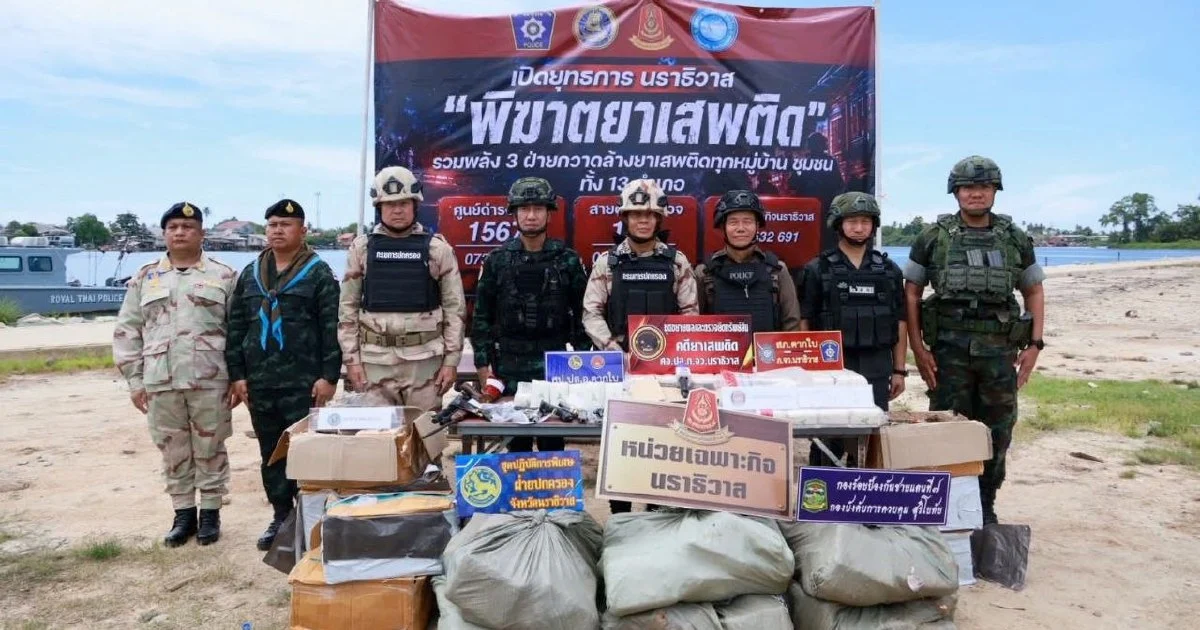
Thai authorities have arrested 233 individuals suspected of involvement in drug trafficking operations across Narathiwat province following an intensive month-long police campaign targeting organized criminal syndicates. The large-scale enforcement action has prompted renewed concerns about the flow of narcotics through Southeast Asian border regions, particularly along the porous frontier between southern Thailand and Malaysia, where criminal networks have historically exploited weak enforcement and limited cross-border cooperation to move contraband goods.
The Narathiwat crackdown represents one of Thailand's significant recent efforts to disrupt supply chains that funnel drugs into neighboring countries. Intelligence gathered by Thai police indicates that several of the arrested individuals maintain operational ties with Malaysian-based trafficking organizations, underscoring the transnational dimension of the region's drug problem. These connections reveal how criminal enterprises in both nations coordinate activities across borders, using established smuggling routes and exploiting gaps in surveillance and coordination between law enforcement agencies on either side of the shared frontier.
The strategic significance of Narathiwat as a trafficking hub lies in its geography and accessibility. The province sits adjacent to northern Malaysian states, particularly Perlis and Kedah, creating natural corridors for narcotics movement. Thai police have long identified this border region as critical for monitoring drug flows, both those destined for Malaysian consumption and those transiting through Malaysia toward more distant markets in Singapore and beyond. The province's remote terrain and limited economic opportunities have made it susceptible to infiltration by organized crime, with local communities sometimes drawn into trafficking networks through financial incentives or coercion.
Malaysia faces particular vulnerabilities in this context. As a major Southeast Asian hub for international trade and logistics, the country's ports, airports, and land borders offer traffickers multiple pathways for moving contraband. The country's own drug problem—reflected in significant domestic consumption rates and the government's sustained focus on supply reduction—creates demand that criminal networks are keen to satisfy. Malaysian authorities have in recent years intensified their own efforts to combat trafficking, though the sheer volume of legitimate commerce flowing through the country makes interdiction efforts inherently challenging.
The Thai operation's revelation of Malaysian connections suggests that coordinated regional enforcement strategies remain essential. When individual nations act unilaterally, traffickers simply adapt by shifting routes or adjusting operational methods. Thai successes in disrupting networks operating from Narathiwat are meaningful only if Malaysian authorities simultaneously target the receiving end of these supply chains and the Malaysian-based organizations coordinating with Thai counterparts. Without synchronized action across borders, arrests in one jurisdiction may simply cause temporary disruption rather than dismantling established criminal infrastructure.
Cross-border cooperation in Southeast Asia has improved incrementally over recent years, with ASEAN member states establishing information-sharing protocols and conducting joint operations. However, challenges remain. Corruption within enforcement agencies, limited resources in smaller nations, and occasional diplomatic tensions between countries can hinder effective collaboration. The Narathiwat arrests highlight both the need for such cooperation and its limitations—while Thai police can target local networks, breaking connections to Malaysian operations requires Malaysian authorities to act simultaneously, a coordination that does not always occur seamlessly.
The broader context involves the evolution of drug trafficking methods in the region. Traditional heroin trafficking through the Golden Triangle has been supplemented by newer synthetic drugs, particularly methamphetamine in tablet and crystal forms, which are easier to produce, transport, and distribute than plant-based narcotics. These drugs are manufactured in clandestine labs across Southeast Asia, including in Thailand, and command high prices in markets across the region. Criminal organizations have become increasingly sophisticated, employing counter-surveillance tactics, using encrypted communications, and maintaining compartmentalized operations that allow them to survive law enforcement disruptions.
For Malaysian policymakers and law enforcement, the Thai operation carries important implications. It demonstrates that the threat from transnational trafficking remains acute and that success in neighboring countries can generate knock-on benefits for Malaysia if the momentum is maintained through coordinated follow-up. It also underscores the importance of investment in border security infrastructure, intelligence gathering, and enforcement capacity in states like Perlis and Kedah, which face direct exposure to trafficking flows originating from Narathiwat and other Thai provinces.
The 233 arrests should not be interpreted as a final blow to trafficking networks but rather as a significant disruption that will force reorganization among criminal syndicates operating across the region. History suggests that arrests of this scale typically result in temporary supply constraints followed by adaptation as surviving members restructure operations and recruit replacement personnel. The real measure of success lies in whether the Thai operation catalyzes sustained enforcement momentum and enhanced coordination with Malaysian authorities to prevent these networks from quickly reestablishing their earlier operational capacity and market position.

