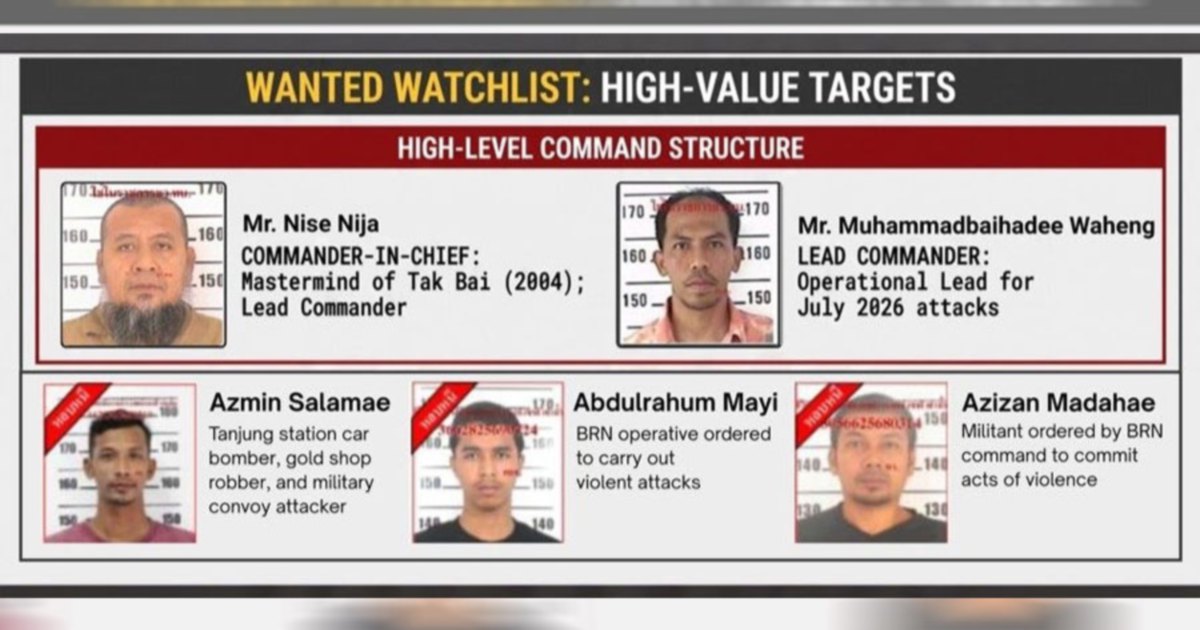
Thai law enforcement has launched a manhunt for five individuals suspected of orchestrating an armed assault on a security checkpoint in Narathiwat province's southern borderlands. The incident, which occurred on July 22 at a checkpoint position along Bukit Sami Municipal Road in Tanjong Mas subdistrict, Ra-ngae district, resulted in fatalities and injuries among checkpoint personnel. The issuance of formal arrest warrants represents a significant escalation in the investigation and signals authorities' determination to bring those responsible to justice.
Narathiwat, Thailand's southernmost province, has long been a flashpoint for security concerns and militant activity. The region's proximity to Malaysia and its diverse ethnic and religious demographics have made it vulnerable to armed insurgency and cross-border tensions. The ambush typifies the kind of coordinated violence that has plagued the province for years, creating an atmosphere of insecurity that affects both Thai officials and local communities caught in the middle of the conflict.
The specific targeting of a security checkpoint underscores the strategic intent behind the operation. Such facilities represent visible symbols of state authority and are typically manned by military or police personnel tasked with maintaining order and preventing smuggling or militant movement across vulnerable territory. By attacking a checkpoint, perpetrators send a message challenging governmental control while also potentially attempting to acquire weapons, intelligence, or simply to inflict symbolic damage.
The number of suspects identified—five individuals—suggests the ambush was not an spontaneous act of violence but rather a planned operation requiring coordination and preparation. This level of organization points toward involvement by established militant networks or insurgent groups operating in the region, rather than isolated extremists. Such groups typically have logistical infrastructure, safe houses, weapons caches, and operational experience that enable them to execute complex attacks.
From a Malaysian perspective, developments in Thailand's southernmost provinces carry significant implications. Narathiwat's position directly across the border from Kelantan and Terengganu means that instability, weapons trafficking, or militant movement can have direct ramifications for Malaysian security. Cross-border criminal networks and insurgent movements have historically used the shared maritime and land boundaries to evade capture, seek refuge, or launch operations. Malaysian authorities maintain close cooperation with Thai counterparts to monitor threats and prevent spillover effects.
The investigation's progress depends heavily on intelligence gathering, witness cooperation, and coordination among Thai security agencies. Local informants and community engagement often prove crucial in apprehending suspects in insurgency-affected areas, though fear and distrust can hinder cooperation. Authorities must balance enforcement operations with efforts to build trust among civilians who may possess critical information but fear retaliation or further violence.
Regional security analysts view the persistent violence in Thailand's south as symptomatic of deeper grievances rooted in historical marginalization, economic disparities, and identity concerns. The predominantly Muslim population in provinces like Narathiwat has expressed frustrations over perceived Thai Buddhist-majority government policies, educational inequities, and limited representation in national governance. While criminal networks exploit these tensions, addressing underlying causes requires longer-term political and social reforms alongside security operations.
The timing and nature of such attacks can also reflect broader patterns of insurgent activity. Seasonal fluctuations, reactions to government policies, or responses to military operations often influence the frequency and intensity of violence. Understanding these patterns helps analysts predict potential flashpoints and allows security forces to position resources more effectively, though preventing determined attackers remains perpetually challenging.
International dimensions add complexity to the situation. Various Southeast Asian nations have expressed concerns about transnational terrorist networks and criminal syndicates that exploit border regions. Intelligence sharing through regional forums and bilateral arrangements has improved over recent years, but gaps remain. The arrest and prosecution of suspects requires coordination across jurisdictions and sometimes involves extradition processes that can extend investigations significantly.
For ordinary citizens in Narathiwat and surrounding areas, such violence creates a cycle of fear that disrupts daily life, economic activity, and social cohesion. Markets, schools, and transportation networks all experience disruption when security incidents occur or sweeping operations commence. Long-term peace in the region requires not only apprehension of perpetrators but sustained efforts to address grievances and create conditions where communities have alternatives to violence and insurgency.

