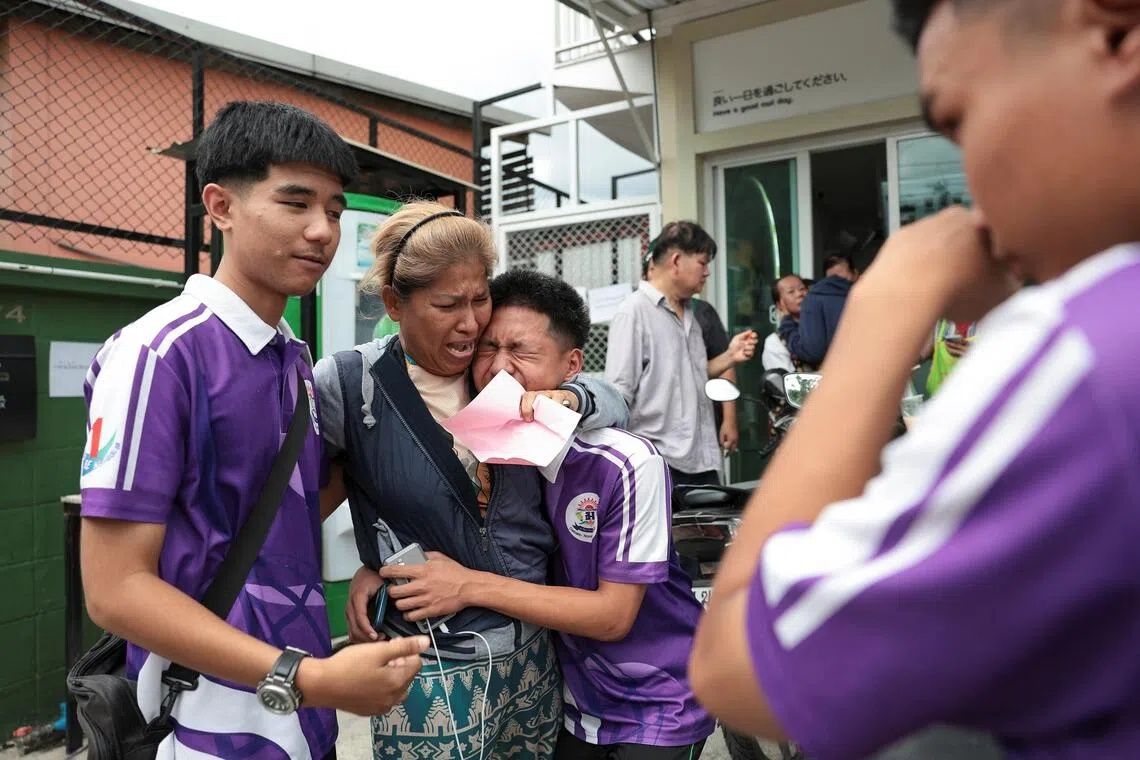
Stunned Thai students clung to one another in grief outside Debsirin Nonthaburi secondary school on Friday following a shooting rampage by a 14-year-old classmate who fatally wounded at least five members of the school's staff before ending his own life. The incident unfolded in Nonthaburi province, just north of Bangkok, leaving the sprawling government campus paralysed by emergency responses as parents rushed to locate their children and medical teams attended to the wounded.
Witnesses to the tragedy conveyed their anguish in fragmented recollections. Thatchai Jaiyen, a 16-year-old student, struggled to articulate his devastation over the death of a former instructor he held in high regard. The young man explained that he had believed the slain teacher possessed such integrity and compassion that she might have successfully communicated with the shooter had their paths crossed during the violence. The loss seemed to defy his sense of logic and fairness, leaving him oscillating between shock and profound sorrow.
Investigators determined that the teenager's violent spree commenced at his family residence approximately 20 kilometres from the school. Police accounts indicate that he first fatally shot both his grandparents using his grandfather's firearm, then travelled to the secondary institution where he killed a mathematics instructor, a Thai language teacher, the school's guidance counsellor, a student affairs official, and an administrative secretary before concluding with suicide. The sequence of events painted a picture of premeditated violence that rippled through an entire community.
Debsirin Nonthaburi stands as one of the province's most esteemed educational establishments, serving students across multiple grade levels. Its reputation as a prominent institution made the breach of safety all the more jarring for the school community. Grade 12 student Pakonkiat Sangchan described the moment he perceived the gunman approaching the school building, prompting him and nearby classmates to flee without hesitation. His recollection captured the raw instinct for survival that overtook rational thought in those terrifying moments.
Classmates who had known the shooter offered glimpses into his inner world, painting a portrait of a teenager wrestling with serious psychological difficulties. Purin Khumchoo, 17, characterised him as troubled yet disturbingly composed during the attack, noting how methodically the boy wielded the weapon despite his apparent emotional turmoil. Purin revealed that peers familiar with the suspect had observed his fascination with law enforcement agencies and firearms, alongside suffering systematic bullying from other students—a combination suggesting layers of isolation and grievance that may have culminated in violence.
Prime Minister Anutin Charnvirakul offered additional context during remarks to media, noting that the shooter's paternal grandmother, now deceased, had been a former educator who maintained exacting standards regarding her grandson's academic performance. This detail suggested a household environment potentially characterised by considerable pressure and stringent expectations, though investigators would need to examine the fuller circumstances of his upbringing.
Students described their experiences of active shooter protocols with harrowing clarity. Pawarisa Maylissa was participating in a computer class when her instructor announced the emergency, prompting the group to barricade themselves within the classroom and conceal themselves beneath furniture. As subsequent gunfire echoed through the corridors, the terrified students remained hidden, confronting their vulnerability in that confined space. The physical act of hiding beneath desks underscored the shocking reality that such incidents, long considered distant threats in news coverage, had materialised within their own school.
Neighbours of the shooter's family residence recounted their observations with the detached puzzlement of those who encounter violence in familiar surroundings. One woman described hearing two pronounced bangs early Friday morning, initially uncertain whether the sounds originated from firecrackers or gunshots—a hesitation that reflected the psychological distance many maintain from such realities until tragedy forces recognition. She subsequently learned that the grandmother who had once instructed her son now lay dead, collapsing the boundary between community and casualty.
The incident underscores a persistent problem afflicting Thailand, where civilian gun ownership remains extraordinarily widespread across the Southeast Asian region. The nation has witnessed multiple mass shooting episodes despite periodic governmental pledges to strengthen firearms regulations, yet such commitments have repeatedly failed to translate into effective legislative measures. Pawarisa articulated the fears now circulating among her peers: how had a child secured access to lethal weaponry, and how many others might possess similar access to firearms?
The tragedy illuminates the complex intersection of adolescent mental health, social ostracisation, and weapons accessibility that periodically erupts into violence in Thailand and elsewhere. Students who had interacted with the shooter characterised him as an ordinary teenager in many respects—someone who enjoyed basketball and kept pets—yet simultaneously a young person harbouring dangerous fixations and experiencing profound social rejection. This duality haunts those left behind, forcing uncomfortable recognition that catastrophe can emerge from classmates they thought they understood.
For Debsirin Nonthaburi's student body, the immediate aftermath brought collective trauma and individual reckoning with fragility. The slain staff members earned particular remembrance from students whose lives had been shaped by their instruction and mentorship. The community now confronts not merely the fact of five deaths, but the rupture of institutional trust and the unsettling knowledge that their school, despite its prominence and presumed security, could not prevent determined violence from penetrating its grounds.

