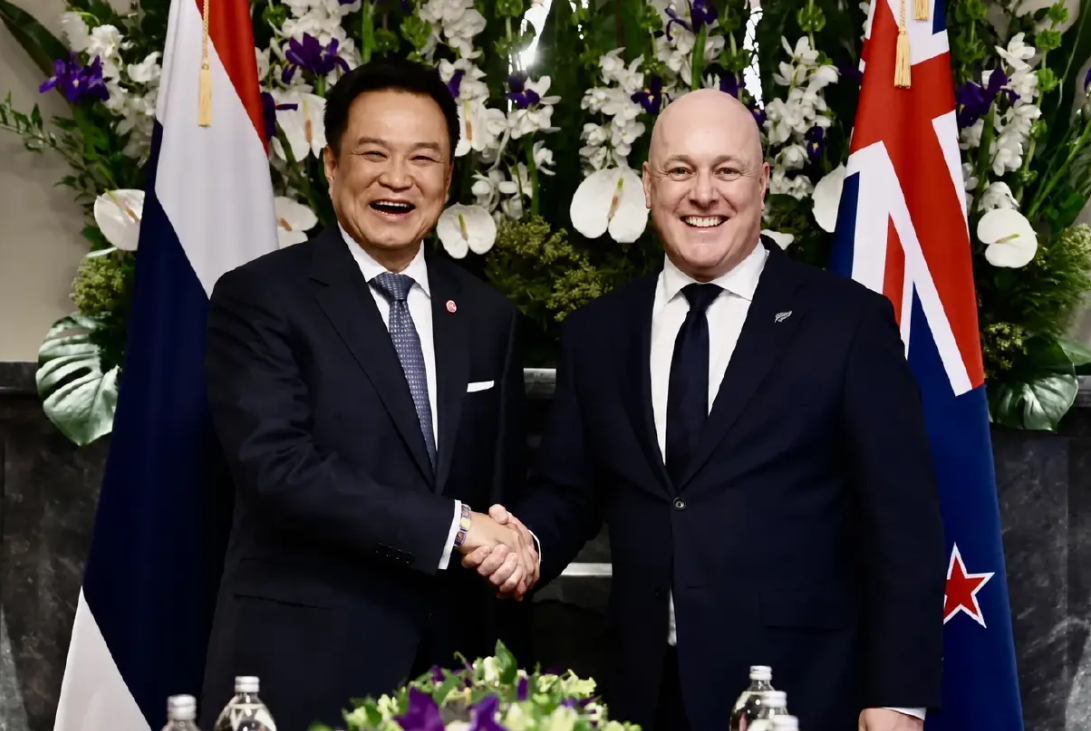
Thailand and New Zealand have taken a significant step to deepen their relationship by formalising a strategic partnership that promises to reshape economic and diplomatic ties between the two nations. Prime Minister Anutin Charnvirakul and New Zealand Prime Minister Christopher Luxon signed the Joint Declaration on the Strategic Partnership following bilateral discussions in Wellington on Friday, marking a pivotal moment as the countries commemorate seven decades of diplomatic relations. The elevation from conventional bilateral engagement to a strategic partnership signals mutual commitment to addressing shared challenges and pursuing common opportunities across multiple domains.
Central to this upgraded relationship is an audacious economic goal: tripling bilateral trade to US$7.5 billion, equivalent to approximately 246 billion baht, by 2045. This target reflects confidence in expanding commercial ties that have historically remained modest relative to the two nations' combined economic potential. The trade target underscores recognition that increased economic interdependence can strengthen political relationships and create sustained prosperity for businesses and workers in both countries. For Thai exporters and investors, this commitment opens pathways to tap into New Zealand's developed market and stable regulatory environment, whilst New Zealand enterprises gain clearer signals of welcome access to Southeast Asian opportunities.
The strategic partnership framework encompasses four distinct pillars designed to create comprehensive cooperation. The political and security dimension prioritises tackling transnational threats, with particular emphasis on combating organised crime, online fraud networks and human trafficking. This reflects contemporary security realities facing both nations and the broader Indo-Pacific region. Strengthened law-enforcement coordination and intelligence-sharing between Thai and New Zealand agencies represent practical mechanisms through which the partnership translates into tangible security outcomes that protect citizens and maintain regional stability.
The economic and innovation pillar forms the commercial heart of the partnership. Beyond the headline trade target, both governments have committed to nurturing closer ties in food security, renewable energy, sustainable agriculture and environmental conservation. These sectors align with global megatrends driving investment and innovation, particularly the transition towards green economies. For Malaysia and Southeast Asia more broadly, the Thailand–New Zealand partnership demonstrates how regional economies can position themselves as partners in addressing climate change and resource sustainability whilst simultaneously pursuing economic growth.
Education, cultural exchange and people-to-people connections constitute the third pillar, reflecting recognition that sustainable partnerships require deep societal roots. Expanded cooperation in skills development and capacity-building promises to enhance human capital in both nations whilst promoting cultural understanding. This dimension assumes particular importance given geographical and cultural distances between the two countries, where deliberate efforts to foster familiarity can prevent misunderstandings and build constituencies for continued cooperation.
The fourth pillar positions the bilateral partnership within broader regional and multilateral frameworks, including engagement through Mekong cooperation mechanisms and Asean-led institutions. This placement reflects Thailand's status as an Asean member and New Zealand's strategic interest in Indo-Pacific stability. By anchoring bilateral ties within established multilateral structures, both countries signal commitment to rules-based international order and emphasise that their partnership serves regional rather than exclusively bilateral interests.
The resumption of direct air services between Bangkok and Auckland emerges as a crucial enabler of this expanded relationship. Thai Airways' target commencement of direct flights in March 2027, with potential for earlier restart, addresses a longstanding connectivity gap that has constrained tourism, business travel and personal exchanges. Direct aviation links typically generate multiplier effects throughout tourism and hospitality sectors, whilst facilitating business meetings and educational partnerships that might not otherwise occur. For Malaysian travellers and businesses, enhanced Thailand–New Zealand connectivity demonstrates how aviation infrastructure investments support broader economic integration strategies.
The partnership also reflects Thailand's international positioning ambitions. Prime Minister Anutin sought New Zealand's support for Thailand's application to join the Organisation for Economic Co-operation and Development, with Luxon providing affirmation. Admission to the OECD, a club of wealthy developed economies, would represent validation of Thailand's economic and governance standards whilst providing access to policy expertise and comparative benchmarking. Regional observers will watch whether Thailand's strategic partnership approach yields diplomatic dividends for its OECD aspirations.
Four subsidiary agreements signed concurrently address specific cooperation domains: cultural exchange, civil service education coordination, police partnership and private-sector technology collaboration between Chata Instruments and Aeroqual Limited. These instruments translate high-level declarations into operational frameworks with identifiable objectives and implementing agencies. The diversity of signatories—government ministries, law-enforcement bodies and private companies—reflects comprehensive engagement across state and non-state actors.
The timing of this partnership's formalisation carries significance within Thailand's broader geopolitical context. Regional tensions, evolving great power competition and transnational challenges necessitate Thailand cultivating relationships with middle-power democracies like New Zealand that share commitment to multilateralism and stable order. New Zealand's geographical distance from Southeast Asia paradoxically enhances its utility as a trusted partner unburdened by immediate regional competition or historical tensions that complicate relationships among neighbouring states.
For Malaysian policymakers and business communities, the Thailand–New Zealand strategic partnership offers instructive lessons about deepening bilateral relationships through structured frameworks and ambitious shared targets. The emphasis on sectoral diversification—security, trade, education, culture—mirrors approaches that Southeast Asian countries increasingly adopt to create resilient partnerships less vulnerable to disruption from political fluctuations or external shocks. The explicit timeline and quantified trade goal provide accountability mechanisms that differentiate this arrangement from purely rhetorical partnerships.
The partnership's emphasis on inclusive prosperity and sustainable development aligns with global priorities articulated through the United Nations Sustainable Development Goals and Paris Climate Agreement. By highlighting environmental conservation, renewable energy and sustainable agriculture alongside conventional trade and investment, Thailand and New Zealand position their relationship as responsive to contemporary challenges whilst building commercial opportunities. This framing appeals to younger constituencies and investors increasingly concerned with environmental and social governance criteria.
Looking forward, the success of this strategic partnership will depend on implementation rigour, continued political commitment across government transitions, and tangible outcomes that demonstrate benefits to ordinary citizens. The tripling of trade to US$7.5 billion represents an ambitious but achievable target given projected regional growth trajectories. Restored aviation connectivity serves as an early test of partnership substance. For Southeast Asia's broader integration project, this Thailand–New Zealand arrangement exemplifies how individual bilateral relationships can strengthen regional cohesion when structured around shared values, complementary interests and rules-based cooperation.

