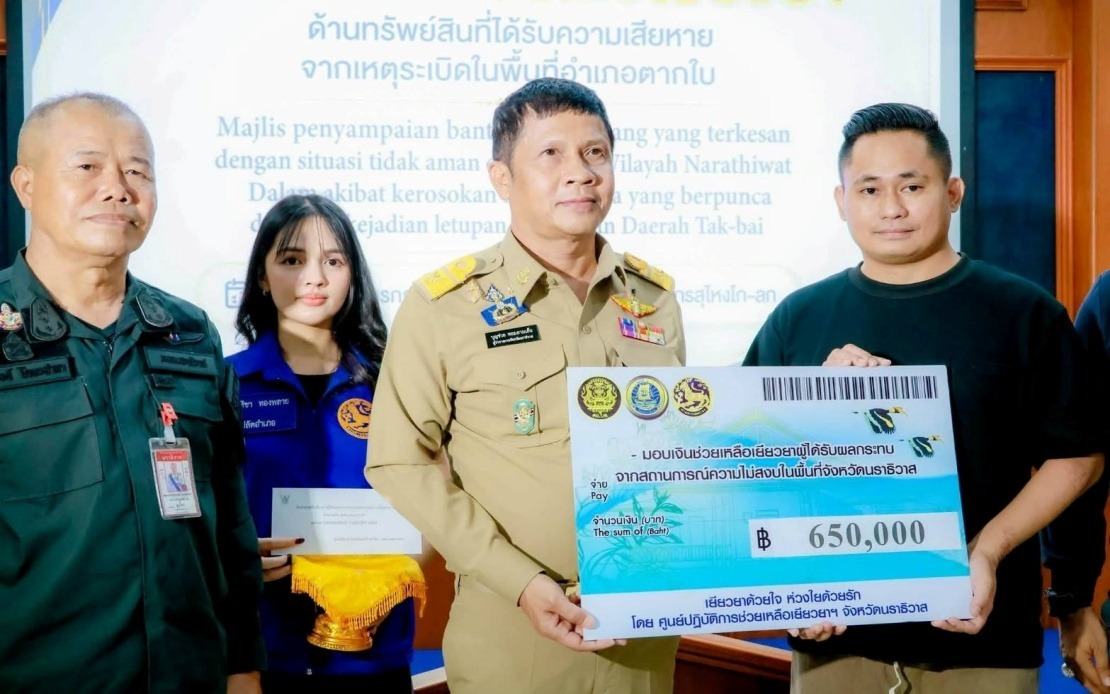
Malaysia's diplomatic relations with Thailand have been reinforced through a compensation package delivered to one of two Malaysian nationals injured in a roadside bombing in Thailand's Deep South. On Friday, Narathiwat Governor Boonchuay Homyamyen formally presented 650,000 baht—equivalent to roughly RM80,000—to Muhammad Yusri Udin at the Sungai Golok Customs Office, marking an official acknowledgment of responsibility and commitment to victim support following the security incident.
The bomb explosion occurred on June 29 near the Sapom junction in Tak Bai district, detonating at approximately 11.40 am local time. Muhammad Yusri, aged 38, and his companion Abdullah Syarapi Abd Rahman, 45, sustained injuries from an improvised explosive device that had been concealed in a roadside drainage channel. Thai authorities have clarified that the pair were not the intended targets, suggesting the attack was directed at other objectives by what officials believe was a separatist militant group operating in the volatile border region.
The Thai government's swift response in providing compensation demonstrates its desire to maintain bilateral goodwill with Malaysia, particularly given the region's sensitivity and the need to reassure neighbouring countries about security standards. Governor Boonchuay expressed official regret over the incident during the handover ceremony, emphasising that the Thai administration takes full responsibility for ensuring visitor safety. His public statements underscored that Bangkok is not merely offering financial redress but signalling a broader commitment to improving conditions in the southern provinces where cross-border trade and tourism remain economically significant.
The compensation was processed through a dedicated Thai government fund established specifically to support victims of security-related incidents. This mechanism encompasses both personal injury claims and property damage reimbursements, providing a structured framework for addressing collateral civilian harm resulting from insurgent activities. The existence of such a fund reflects the ongoing security challenges in Thailand's southern border provinces, where explosions and armed clashes have been intermittent yet recurring phenomena for years.
In the immediate aftermath of the June 29 incident, Thai security forces mobilised comprehensively to address the threat. A 40-year-old suspect was apprehended, though details regarding the individual's background and alleged affiliations have not been disclosed publicly. Simultaneously, authorities conducted extensive explosive ordnance disposal operations at and surrounding the blast site, coupled with forensic investigations to recover evidence and establish the device's origin and construction methodology. These investigative measures typically form part of Thailand's counter-insurgency efforts in Narathiwat, Yala, and Pattani provinces, where militant groups have waged sporadic campaigns since the early 2000s.
For Malaysian readers and cross-border communities, such incidents carry particular resonance. The Deep South provinces sit adjacent to Malaysia's Perlis and Kedah, and the border region hosts significant commercial activity involving Malaysian traders, tourists, and workers. Security incidents that affect Malaysian nationals inevitably prompt questions about the adequacy of safeguards and bilateral security cooperation. The Thai government's compensation gesture, while financially modest in absolute terms, signals that Bangkok acknowledges its responsibility to foreign nationals within its borders and is prepared to provide recourse when harm occurs through no fault of visitors.
Governor Boonchuay's public assurances regarding enhanced security measures carry importance for Malaysia's tourism and business sectors. He stated explicitly that Thailand will not remain passive in addressing security threats and reiterated the administration's determination to restore international confidence in visiting the region. Such messaging is crucial for Southeast Asian nations where perceptions of safety directly influence travel patterns and investment flows. Malaysian businesses with operations or supply chains extending into southern Thailand monitor these statements carefully, as security deterioration can disrupt commerce and necessitate costly contingency planning.
The incident also highlights the persistent challenge of militant activity in southern Thailand, an issue that has affected regional stability for decades. While the separatist insurgency has ebbed and flowed in intensity, recurring attacks—particularly those targeting infrastructure and civilians—demonstrate that the underlying conflict remains unresolved. Thai security forces maintain an active presence in the region, yet the ability of insurgent groups to construct and deploy improvised explosive devices indicates continued organisational capacity and access to materials. The apprehension of a 40-year-old suspect may yield intelligence, but resolving the broader security situation requires political dialogue and developmental initiatives alongside military operations.
For Malaysia's government, managing the welfare of citizens affected by incidents abroad involves diplomatic channels and formal mechanisms. The coordination evident in this compensation case—with the Thai governor presenting the award at a customs office location symbolically situated between nations—reflects established protocols for cross-border incident management. Malaysian authorities likely engaged with Thai counterparts to expedite the compensation process, demonstrating the practical cooperation that undergirds bilateral relations despite occasional tensions over maritime boundaries and refugee issues.
Looking forward, the implications of this incident ripple across Southeast Asia's border regions where security challenges persist. Thailand's response sets a precedent for how nations should address harm to foreign nationals resulting from internal security threats. By compensating injured Malaysians and publicly committing to enhanced protective measures, Bangkok attempts to prevent diplomatic escalation and maintain regional goodwill. However, the underlying security vulnerabilities remain, and similar incidents may recur unless Thailand's government implements comprehensive counterinsurgency strategies that combine military operations with political reconciliation and socioeconomic development in the southern provinces.

