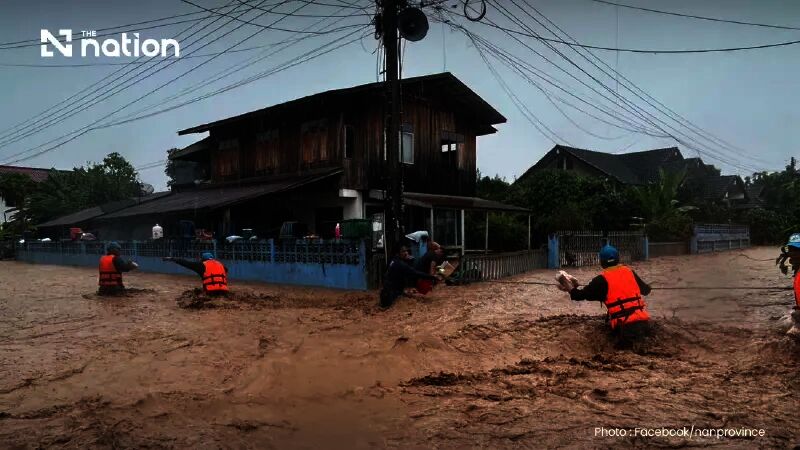
Thailand's government has formally declared Nan province a disaster area following severe flooding triggered by persistent heavy rainfall across the northern region, with two neighbouring provinces now under heightened alert status. The declaration came as roads remained impassable and residents were forced to flee their homes to escape rising floodwaters, prompting an urgent coordinated response from multiple government agencies and military units.
Prime Minister Anutin Charnvirakul, currently undertaking an official visit to Australia, has maintained direct oversight of the unfolding crisis through remote communication with his cabinet and disaster management teams. Rather than interrupt his diplomatic commitments, the premier has issued comprehensive instructions to coordinate relief operations across all relevant agencies, demonstrating the scale of the emergency response now mobilised at the highest levels of government.
The Prime Minister's directives emphasise the deployment of rapid-response teams and heavy machinery to regions identified as particularly vulnerable, with an immediate focus on removing accumulated floodwater from low-lying areas that historically experience inundation during the monsoon season. This preventive approach reflects lessons learned from previous flooding events and represents an attempt to mitigate damage before water levels reach critical thresholds that would render rescue operations more difficult and dangerous.
Government spokesperson Rachada Dhnadirek highlighted that the Prime Minister has explicitly prioritised human safety above other considerations, with particular attention directed toward protecting the most vulnerable populations including elderly residents, hospitalised patients, and young children who face heightened risks during natural disasters. The instruction underscores the importance of rapid damage assessments across affected communities and continuous monitoring of meteorological data to enable timely public warnings should rainfall intensity increase further.
Meanwhile, Deputy Prime Minister Yodchayan Wongsawat, who holds responsibility for northern flood mitigation efforts, has issued separate directives to provincial governors in Nan, Phayao, and Lamphun demanding that comprehensive preparedness measures be implemented immediately. This parallel chain of command from the deputy prime minister reflects the seriousness with which officials view the meteorological forecasts and the potential for the situation to deteriorate significantly over the coming days.
The Thai Meteorological Department's extended forecast for August predicts continued atmospheric instability characterised by scattered thunderstorms, concentrated periods of heavy precipitation, and gusty winds—conditions that systematically increase the likelihood of flash flooding, overland water runoff, and slope failures across steep terrain. These meteorological patterns are typical of the region's southwest monsoon season, which annually brings substantial water to Thailand's northern watersheds and periodically causes major flooding events that displace communities and damage agricultural zones.
The warning issued to residents extends beyond Nan and its two adjacent provinces, encompassing the entire northern region as well as north-eastern and central zones of the country. This broader alert reflects meteorological concerns that the weather system responsible for current flooding may migrate southeastward and eastward, potentially affecting a much wider geographic area and complicating relief and recovery efforts across multiple regions simultaneously.
The timing of this disaster declaration carries particular significance for Thailand's monsoon-prone geography. The nation's topography, characterised by river valleys and alluvial plains surrounded by elevated terrain, creates natural collection basins for rainfall and runoff. When tropical systems stall over these regions or deliver exceptionally heavy precipitation, the combination of steep upstream gradients and limited downstream drainage capacity frequently overwhelms local infrastructure, particularly in rural and provincial areas where flood-control systems remain less developed than in urban centres.
For Malaysian observers, Thailand's experience with northern flooding carries direct relevance given the shared monsoon patterns affecting mainland Southeast Asia and the importance of the Mekong River system that links multiple countries. Thailand's approach to disaster management—emphasising coordination between civilian and military resources, remote command structures, and focus on vulnerable populations—offers insights into regional approaches to climate-related emergencies that are becoming increasingly frequent across Southeast Asia as extreme weather events intensify.
The declaration of Nan as a formal disaster zone triggers specific governmental protocols and financial mechanisms that enable rapid deployment of resources, compensation frameworks for affected residents, and coordination with international humanitarian actors if assistance proves necessary. This administrative designation represents not merely symbolic recognition of the emergency but a substantive activation of Thailand's disaster response apparatus with implications for budgetary allocations, inter-agency coordination, and public resource prioritisation over the coming weeks.

