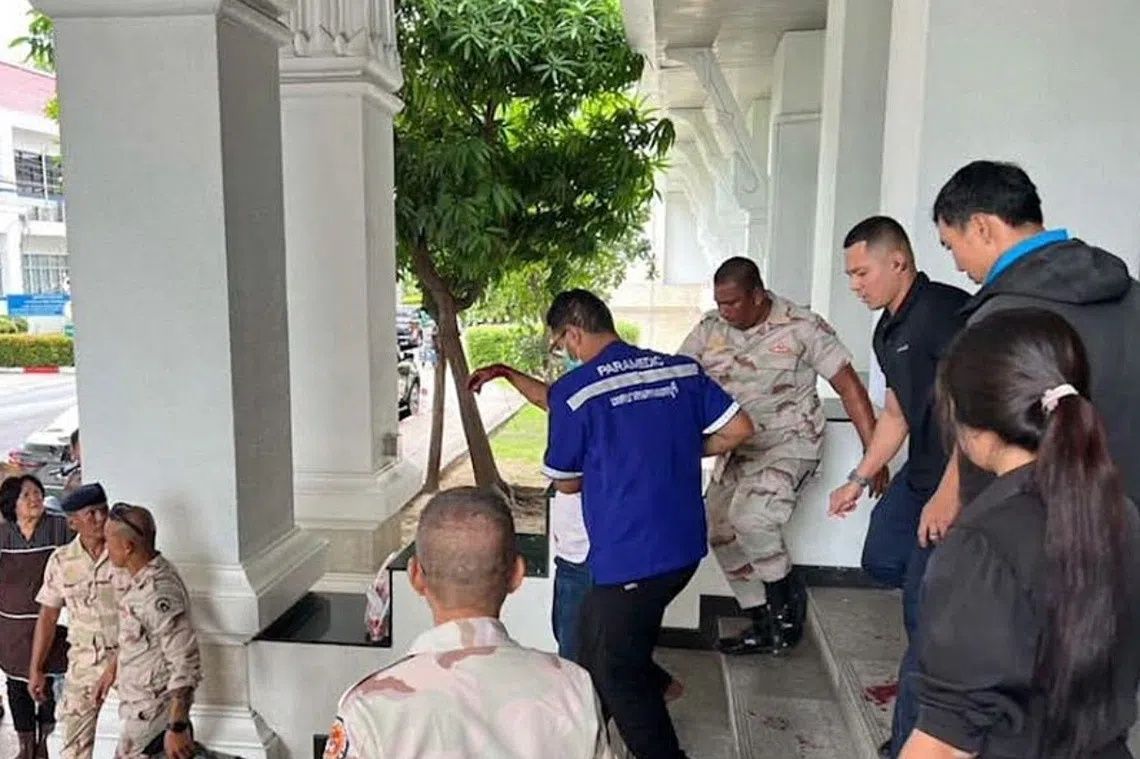
Thailand's fragile peace was shattered again on Monday when a former lawmaker opened fire at a local government office on Bangkok's outskirts, injuring two officials and reigniting urgent conversations about the nation's approach to firearms regulation. The incident, which saw the suspected gunman swiftly apprehended by authorities, unfolded just days after one of the country's most devastating mass shootings in recent memory, suggesting that Thailand faces a deepening crisis of gun violence that extends far beyond isolated incidents.
According to provincial police commander Major General Dejrapee Kongdee, the former lawmaker discharged his weapon at a senior provincial official and the official's driver during the Monday morning attack. Both victims sustained injuries and were transported to hospital, where they received medical treatment. The rapid apprehension of the suspect prevented what could have become an even more tragic situation, though the incident underscores the ease with which firearms continue to be deployed in acts of violence across Thailand.
The timing of this shooting proves particularly alarming given the context of Friday's massacre at Debsirin Nonthaburi School, which claimed nine lives and left over twenty people wounded in Thailand's deadliest mass shooting incident in nearly four years. That tragedy unfolded when a fourteen-year-old boy first shot his grandparents before proceeding on a shooting rampage through the school premises, ultimately taking his own life. The school shooting shocked the nation and prompted immediate calls for stricter firearm regulations, yet Monday's incident demonstrates that such violence is not limited to a single perpetrator or isolated to educational settings.
The concentration of these two major shooting events within the same province within such a brief timeframe has intensified scrutiny on Thailand's gun ownership policies and enforcement mechanisms. Questions now surface about how firearms find their way into the hands of individuals—whether teenagers, former politicians, or other potentially unstable persons—without adequate safeguards or intervention. The proximity of these incidents suggests systemic vulnerabilities in Thailand's firearms management that extend across multiple sectors of society and age groups.
In the immediate aftermath of Friday's school shooting, Prime Minister Anutin Charnvirakul signalled his administration's commitment to strengthening gun control measures. The precise details of proposed legislation remain unclear, but the government's stated intention reflects acknowledgement that existing regulations have proven insufficient to prevent mass casualty incidents. Such announcements carry particular weight in Thailand's political context, where security and public safety rank among the most sensitive governance issues.
The response from Thai educational authorities demonstrated heightened security consciousness as schools reopened on Monday. Students at various institutions passed through metal detectors and underwent additional security screening as they returned to classrooms, a visible manifestation of the anxiety gripping families and educators. These measures, while providing some psychological reassurance, simultaneously underscore the troubling reality that schools in Thailand now require airport-style security protocols to protect children from armed violence.
Thailand's struggle with gun violence reflects broader regional challenges shared by several Southeast Asian nations, where rapid urbanisation, changing social dynamics, and inadequate regulation of firearms have created conditions for sudden, catastrophic incidents. Malaysia and other neighbouring countries have implemented various approaches to firearm regulation, offering potential models that Thai policymakers might examine as they formulate stricter controls. The transnational dimensions of gun violence and the comparative effectiveness of different regulatory regimes warrant serious consideration in Thailand's policy discussions.
The involvement of a former lawmaker in Monday's shooting adds a particularly troubling dimension to Thailand's ongoing security crisis. That an individual with political background and presumed familiarity with legal processes allegedly resorted to gun violence suggests that the problem transcends simple categories of criminal elements or unstable individuals acting outside normal social structures. This incident raises uncomfortable questions about access to firearms among politically connected individuals and whether such connections have historically insulated certain groups from effective firearms regulations.
Experience from other nations indicates that effective gun control requires comprehensive approaches extending beyond mere legislative amendments. Background checks, mental health screening, secure storage requirements, licensing restrictions, and mandatory training represent components that numerous countries have implemented with varying degrees of success. Thailand's challenge lies in designing and implementing a coherent framework that addresses the particular cultural, political, and social contexts in which gun violence occurs within the kingdom.
The psychological impact on Thai society of experiencing two major shooting incidents in such rapid succession cannot be understated. Confidence in public safety erodes quickly when violence strikes schools and government offices with apparent randomness, creating a sense of vulnerability that extends across all demographic groups. This erosion of confidence in institutional safety places additional pressure on political leadership to deliver substantive, demonstrable progress on gun control rather than rhetorical commitments alone.
As Thailand moves forward, the challenge for policymakers involves translating the current moment of heightened public concern into sustainable, effective policy changes that address both supply and demand dimensions of gun violence. Whether Monday's incident galvanises meaningful reform or becomes absorbed into a succession of forgotten crises will largely determine whether Thailand can break the pattern of recurring mass shootings that now threatens to become normalised within the national experience.

