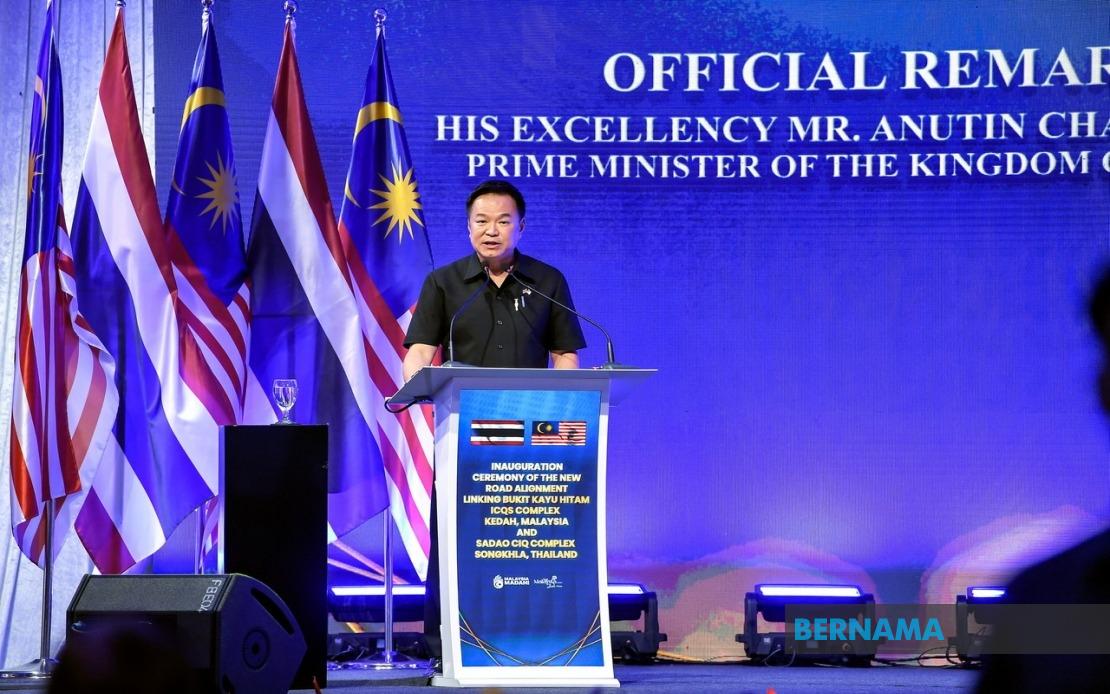
Thailand is determined to fill critical gaps in its transport network to enable the seamless passage of goods and people from Malaysia through Thai territory toward China, Russia, and other regional destinations, according to Thai Prime Minister Anutin Charnvirakul. Speaking at the inauguration of a newly constructed road alignment between the Sadao Customs, Immigration and Quarantine Complex in Thailand and the Bukit Kayu Hitam Immigration, Customs, Quarantine and Security Complex in Kedah, Anutin framed the project as part of a broader commitment to strengthen economic ties and regional connectivity across Southeast Asia and beyond.
The fresh road link represents a tangible outcome of collaborative efforts between Bangkok and Kuala Lumpur to streamline border procedures and reduce travel times for both passengers and commercial cargo. By shortening the route between the two inspection facilities, the alignment aims to alleviate congestion at one of the busiest crossing points along the Malaysia-Thailand frontier, a persistent bottleneck that has constrained bilateral trade and tourism flows. The project's completion signals a willingness on both sides to invest in physical infrastructure that facilitates genuine economic integration rather than merely rhetorical cooperation.
Anutin emphasised that the benefits of improved connectivity would operate bidirectionally, allowing Thai and Chinese merchandise to reach Singapore and Indonesia more expeditiously via Malaysian territory. This framing underscores how infrastructure investments at one border influence the competitiveness of entire regional supply chains. For Malaysian stakeholders, particularly in the northern states, the implication is that their economy becomes increasingly integrated into transcontinental logistics networks anchored in Thai and Chinese production hubs. The Malaysian Prime Minister Datuk Seri Anwar Ibrahim jointly inaugurated the facility, signalling institutional support for the initiative at the highest political level.
Beyond the immediate road project, both governments have identified three additional cross-border connectivity corridors requiring development: the Songkhla-Kedah route, the Satun-Perlis link, and the Narathiwat-Kelantan passage. These potential routes span the length of the shared frontier and collectively represent an ambitious vision for transforming the Malaysia-Thailand border from a conventional boundary into a permeable economic zone. Anutin's emphasis on unlocking the economic potential of southern Thailand and northern Malaysia suggests that Bangkok views regional inequality—particularly the relative underdevelopment of its southern provinces—as a strategic challenge that transcontinental connectivity can help address.
The practical implications for Malaysian consumers and businesses extend beyond mere convenience. Improved transport links typically reduce logistics costs, which can translate to lower consumer prices for goods imported through Thai ports and lower shipping costs for Malaysian exporters routing products through Thailand toward East and Central Asian markets. However, the benefits are unlikely to be distributed evenly. Large multinational corporations and established trading houses will capture disproportionate gains, while small and medium enterprises may struggle to leverage new infrastructure without complementary investments in logistics technology and trade financing facilities.
The focus on border procedures and documentation represents an often-overlooked aspect of regional integration. Anutin and Anwar discussed resolving outstanding procedural issues that currently impede cross-border movement, suggesting that bureaucratic harmonisation remains as important as physical infrastructure. In practice, traders and travellers frequently experience delays not from geographical distance but from incompatible regulatory frameworks, inconsistent interpretation of rules, and insufficient coordination between Thai and Malaysian authorities. Addressing these issues requires sustained administrative cooperation and mutual trust, arguably more challenging to achieve than ribbon-cutting ceremonies for new roads.
China's prominence in Anutin's remarks—he specifically mentioned facilitating flows to China and Russia—reflects Bangkok's strategic positioning of Thailand as a crucial hub for transcontinental commerce. The Belt and Road Initiative and associated infrastructure projects have incentivised Thailand to position itself as an indispensable node in East-West trade corridors. Malaysia, situated strategically between the Indian Ocean and South China Sea, benefits from this Thai vision insofar as improved connectivity enhances its own role in regional supply chains. However, Malaysia must ensure that becoming a transit hub does not translate into excessive economic dependency on Thai infrastructure or Chinese investment.
The ceremony itself, with both prime ministers present, symbolises a relationship characterised by pragmatic cooperation despite periodic tensions over shared maritime boundaries and water rights. The timing of Anutin's visit during Malaysia's implementation of significant economic policies suggests coordinated regional efforts to enhance competitive positioning amid global supply chain restructuring. Southeast Asian nations collectively are seeking to diversify away from China-dependent manufacturing, and improved intraregional infrastructure directly supports this goal by making shorter regional supply chains more viable economically.
For Malaysian policymakers, the challenge lies in ensuring that border infrastructure investments are matched by complementary domestic initiatives. Improved connectivity to Thailand and China yields limited benefits if northern Malaysian states lack the industrial capacity, skilled workforce, and business environment to attract investment or generate high-value exports. The road link between Bukit Kayu Hitam and Sadao is necessary but insufficient; upstream investments in education, digital infrastructure, and business development services remain critical priorities for translating physical connectivity into sustainable economic growth.
The commitment to resolving outstanding issues and deepening cooperation reflects a broader pattern of Southeast Asian pragmatism. Despite periodic bilateral disputes, Thailand and Malaysia have maintained relatively stable economic relationships and continue seeking mutually beneficial arrangements. This approach contrasts sharply with the protectionist trends evident in developed economies and offers lessons for regional integration architecture. The emphasis on creating job opportunities and improving livelihoods for border communities suggests awareness that connectivity benefits must be visibly distributed to populations closest to the border to maintain political support for continued integration efforts.
Looking forward, the success of this initiative will be measured not merely by traffic volumes crossing the new road but by whether genuinely expanded economic opportunities emerge in border regions. If improved connectivity primarily enables large corporations to exploit cheaper Thai labour or redirect supply chains away from Malaysian manufacturing, local populations may perceive the project as dispossessing rather than enriching. Conversely, if local entrepreneurs successfully establish cross-border businesses or if regional industries develop competitive advantages through reduced logistics costs, the connectivity initiative can deliver tangible development benefits that justify political commitment from both governments.

