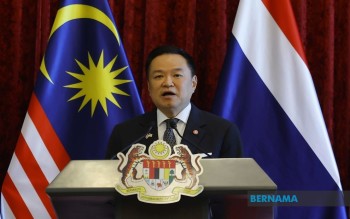
Thailand is poised to reach a major trade milestone with Malaysia, with Prime Minister Anutin Charnvirakul declaring confidence that the two nations will achieve a US$30 billion bilateral trade target by 2027. The optimistic outlook reflects deepening economic ties between the neighbours, who currently conduct trade worth approximately US$28 billion annually. Anutin made the assertion during a joint press conference with Prime Minister Datuk Seri Anwar Ibrahim at Perdana Putra Complex in Putrajaya on July 9, following the exchange of a memorandum of understanding between the two governments.
The proximity of current trade volumes to the target demonstrates the momentum already built into the Malaysia-Thailand economic relationship. With Malaysia serving as Thailand's largest trading partner within the Association of Southeast Asian Nations (ASEAN), the region's economic architecture increasingly hinges on the success of this bilateral corridor. The narrow gap of US$2 billion separating present-day commerce from the 2027 goal underscores the feasibility of the objective, provided both capitals maintain the requisite policy coordination and institutional support. Thai officials expect this target to be surpassed as complementary industrial strengths and geographic proximity drive incremental growth.
Anutin emphasised that Thailand will champion efforts to strengthen regional value chains and supply chains by leveraging the distinct competitive advantages each economy brings to the table. For Malaysia, this encompasses advanced manufacturing capabilities, financial services, and established logistics infrastructure. Thailand contributes agricultural production, petrochemical expertise, and automotive manufacturing prowess. The confluence of these strengths positions the bilateral relationship as a cornerstone of ASEAN economic integration, enabling both nations to compete more effectively in global markets and insulate themselves against external trade shocks.
Focal areas for future cooperation will concentrate on food security, energy security, and the burgeoning digital economy, including high-technology manufacturing sectors. These priorities reflect shared vulnerabilities and opportunities across Southeast Asia. Food security remains critical given both nations' reliance on agricultural exports and global supply chain disruptions. Energy security addresses rising demand in an increasingly developed region while climate pressures constrain conventional energy sources. The digital economy axis signals Bangkok and Kuala Lumpur's determination to position themselves competitively in artificial intelligence, semiconductors, and digital financial services—domains where regional players can build comparative advantage.
Anwar responded to the trade ambitions by committing Malaysia's governmental machinery to realising the target. He explicitly identified the Ministry of Foreign Affairs and the Ministry of Investment, Trade and Industry (MITI) as lead agencies responsible for driving progress toward the US$30 billion objective. This institutional delineation clarifies accountability and signals to the private sector that both governments view trade expansion as a strategic priority deserving senior-level attention and resources. The Malaysian premier characterised economic and trade fundamentals as the bedrock upon which sustainable bilateral friendship and collaboration must rest.
Beyond commerce, Anwar flagged tourism as an emerging pillar of the bilateral relationship warranting amplified efforts. Thailand and Malaysia represent reciprocal destinations of substantial importance to each other's tourism industries, with millions of visitors crossing borders annually. Enhanced connectivity, simplified visa procedures, and joint marketing initiatives could unlock considerable value, particularly as intra-ASEAN leisure travel recovers and expands post-pandemic. Tourism development would complement trade in creating jobs, strengthening people-to-people bonds, and diversifying the economic benefits of the relationship beyond conventional merchandise exchange.
The bilateral meeting between Anutin and Anwar served to comprehensively review progress across the Malaysia-Thailand partnership and chart strategic directions for expanded cooperation across multiple domains. This consultative framework ensures that trade negotiations proceed in tandem with broader diplomatic objectives and security considerations. The meeting also provided an opportunity to address any friction points that might impede commerce or strain political relations, critical for maintaining the stability necessary for sustained economic engagement.
Anutin's two-day official visit commenced on July 9, with his arrival at Kuala Lumpur International Airport at 11:11 am, marking his first journey to Malaysia in his capacity as prime minister since his reappointment in March 2026. The visit explicitly aimed to reinvigorate bilateral ties and deepen cooperation in sectors of mutual benefit. The timing and tenor of the visit underscore Thailand's commitment to the Malaysia relationship as a cornerstone of its broader Southeast Asian diplomacy and economic strategy.
The MoU exchange ceremony at Perdana Putra Complex symbolised the institutionalisation of the two nations' commitment to elevated cooperation. Such instruments typically establish frameworks for regular dialogue, dispute resolution mechanisms, and coordination protocols across government agencies. They serve to elevate trade from the realm of ad-hoc commercial transactions into structured, government-backed initiatives with policy backing and resource allocation. For Malaysian businesses contemplating expansion into Thailand or Thai firms eyeing Malaysian markets, such formal agreements reduce uncertainty and create predictability in regulatory environments.
The joint trade committee mechanism that Anutin referenced will assume responsibility for setting more ambitious targets beyond the US$30 billion 2027 goal. This forward-looking posture suggests that both capitals envision the bilateral relationship as perpetually evolving, with each milestone serving as a springboard for the next phase of integration. The committee structure also provides a forum for regular consultations, allowing both governments to respond dynamically to changing market conditions, emerging technologies, and evolving consumer preferences.
For Malaysia and Thailand, the pursuit of the US$30 billion trade target reflects broader aspirations to consolidate ASEAN's position as an economic hub of global significance. As geopolitical tensions and trade fragmentation characterise the international environment, intra-regional commerce becomes increasingly valuable as a stabilising force and source of resilience. The Malaysia-Thailand relationship, as ASEAN's most developed bilateral trade axis, demonstrates the viability of deep economic integration within the region and offers a template for other bilateral partnerships seeking to amplify their commercial relationships.
Looking beyond 2027, both nations appear intent on constructing a trading architecture resilient to external shocks and responsive to the exigencies of a rapidly transforming global economy. The emphasis on digital economy and high-technology industries signals recognition that traditional manufacturing alone cannot sustain competitiveness in an increasingly knowledge-intensive global marketplace. By aligning their ambitions and pooling institutional resources, Malaysia and Thailand are positioning themselves not merely as bilateral trade partners but as collaborative architects of a more integrated, prosperous Southeast Asia.

