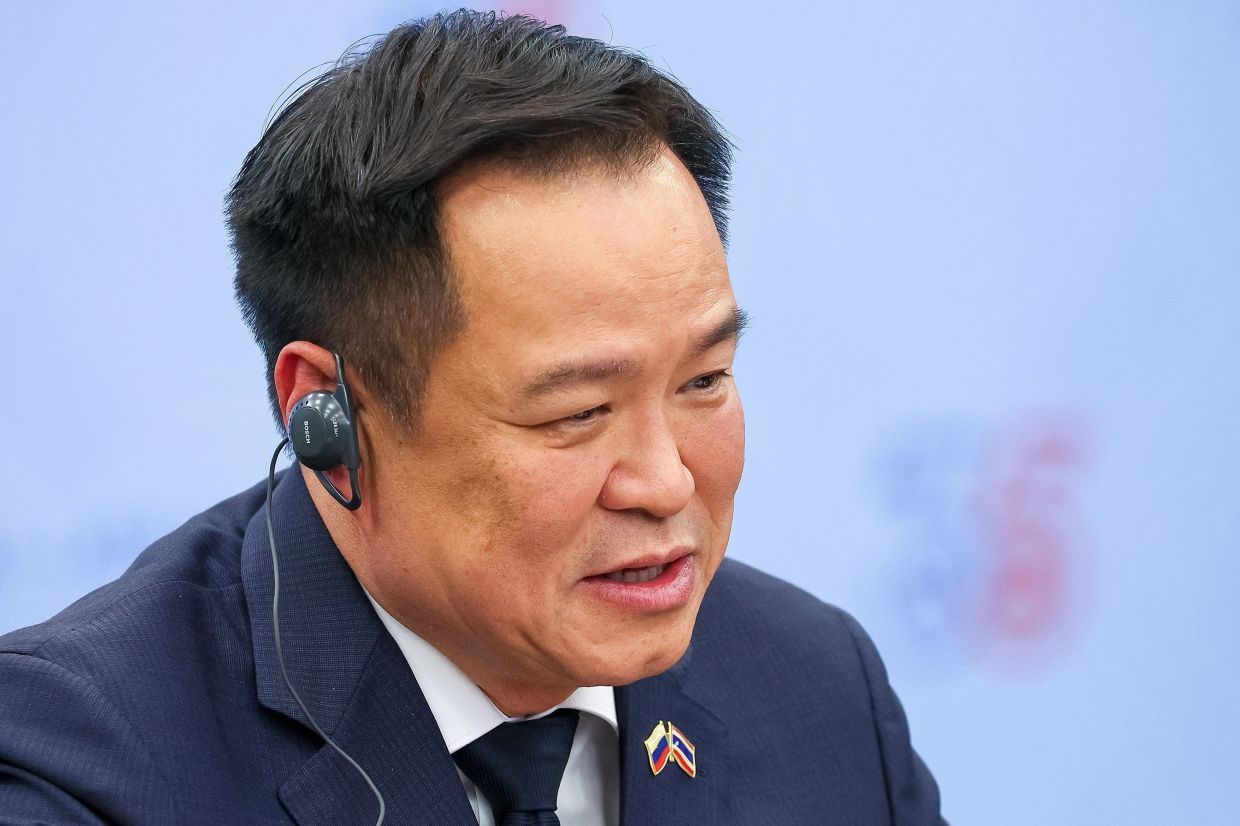
Thailand's 32nd prime minister, Anutin Charnvirakul, marks his centenary in office on June 27, arriving at the milestone having demonstrated considerable tactical competence in managing immediate crises while leaving longer-term structural challenges largely untouched. Since taking the oath on March 20 following his February 2026 election victory, the 59-year-old leader has consolidated his hold on power through careful navigation of geopolitical turbulence and strategic delivery of campaign promises, though observers increasingly question whether his approach amounts to governing or merely firefighting.
The government's most significant test arrived almost immediately upon Anutin's inauguration. The February 28 US-Israel military strikes on Iran set off a chain reaction of supply disruptions that reverberated across Southeast Asia's energy-dependent economies. Oil shipments through the critical Strait of Hormuz faced repeated interruptions, pushing crude prices above the US$100-per-barrel mark for sustained periods and laying bare the region's structural vulnerability to conflicts occurring thousands of kilometres away. Within Thailand's borders, the practical consequences manifested quickly: petrol stations struggling to replenish supplies as panic buying overwhelmed distribution networks, transportation costs climbing, and household fuel expenses adding pressure to already-stretched family budgets.
Anutin's administration responded with pragmatism rather than innovation, deploying existing policy mechanisms to blunt the shock. The national Oil Fuel Fund became the primary instrument for price stabilisation, with government subsidies absorbing the gap between market rates and what consumers paid at the pump. Simultaneously, coal-fired power plants ramped to maximum capacity, and officials initiated negotiations to diversify fuel sourcing from the United States, Malaysia, and Brunei, reducing dependence on Middle Eastern supplies. The approach earned qualified approval from political analysts, with University of Michigan researcher Mathis Lohatepanont observing that the government had successfully "weathered the initial storm" without triggering the street protests or social unrest that such commodity shocks typically provoke in developing economies.
Beyond energy management, Anutin consolidated electoral support through aggressive pursuit of nationalist positioning on the Cambodia border dispute, a theme that had powered his Bhumjaithai Party to plurality status in the February elections. As prime minister, he followed through by unilaterally terminating the 2001 maritime boundary agreement with Phnom Penh and escalating the matter to United Nations arbitration, moves that appealed to his core constituency while maintaining military prominence in border security operations. This alignment between campaign rhetoric and executive action demonstrated political discipline and rewarded voter expectations, reinforcing Anutin's standing within his own party and among nationalist constituencies.
The administration's signal economic initiative, the "Thais Help Thais Plus" subsidy programme launched on June 1, epitomises both the government's strengths and its limitations. The scheme distributes approximately 176 billion baht (US$5.27 billion) among roughly 30 million eligible citizens, allowing them to purchase selected goods at 40 per cent of retail price while the state covers the remainder. Rollout has been smooth and politically popular, translating easily into voter satisfaction and demonstrating the government's administrative capacity to implement large-scale distribution programmes. Yet experts recognise the scheme's fundamental character: temporary relief rather than structural remedy. As Chulalongkorn University political scientist Puangthong Pawakapan notes, the programme addresses symptoms of household financial stress rather than addressing the underlying economic pathologies generating that stress in the first place.
That distinction illuminates the central criticism levelled against Anutin's first hundred days. Thailand's economic trajectory presents a troubling picture that subsidy programmes cannot ameliorate. Over the past five years, the kingdom has failed to achieve annual gross domestic product expansion exceeding three per cent, a threshold that development economists consider the minimum necessary to generate meaningful employment growth and poverty reduction. The International Monetary Fund projects just 1.5 per cent growth for the current year, positioning Thailand as Southeast Asia's slowest-expanding major economy. By comparison, Vietnam anticipates 7.1 per cent growth, Cambodia four per cent, and even Myanmar, wracked by civil conflict, projects three per cent expansion. The demographic headwinds compounding this sluggish growth trajectory—an ageing population requiring expanding healthcare and pension expenditures while the labour force shrinks—suggest that inertia will prove increasingly costly.
Higher-order economic challenges compound Thailand's growth deficiency. Household debt relative to income remains elevated, constraining consumer spending and limiting the effectiveness of stimulus programmes targeting discretionary purchases. The economy's productive base has not undergone meaningful diversification or modernisation, with traditional manufacturing and agriculture remaining central while emerging sectors like digital technology and artificial intelligence remain nascent rather than transformative. Anutin has articulated aspirations toward these newer domains, yet observers detect no coherent strategic roadmap translating rhetoric into operational implementation. Political science lecturer Stithorn Thananithichot of Chulalongkorn University observes that the government's energies have dissipated into "routine administration and day-to-day management rather than into any initiative aimed at meaningful economic or political change."
The constitutional reform question further illustrates the government's apparent reluctance to embrace substantive structural change. In February's referendum accompanying the general election, nearly 60 per cent of voters—approximately 20 million citizens—explicitly endorsed modifications to the 2017 Constitution, a document widely condemned as undemocratic owing to its origins under military rule and former prime minister Prayut Chan-o-cha. That referendum represented a clear popular mandate for constitutional revision, yet six months into Anutin's tenure, the issue languishes virtually unaddressed. Stithorn argues this immobility reflects deliberate choice rather than temporary neglect: "A government that intended to reform would have signalled at least one substantive structural commitment at the outset; this one did not, and that absence is by design rather than a matter of time."
The broader pattern suggested by these omissions reflects how Thailand's recent history of military interventions and rapid government transitions has conditioned political leadership toward short-termism. Coups in 2006 and 2014, combined with the subsequent dissolution of successive elected governments, have fragmented policymaking and discouraged long-range strategic planning. Officials understand intuitively that instability can terminate mandates abruptly, creating incentive structures favouring immediate political wins and visible short-term benefits over investments in institutional capacity or structural reform that yield payoffs only across years or decades. Anutin's approach—stabilising energy markets, delivering popular subsidies, pursuing nationalist positioning—aligns perfectly with this logic, maximising the probability of political survival while minimising exposure to the risks inherent in ambitious reform agendas that might provoke resistance.
Yet this tactical orientation carries substantial costs for a Southeast Asian nation increasingly squeezed between more dynamically growing rivals. Vietnam's trajectory across the past decade has demonstrated how strategic focus on manufacturing competitiveness and digital infrastructure can accelerate development; Cambodia and Myanmar, despite civil turbulence, continue expanding faster than Thailand. The kingdom's human capital remains strong, its infrastructure relatively advanced, and its geographic position strategically significant. These advantages, however, depreciate when not mobilised through coherent developmental strategy. As Southeast Asia's economic competition intensifies and emerging technologies reshape global production, the choice between immediate political management and structural repositioning becomes progressively consequential.
Anutin's government may yet pivot toward more ambitious reform initiatives as his mandate solidifies and immediate crises subside. The hundred-day mark provides natural moment for reflection on whether stability has been purchased too dearly at the cost of dynamism. Yet the pattern so far suggests that absent compelling external pressure or internal political shift, the administration will continue optimising for continuity rather than transformation—managing problems as they emerge rather than addressing their roots. For Malaysia and other Southeast Asian economies competing for investment and talent, Thailand's approach offers cautionary example: short-term stability divorced from long-term structural adaptation may prove ultimately destabilising.

