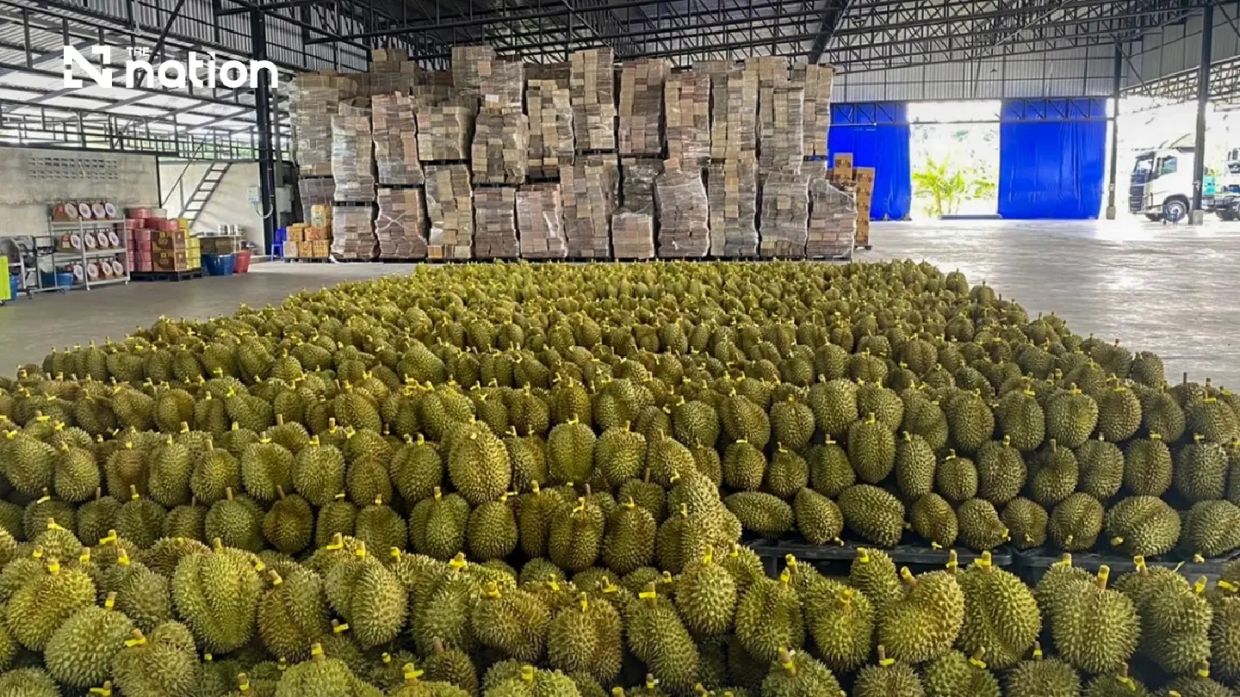
Thailand has reached a watershed moment in its agricultural trade with China, with fresh durian exports to the world's largest importer exceeding THB100 billion for the first time in a half-year period. Spanning the first six months of 2026, the kingdom shipped more than 870,000 tonnes of fresh durian across 53,665 containers, totalling THB100.07992 billion in value. This unprecedented achievement signals not merely a commercial success but a fundamental shift in how Thai agriculture is being managed and regulated at the institutional level.
The breakthrough emerged from a deliberate policy overhaul implemented by Agriculture and Cooperatives Minister Suriya Jungrungreangkit, who prioritised the establishment of comprehensive quality management systems spanning the entire durian export supply chain. Rather than addressing problems reactively as they surfaced, Thai authorities constructed a proactive, systemic framework designed to eliminate defects before products reached Chinese ports. This shift reflected recognition that Chinese importers had become increasingly stringent in their sanitary and phytosanitary requirements, and that maintaining market access required demonstrating institutional competence across multiple checkpoints simultaneously.
Central to this transformation was the implementation of the "Four Nos" protocol, a set of enforcement measures targeting the most common grounds for rejection by Chinese authorities. The framework explicitly prohibits immature durian from entering export channels, eliminates shipments containing worms or other pest contamination, prevents fraudulent origin claims, and screens out products containing Basic Yellow 2, a synthetic dye that had repeatedly triggered rejections at Chinese customs. These measures, while straightforward in concept, required coordinating action across multiple government agencies, provincial authorities, private operators, farmers, testing laboratories, and Chinese regulatory bodies—a coordination challenge that many Southeast Asian nations struggle to maintain effectively.
The underlying architecture supporting these measures reflects technological and institutional innovation rather than simple enforcement intensity. Thailand integrated electronic phytosanitary certificate systems (e-Phyto) with information networks connecting production sources, packing houses, and testing laboratories, creating real-time traceability across the supply chain. This "four-layer PLUS screening" approach applies science-based risk management protocols designed to identify potential problems before shipment rather than relying on inspections at destination ports. By reducing the number of bureaucratic checkpoints required for export approval, the system paradoxically strengthened quality control while accelerating the movement of goods.
The results speak to broader lessons about agricultural trade competitiveness in Southeast Asia. Throughout 2025 and into 2026, China had rejected multiple Thai durian shipments due to contamination by cadmium, Basic Yellow 2, immature fruit, and seed borer infestations. These rejections created bottlenecks at ports, damaged trader relationships, and prompted Chinese authorities to threaten restrictions on Thai durian imports. The new management system addressed these specific vulnerabilities by making their prevention systemic rather than episodic. When the first half of 2026 concluded, rejections had substantially diminished, and the volume of goods flowing through Chinese ports accelerated noticeably.
Minister Suriya framed this achievement as foundational rather than terminal, emphasising that the THB100 billion milestone represented successful execution of institutional reform rather than a mere commercial outcome. He articulated a vision in which Thai agricultural exports would become characterised by "quality, standards, transparency, traceability and international acceptance"—qualities that extend far beyond durian and could theoretically reshape how Thailand manages exports of mangosteen, longan, and other horticultural products facing similar market challenges. His comments suggested awareness that Southeast Asian agricultural exporters compete not merely on price but on the credibility of their quality assurance systems, particularly when supplying Chinese consumers and distributors.
The Department of Agriculture, designated as the lead agency for implementing these changes, reframed its institutional mission as becoming a "Smart Regulator" that deploys science, technology, and risk-based oversight rather than traditional command-and-control enforcement. This terminology, borrowed from contemporary regulatory theory, signals that Thai authorities recognised that modern international trade requires demonstrating technical sophistication and data-driven decision-making. Rapibhat Chandarasrivongs, the department's director-general, argued that this approach simultaneously reduced burdens on operators and farmers—whose compliance costs decline when inspections become targeted rather than universal—while strengthening confidence among trading partners through transparent, auditable processes.
Looking ahead, Thailand has established a full-year export target of THB150 billion for fresh durian to China in 2026. This projection, if achieved, would represent approximately 80 percent growth compared to the most successful previous year on record. The ambition reflects confidence that the quality management reforms will sustain momentum through the second half of the year, when durian production typically declines seasonally but prices often rise. However, the target also carries implicit risk: maintaining such growth requires both continued Chinese demand—itself subject to economic cycles and shifting consumer preferences—and flawless execution of quality controls across multiple harvesting seasons and geographical production zones.
For Malaysia and other Southeast Asian durian exporters, Thailand's achievement carries competitive implications. Malaysia has historically competed with Thailand in supplying durian to China and other Asian markets, and the introduction of sophisticated, integrated quality management systems raises the technical bar for all regional competitors. Malaysian exporters may face pressure to upgrade their own supply chain oversight, potentially requiring investment in laboratory capacity, traceability technology, and inter-agency coordination. Conversely, Thai success in converting quality management into market share offers a template that Malaysian agricultural authorities and exporters could study and potentially adapt to their own contexts.
The durian export success also carries political dimensions within Thailand. Minister Suriya, relatively new to office when implementing these reforms, has used the achievement to demonstrate that systematic institutional reform can deliver measurable economic results. The case study of durian export management may serve as a proof-of-concept that justifies similar overhauls in other agricultural sectors or government agencies, particularly if he remains in the agriculture portfolio. The reform effort also reflects underlying diplomatic dynamics: Chinese regulators' willingness to accept Thai durian in large volumes depends partly on maintaining political relationships between governments, and quality improvements serve to reinforce official goodwill.
Beyond commerce, the durian export story illustrates how agricultural trade has become inseparable from regulatory capacity, technological implementation, and institutional coordination. Thailand's achievement stemmed not from discovering new production techniques or accessing new growing areas, but from organising existing capacity more intelligently. This lesson resonates across Southeast Asia, where numerous agricultural exporters possess productive capacity but lack the institutional coherence required to consistently meet the exacting standards that major Chinese importers now demand. As regional trade relationships deepen and Chinese consumer expectations continue rising, the competitive advantage will increasingly accrue to exporters whose governments can build and maintain robust quality assurance systems rather than those relying primarily on price competition.

