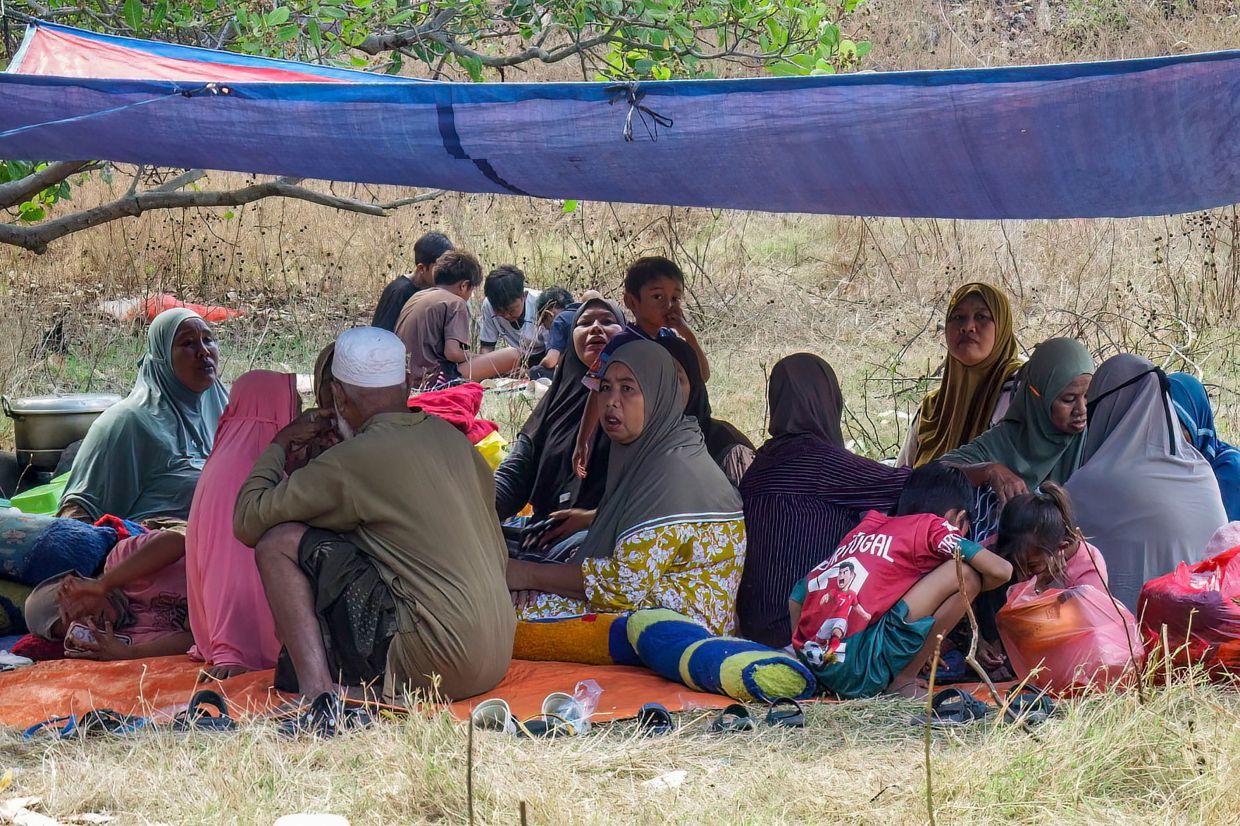
Thousands of displaced residents on Indonesia's Flores island remain without adequate shelter and supplies following a catastrophic 7.7-magnitude earthquake that struck early Saturday, claiming at least 48 lives and injuring over 100 people. The disaster, centred off the island's north coast, sent frightened inhabitants scrambling to higher ground, where many have refused to descend despite the passage of more than 24 hours. Authorities report that approximately 5,000 people evacuated their homes in the immediate aftermath, with hundreds still clustered in makeshift camps across the affected region awaiting government and humanitarian assistance.
The seismic event unleashed a devastating cascade of aftershocks numbering at least 341 in the hours immediately following the initial tremor, according to Berton Suar Pelita Panjaitan, a spokesperson for Indonesia's BNPB national disaster management agency. This relentless sequence of ground movements has compounded residents' trauma and complicated recovery efforts, as structural damage assessment becomes hazardous and rebuilding efforts remain suspended. The shallow epicentre meant that the earthquake's destructive energy was concentrated near populated areas, with particularly severe impacts across residential and public infrastructure zones throughout the island's northern regions.
The physical toll extends across a broad spectrum of essential facilities and housing stock. At least 914 houses have sustained severe structural damage, with hundreds more experiencing moderate to minor harm. Beyond residential properties, the quake has crippled critical infrastructure including 93 educational institutions and 36 health facilities, alongside 38 government offices. This destruction of schools and medical centres poses profound challenges for the affected communities during this humanitarian crisis, as children lack learning spaces and medical services remain severely compromised precisely when they are most needed.
Communications and power systems remain down across significant portions of the affected zone, effectively isolating survivors from external support networks and hindering coordination of relief efforts. At least one critical access road has become impassable, restricting the flow of supplies and emergency personnel into the hardest-hit communities. Residents stranded in these communications blackout zones face acute uncertainty regarding when aid will arrive and what assistance has been mobilised on their behalf. The infrastructure collapse has transformed what might otherwise be a coordinated disaster response into a fragmented and difficult operation.
The human dimension of this crisis carries particular poignancy given that many survivors carry traumatic memories of a previous catastrophe. Flores was devastated by an earthquake of identical magnitude 7.7 in 1992, an event that triggered a tsunami and claimed approximately 2,500 lives across the island. Residents like Nurhidayati, a 55-year-old survivor of that earlier disaster, express deep psychological wounds that have been reopened by this new upheaval. She described spending the night sheltering on a hillside mat, consumed by fear and unable to return home despite the passage of many hours. This layering of trauma across generations makes the psychological recovery from this disaster especially complex and underscores the particular vulnerability of communities that have experienced seismic devastation previously.
Survivors articulate specific and urgent humanitarian needs that remain largely unmet. Umri, a resident of the northern coastal village of Nangahale, pleaded for food, drinking water, medicines, and nappies for children, basic necessities that illustrate the immediate deprivation facing those in temporary shelters. These are not luxury requests but survival fundamentals necessary for sustaining life, particularly for vulnerable populations including young children and the elderly. The absence of these essentials after more than a full day suggests that supply chains from national stockpiles have not yet functioned effectively across the affected territory.
The Indonesian government has initiated emergency response mechanisms, with the East Nusa Tenggara provincial administration moving toward establishing a formal 14-day emergency status to unlock additional resources and streamline decision-making. The central government deployed an initial allocation of 50,000 aid packages with a combined weight of 275 tonnes to affected areas, a significant initial commitment that nonetheless must sustain tens of thousands of people across weeks of recovery. The International Federation of Red Cross and Red Crescent Societies has mobilised preparations to deliver assistance to those sheltering in temporary encampments, working to supplement government efforts with established international humanitarian logistics networks.
International solidarity has also materialised, reflecting the scale of the disaster. European Union President Ursula von der Leyen offered the bloc's Copernicus Earth observation satellites to support Indonesian search and rescue operations, enabling detailed satellite imagery to guide rescue teams across inaccessible terrain. This technological assistance provides critical tools for identifying collapsed structures and potential survivor locations that ground-based teams might otherwise struggle to access given damaged roads and communication blackouts. The gesture underscores how global institutions increasingly recognise seismic disasters in the region as matters of international humanitarian concern.
The immediate aftermath revealed additional dangers that complicated evacuation and response procedures. Coastal residents observed the ocean receding dramatically, a phenomenon that historically precedes tsunami formation and sends strong psychological signals to populations with inherited knowledge of such threats. This observation triggered mass movement toward higher elevations, which ultimately proved protective when the BMKG geological agency registered waves of up to 1.6 metres in certain coastal regions. Although a formal tsunami warning was subsequently withdrawn, authorities maintained strict prohibitions against residents returning to damaged buildings, as structural compromises from the initial quake make them vulnerable to collapse if subsequent aftershocks, however minor, destabilise already-weakened load-bearing elements.
Flores's vulnerability to seismic events flows from its geological setting within Indonesia's broader tectonic context. The Indonesian archipelago sits directly atop the Pacific Ring of Fire, an arc of exceptional seismic activity that encompasses Japan, Southeast Asia, and extends across the Pacific basin. This positioning means that major earthquakes represent not exceptional catastrophes but recurring, predictable hazards that shape long-term development patterns and disaster preparedness systems. The 2004 Sumatra earthquake, measuring 9.1 magnitude, exemplified the region's destructive potential; that event generated a tsunami that claimed 220,000 lives across the Indian Ocean region, with approximately 170,000 of those deaths occurring in Indonesia alone. This historical context renders the current Flores disaster part of an ongoing seismic reality that Southeast Asian nations must systematically address through improved building codes, early warning systems, and pre-positioned relief supplies.
The search and rescue operations have achieved initial success in avoiding large numbers of missing persons. Fathur Rahman, a local search and rescue official, reported on Sunday that no significant population of buried or missing residents had been identified, a relatively positive indicator suggesting that early warnings prompted most people to evacuate structures before collapse. Rescue teams have concentrated their efforts on methodical sweeps of the affected territories to ensure no isolated survivors or trapped individuals remain undiscovered. This ongoing search work remains a priority despite the shift of focus toward humanitarian assistance, as isolated cases of persons trapped in rubble can require days or weeks to locate and extract successfully.
The coming weeks will determine whether Indonesia's disaster management systems can translate initial mobilisation into sustained, adequate assistance. History suggests that immediate media attention often fades rapidly after natural disasters, potentially creating a gap between when international aid pledges diminish and when affected communities complete the lengthy reconstruction process. For Flores, the challenge extends beyond emergency shelter and food distribution toward the restoration of functioning schools, health systems, and housing stock—a process typically requiring months or years. The trauma experienced by survivors will similarly require sustained psychosocial support programmes that extend far beyond the initial emergency response phase. How effectively Indonesia and international partners address these longer-term recovery needs will shape the island's trajectory across the coming years.

