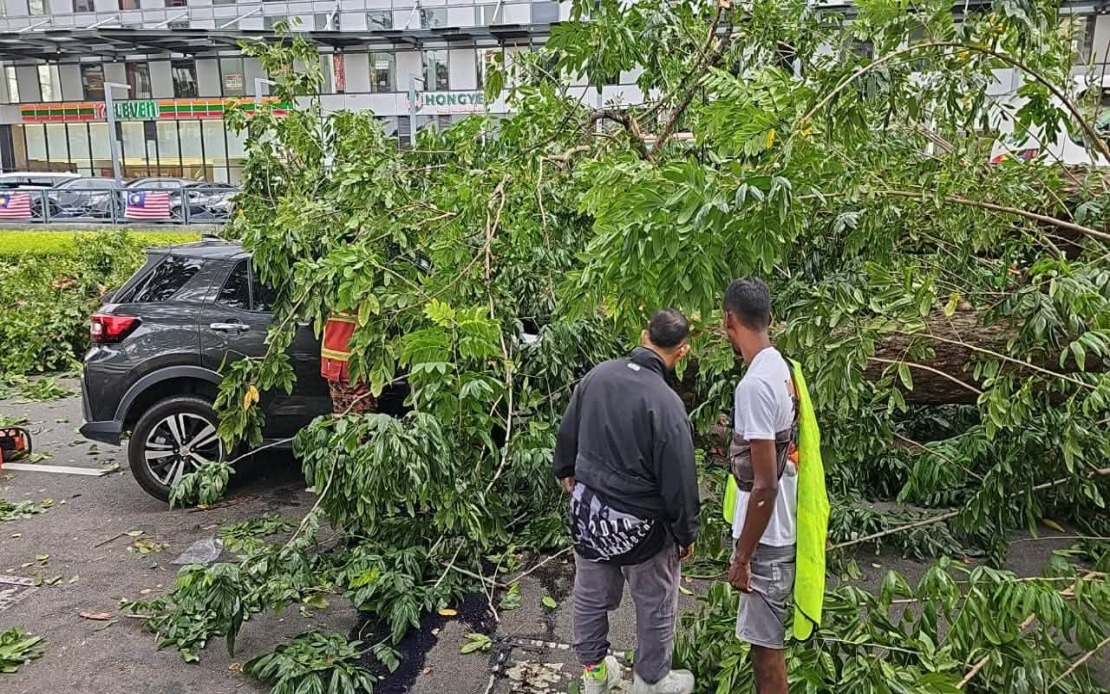
A potentially tragic incident unfolded in George Town this morning when a towering tree collapsed onto a moving vehicle, trapping three occupants inside. The elderly couple and their young granddaughter were traveling in their Perodua Ativa along Jalan Macalister when the tree came down without warning, leaving them stranded in the crushed vehicle. The family's injuries, while serious enough to warrant hospitalization, could have been far more severe had emergency services taken longer to respond or had bystanders not intervened so swiftly.
Firefighters received the emergency call at 9:12 am and dispatched a team of eight personnel from the Jalan Perak Fire and Rescue Station to the scene. However, by the time the Malaysian Fire and Rescue Department (JBPM) arrived, members of the public had already managed to extract all three victims from the damaged vehicle. This rapid civilian response likely prevented the situation from deteriorating further, demonstrating the value of immediate community action during traffic emergencies. According to John Sagun Francis, an Assistant Director of the Operations and Firefighting Division of JBPM's Penang operations, the successful extraction was completed before professional rescue teams could position themselves.
The incident highlighted the unpredictable nature of falling tree hazards in urban and semi-urban Malaysian settings, particularly during weather events or as aging trees reach the end of their structural integrity. Jalan Macalister, a major thoroughfare in central George Town, became the focal point of both rescue and recovery operations. Beyond the immediate crisis of extracting the trapped family, the authorities faced a broader challenge: securing the area and removing additional tree debris to prevent further accidents and restore normal traffic flow.
Cleanup efforts proved time-consuming and labour-intensive. By noon, fire department personnel and local authorities were still actively engaged in cutting down and clearing the remaining fallen tree material. The operation was critical to ensuring the safety of other motorists and pedestrians who might navigate the area, as weakened branches or unstable sections posed continued danger. The extended nature of the cleanup also underscored the logistical demands that such incidents place on emergency services, particularly when significant natural obstruction blocks a busy road.
The incident immediately disrupted transportation in the vicinity. Traffic congestion became severe as vehicles queued behind the cordoned-off zone, and authorities implemented road closures to facilitate the clearance work. Commuters and residents experienced delays throughout the morning and early afternoon, illustrating how a single tree failure can have cascading effects across an urban transport network. For businesses and individuals relying on timely movement through that corridor, the disruption represented a meaningful economic and logistical burden.
Tanjong Member of Parliament Lim Hui Ying, who holds the position of Deputy Minister of Women, Family and Community Development, responded to the incident with visible concern for the victims' welfare. She issued a public statement via social media confirming that three individuals had been transported to hospital following the accident. Her engagement reflected the political dimension of such incidents—elected representatives increasingly recognize that timely acknowledgment of public safety emergencies and visible follow-up can strengthen constituent confidence in government responsiveness.
Lim's team mobilized to gather information directly from the scene and coordinate assistance for the affected family. She emphasized her commitment to understanding the circumstances fully and providing whatever support might be needed during the victims' recovery. Her appeal for public caution—urging drivers and pedestrians to heed traffic instructions and exercise heightened vigilance—carried weight given her ministerial portfolio focused on family and community welfare. The implicit message was that authorities were taking the incident seriously and that the public should cooperate with ongoing safety measures.
The timing of the incident in early morning hours meant that the road bore considerable traffic volume when the tree failed. Had the collapse occurred during peak congestion periods, the casualty count could have escalated dramatically, potentially affecting multiple vehicles. The relatively modest number of injuries—three people in one vehicle—represented considerable fortune despite the severity of the impact. Weather conditions at the time of the incident were not immediately detailed in emergency reports, though the episode raises questions about whether recent meteorological activity contributed to the tree's sudden failure.
The broader context for Malaysian urban authorities involves the aging condition of many street trees planted during earlier decades of rapid development. As these specimens mature, their root systems may weaken, disease becomes more prevalent, and structural integrity diminishes. Cities across Malaysia, including Georgetown and other major urban centers in the region, face mounting pressure to assess existing tree stocks, remove hazardous specimens proactively, and implement more rigorous maintenance protocols. This incident on Jalan Macalister will likely prompt renewed scrutiny of similar trees along other high-traffic corridors.
For the three victims and their family, the experience will serve as a stark reminder of the fragility of safety during routine travel. Recovery from injuries sustained in vehicle crushing incidents can be protracted and may involve both physical rehabilitation and psychological adjustment. The community response—swift civilian intervention and rapid official coordination—provided some reassurance, yet the incident demonstrates that contemporary urban living carries environmental risks that require constant vigilance and preparedness from both individuals and municipal authorities managing public spaces.

