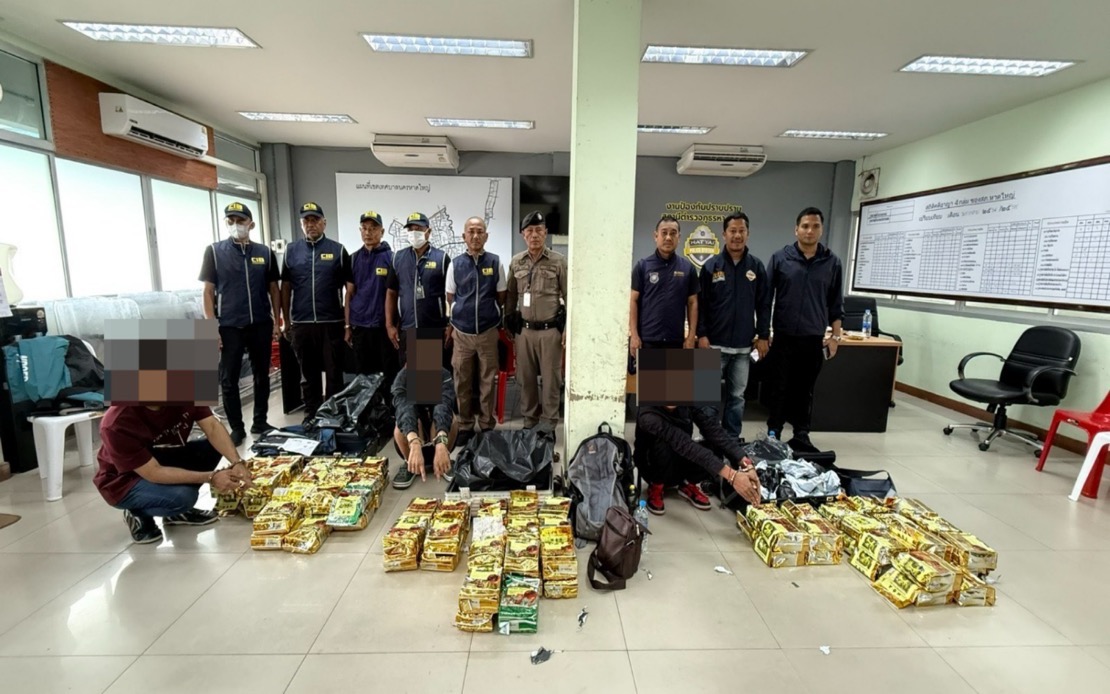
Three Malaysian nationals were intercepted by Thai law enforcement at Hat Yai Railway Station in Songkhla province on July 31 as they attempted to transport 87 kilograms of crystal methamphetamine, commonly known as syabu or ice, across the border into Malaysia. The drug haul, concealed across three wheeled suitcases and three backpacks, represents a significant seizure that underscores the persistent challenge of cross-border narcotics trafficking in Southeast Asia.
The arrest resulted from a coordinated operation involving multiple Thai agencies, including the Tawan Hat Yai unit, railway police, the Crime Suppression Division, the Anti-Trafficking in Persons Division, tourist police, the Narcotics Suppression Bureau, and the Region 9 Office of the Narcotics Control Board. Ratchapon Palakul, director of the ONCB's Region 9 Office, confirmed the interception when the three suspects arrived at the railway terminus after boarding a Bangkok-bound train. The multi-agency response reflects Thai authorities' determination to combat drug trafficking operations that increasingly exploit rail networks and other transit infrastructure spanning the region.
Investigations revealed that the suspects had been recruited by a trafficking syndicate offering each man RM8,000—approximately USD 1,700—as compensation for successfully delivering the narcotics shipment into Malaysian territory. This modest payment structure typical of trafficking networks demonstrates how criminal organisations exploit economically vulnerable individuals as couriers, positioning them as expendable front-line operatives while insulating higher-level distributors and financiers from direct law enforcement exposure. The financial motivation, relatively modest by trafficking standards, suggests the operation targeted lower-income individuals willing to undertake significant personal risk for relatively limited reward.
The individuals now face serious charges under Thai law for joint possession and trafficking of Category 1 narcotics with intent for distribution. Upon conviction, they face potential imprisonment of up to 15 years coupled with financial penalties not exceeding 1.5 million baht, equivalent to approximately RM183,000. These substantial penalties reflect Thailand's hardline approach to drug trafficking, particularly cases involving high-volume shipments destined for cross-border distribution networks. The severity of potential sentencing places these three men at serious risk of lengthy incarceration in Thai correctional facilities, where conditions and treatment of foreign inmates remain matters of concern for Malaysian diplomatic officials and human rights observers.
The Hat Yai railway station seizure highlights an evolving trafficking pattern whereby organised syndicates systematically utilise train networks to move bulk narcotics shipments across borders. The strategic choice of rail transport reflects criminal adaptability to enforcement pressures; while air and sea ports maintain intensive screening protocols, rail terminals often experience less rigorous inspection regimes, particularly during peak travel periods when passenger volume creates operational challenges for security personnel. Hat Yai's geographic proximity to the Malaysia-Thailand border, situated approximately 50 kilometres from the frontier, makes it an ideal staging point for operations targeting Malaysian distribution networks.
Thailand remains a critical transit hub within broader Southeast Asian drug trafficking architectures. Crystal methamphetamine production in the Golden Triangle region—encompassing portions of Thailand, Myanmar, and Laos—generates enormous volumes destined for markets throughout Southeast Asia, Australia, and beyond. Malaysia's position as a densely populated urban-industrial economy with sophisticated distribution networks makes it an attractive final destination for trafficking organisations seeking to establish retail and wholesale operations. The 87-kilogram seizure represents merely one visible incident within vast clandestine flows estimated by regional law enforcement agencies at hundreds of tonnes annually.
Authorities indicated that investigations would pursue identification of syndicate masterminds and additional accomplices operating across the trafficking chain. This investigative direction acknowledges that apprehending courier-level operatives, while operationally significant, addresses symptoms rather than fundamental drivers of trafficking. Dismantling organisational structures requires sustained intelligence gathering, international cooperation, and prosecution of mid-level and senior operatives controlling recruitment, logistics, finance, and distribution. However, such prosecutions face considerable obstacles including witness intimidation, corruption within law enforcement agencies, and the compartmentalised operational structures adopted by sophisticated trafficking networks.
The incident carries implications for Malaysian law enforcement and border security protocols. Customs and immigration authorities at Malaysia's northern frontier must anticipate corresponding enforcement pressure on trafficking syndicates, which may respond by modifying transit routes, transport methods, or recruitment strategies. Enhanced coordination with Thai counterparts, expanding detection capabilities at land borders, and improving intelligence sharing mechanisms represent essential components of comprehensive counter-trafficking responses. Regional challenges demand that Malaysian agencies maintain technological parity with evolving criminal tactics while addressing systemic vulnerabilities within border infrastructure and personnel training.
From a broader Southeast Asian perspective, the arrest underscores the interconnected nature of drug trafficking across the region's borders. Myanmar's continued internal conflict and governance challenges sustain production environments insulated from effective state control. Thailand's geographic centrality positions it inevitably as a transit corridor for vast narcotics volumes. Malaysia's relatively developed infrastructure and consumer economy create demand incentives for trafficking networks. Addressing these challenges requires not merely bilateral cooperation between Thailand and Malaysia but comprehensive regional strategies encompassing production suppression, transit interdiction, demand reduction, and organised crime disruption across multiple jurisdictions simultaneously—a coordination challenge that regional bodies like ASEAN have struggled to achieve effectively.

